
Gabriel Abrantes: Bardo Loop
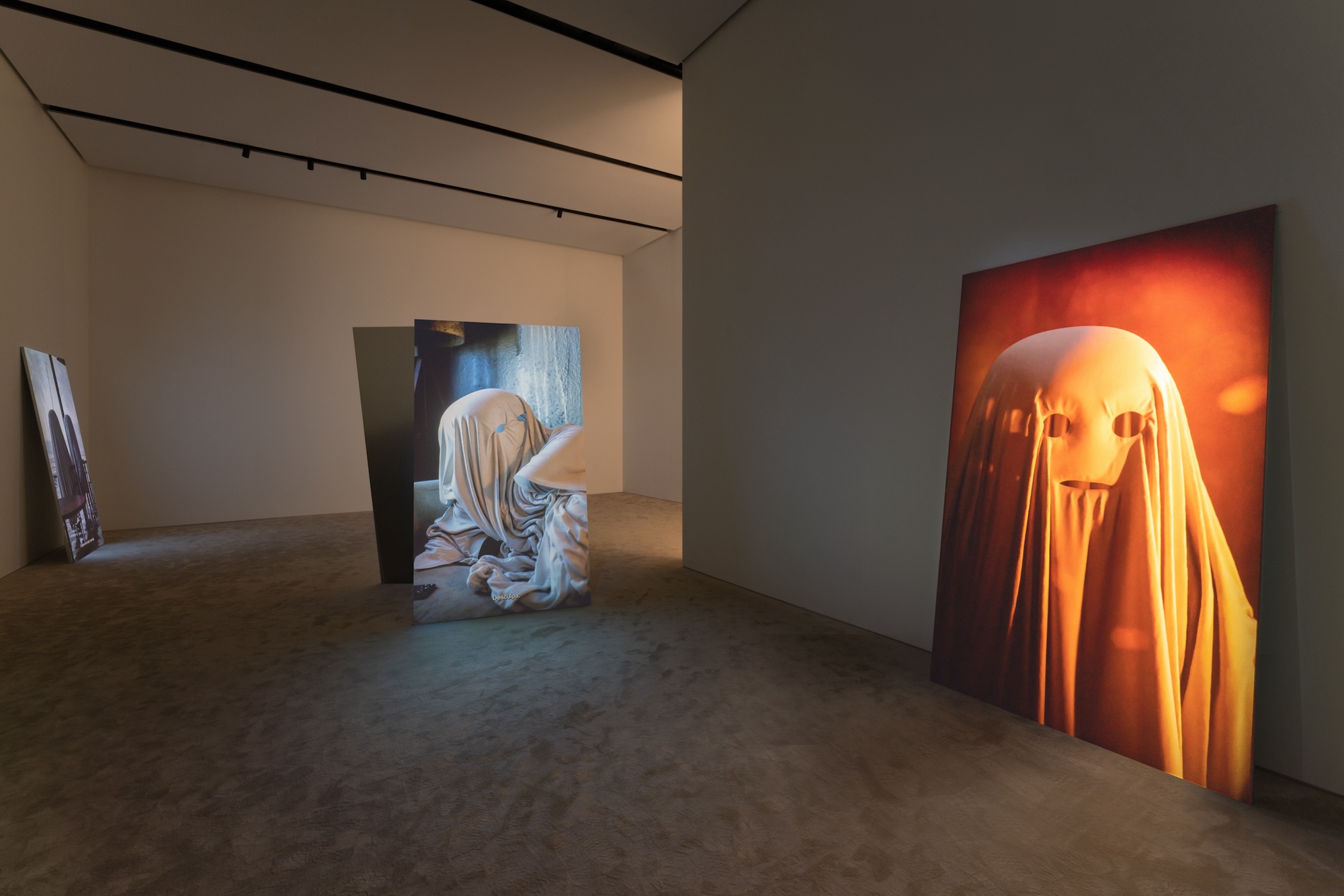
The paradox of the so-called post-apocalyptic culture of the 20th and 21st centuries is revealed even in its very name. Is it possible to conceive of a “post” to what is considered the end of everything? Post-apocalyptic culture, which presupposes the impossible testimony of at least one human witnessing the end of their species, might reflect a civilisation that no longer believes in the power of the end.
In the end-of-the-world scenario imagined by Gabriel Abrantes in the four video animations that compose Bardo Loop, non-human creatures grappling with very human situations are trapped in a space-time that has no end. The title of the work delivers the coordinates of this suspended dimension: the creatures, resembling what popular imagination envisions as ghosts—a white sheet with eyes and a mouth cut out—are imprisoned in the bardo, a kind of limbo. They are stuck in an eternal return of the same, marked by the tight loop of a few minutes’ actions. In the background, a deserted world is ravaged by rains, floods, and fires.
From these ghostly inhabitants of a future world seemingly at the final pages of its history, where humans have likely gone extinct, we might expect reflections on the end: words of longing for times gone by or warnings for what lies ahead. Instead, these specters, oblivious to the devastation around them, are absorbed in their own personal dramas: they fight, argue, cry, sing of loneliness and regret, break up, and have sex—over and over again, caught in an inescapable cycle.
The four video animations—Sad Singer, I want to have a baby, Victims, and Break-up—form a series of discrete works exploring different facets of a central discourse in Abrantes’ practice. How do autobiographical experiences and personal tragedies relate to contemporary society and broader existential issues, such as climate change and the anxieties of a world dominated by digital technologies? To what extent do personal desires and individual will shape the general movement of the world? Can they alter its course? And how do these realms influence one another?
The videos in Bardo Loop emphasise the complex relationship between personal and global spheres of existence through numerous contrasts, starting with the parallel movement of actions/dialogues and the landscape serving as its backdrop. The world drifts toward destruction, indifferent to the suffering of its inhabitants, while the inhabitants, consumed by their own problems, are oblivious to the world collapsing around them. Human dramas are condensed into dialogues or monologues of just a few lines and loaded with pathos. Acted out by these cute ghosts, reminiscent of characters from a Betty Boop cartoon, the tragic emotions they convey teeter on the edge of their opposite. Their cartoonish faces morph into pathetic expressions, appearing woefully inadequate to deal with issues such as the death of a child, the longing for motherhood, the end of a love affair, or loneliness. This sense of absurdity elicits a smile; yet, watching them feels like gazing into a mirror, and the smile twists into its opposite. In Abrantes’s imagery, comedy and tragedy often collapse into one another.
These ghosts are not new to Abrantes’s work. In a series of paintings started in 2022, they are seen performing “human” or rather artistic actions in a flooded, fluid world where humans seem to have vanished. In an interview with OpenAI’s GPT-3 for his solo exhibition Nobody Nowhere at Galeria Francisco Fino in 2022, Abrantes explained: “The ghosts are an image representing the artist as a digital avatar, dissociated from a physical manifestation, and might suggest notions of emptiness, existential dread, and a lack of direction. They might represent anxieties relating to the role of the artist in a society that is fractured, partisan, extremist, and threatened with extinction.”
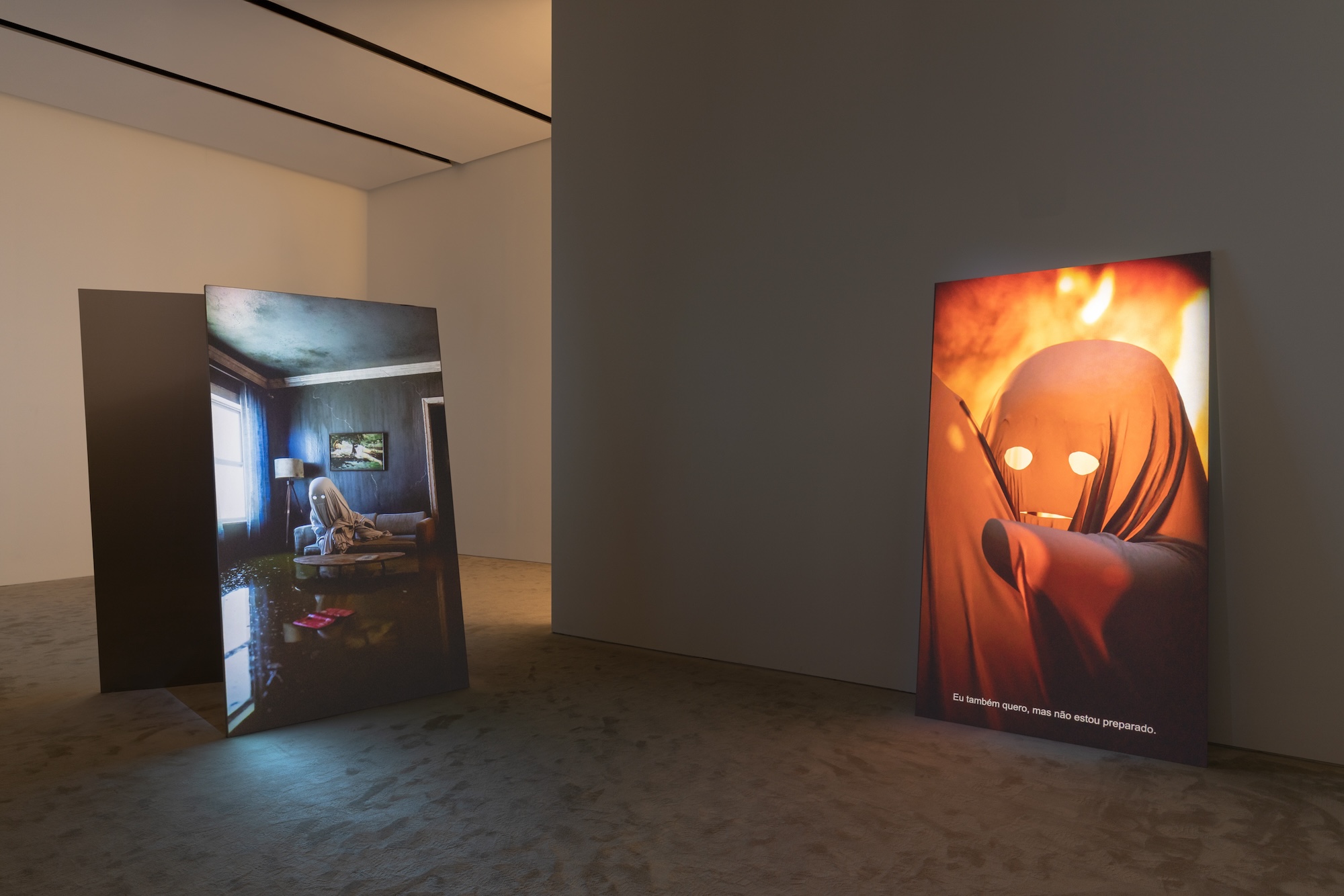
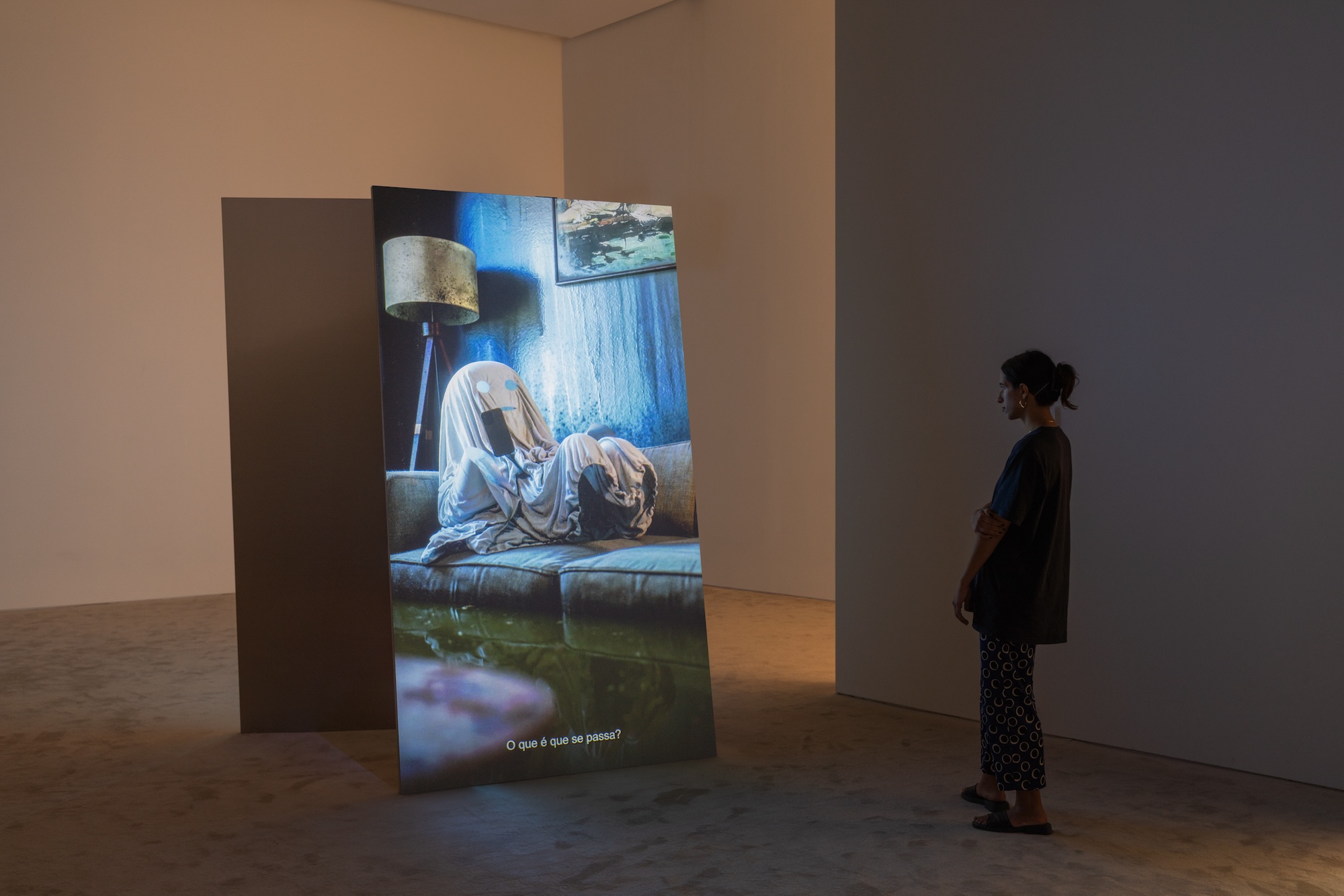
As artificial intelligence advances, what does the future hold for artists, writers, and creators in general? Abrantes’s paintings reproduce, in oil on canvas, the imagery he creates using 3D digital modelling software, paradoxically reversing the roles: the machine conceives and visualises the work, while the artist executes it. In painting his avatar painting (sometimes itself), Abrantes creates a loop—a short circuit in the question of authorship in an automated world.
In the video series, created with digital technologies, this reflection shifts to the subject of the actions. The painting on the wall and the book floating in the flooded house in Break-up, alongside the piano in Sad Singer, seem to evoke the desolate fate of art in a world without humans.
In the dialogue of Victims, the theme of genetics sparks a heated discussion. One character defends its importance in helping children with life-altering genetic conditions, while the other hurls accusations of eugenics and racism. The two ghosts' voices rise, overlapping like in an online chat where the interlocutors' invisibility disinhibits them, easing all empathy and escalating into a climax of aggression. This is the most overtly political video, where the artist appears to critique the dullness and detachment from reality that certain extreme “woke” stances can take on when reduced to clichéd postures—a critique that resonates with the artist’s denunciation of hypocrisy and ignorance as foundations of well-meaning intentions, a theme present in several of his earlier works.
Bardo Loop was commissioned by the Gulbenkian Foundation for the reopening of its Centro de Arte Moderna and is now part of its collection. It is featured in Tide Line, an exhibition of the collection distilled into about eighty works that, beginning with the emblematic date of 25 April 1974, reflect on the constant need for revolution in a political, personal, and social sense, as well as a response to the critical state of health of our planet today.
While the exhibition raises awareness about environmental exploitation and the risks of new technologies, Abrantes’s work projects into the future. Bardo Loop is set in a world where the revolution has not happened. Completely disfigured by fires and floods as depicted on the video screens, it bears an ominous resemblance to the world of today, as the artist himself noted during the opening of the exhibition—in a September when Europe was besieged by torrential rains and floods on one side and raging wildfires on the other, particularly in Portugal.
Yet the bardo also suggests the possibility of rebirth. In Buddhist philosophy, this concept defines an interval, a hiatus, a gap, an in-between space, a transitional place between death and rebirth. It can act as a boundary that divides and separates, marking the end of one thing and the beginning of another, but it can also be a link between the two—it can serve as a bridge or a meeting place that brings together and unites.
Abrantes’s reference to this Tibetan concept draws inspiration from George Saunders’s novel Lincoln in the Bardo (2017), cited by the artist as a source for his imagery of ghosts trapped in limbo. Saunders’s novel begins with the death of Willie, the beloved son of Abraham Lincoln. Newspapers of the time describe that Lincoln visited the crypt and opened his son’s coffin to embrace his body. Drawing from this historical episode, Saunders imagines an afterlife populated with stalled souls, inspired by the concept of the bardo—this intermediate state where consciousness is suspended between past and future lives. In the bardo, Willie, who cannot let go of his father, and Lincoln, who cannot let go of his son, remain in contact. Multitudes of other spirits still too attached to their previous existences also wander in this limbo—like President Lincoln himself, who is as good as dead but must live on for the sake of his country. And so the spirits’ petulant, nostalgic, and heartfelt voices echo the counter-song of history.
By blending logic with absurdity, irony with despair, and true events with fictionalised ones, tragedy and farce are condensed into an undifferentiated, contradictory reality. How can one live, love and accomplish “something big" knowing that everything ends in nothingness? Nothingness is the substance of the cloaked figures in Bardo Loop, caught in their cyclical wandering, without a purpose, without an end. Will they ever bite the snake?
CAM Fundação Calouste Gulbenkian
Sara De Chiara is an art historian, critic and curator of contemporary art. She received her PhD in art history from Sapienza University of Rome in 2022. Since 2019, she has been in charge of publications at the Centre d'Art Contemporain Genève, where she also collaborates on some exhibition projects as a researcher and curatorial assistant. She has contributed essays to numerous catalogs and monographs, collaborates with several art magazines, including Contemporânea, Frieze, Flash Art International and writes on the cultural supplement of the Italian newspaper Il Sole 24 Ore.
Proofreading: Diogo Montenegro
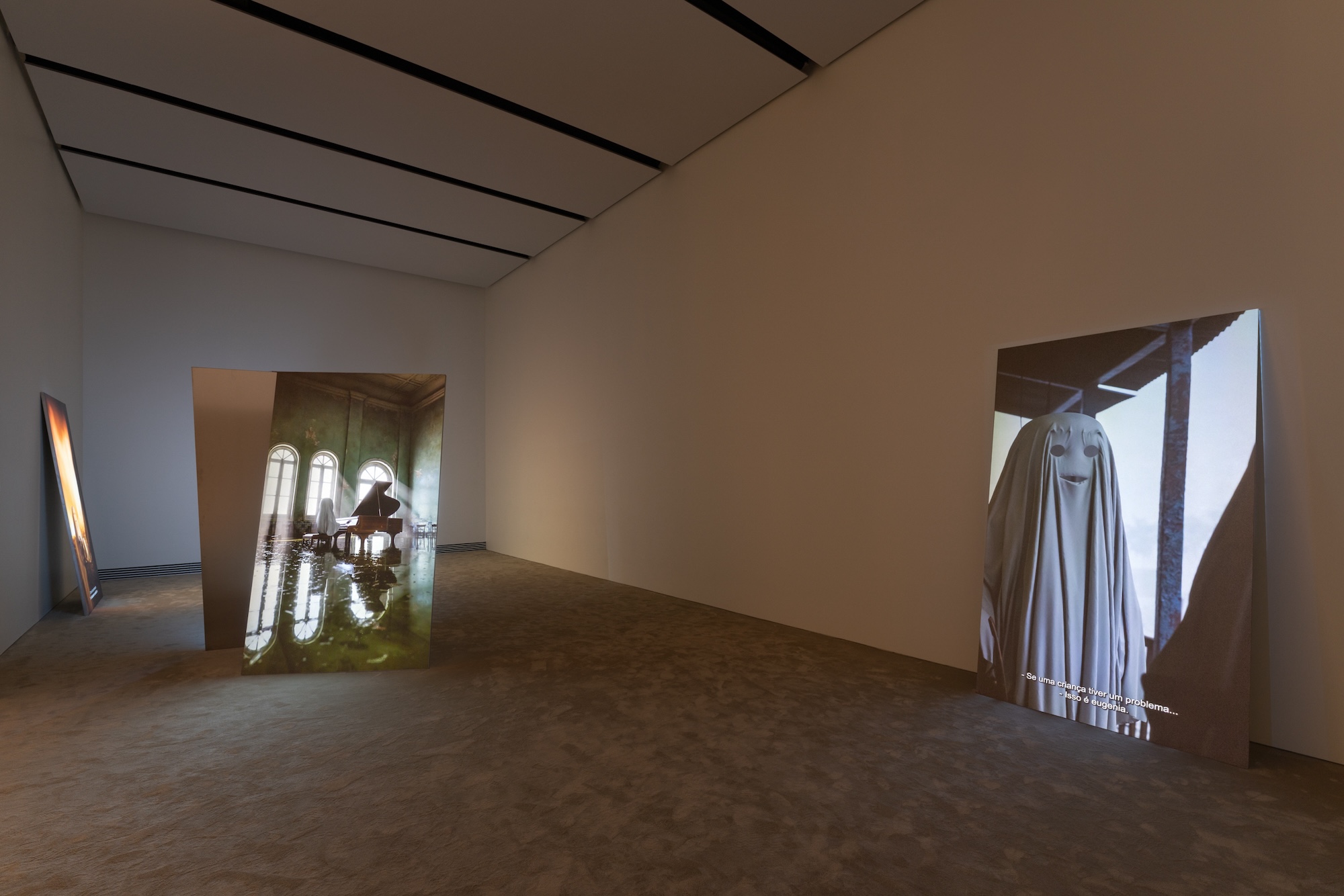
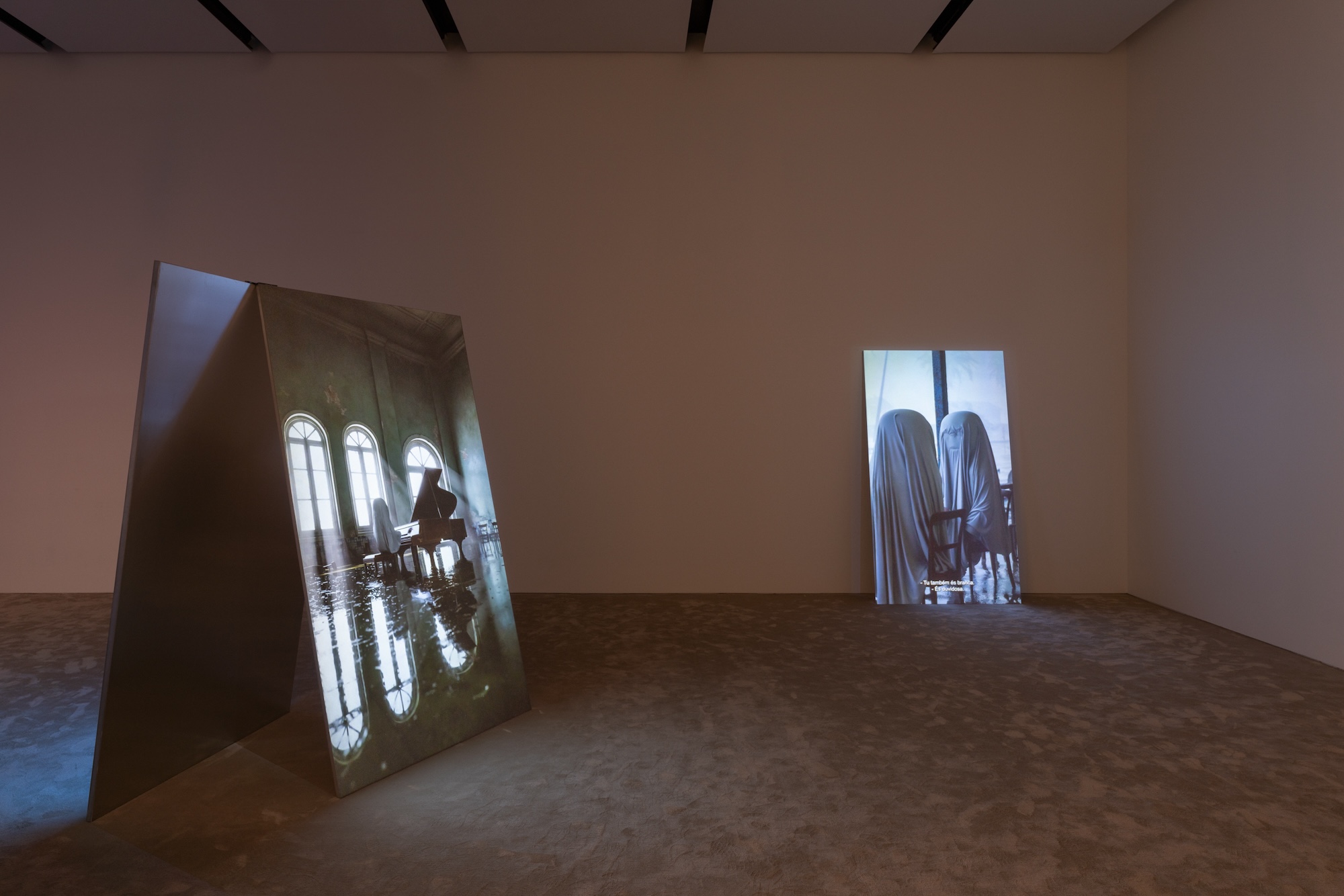
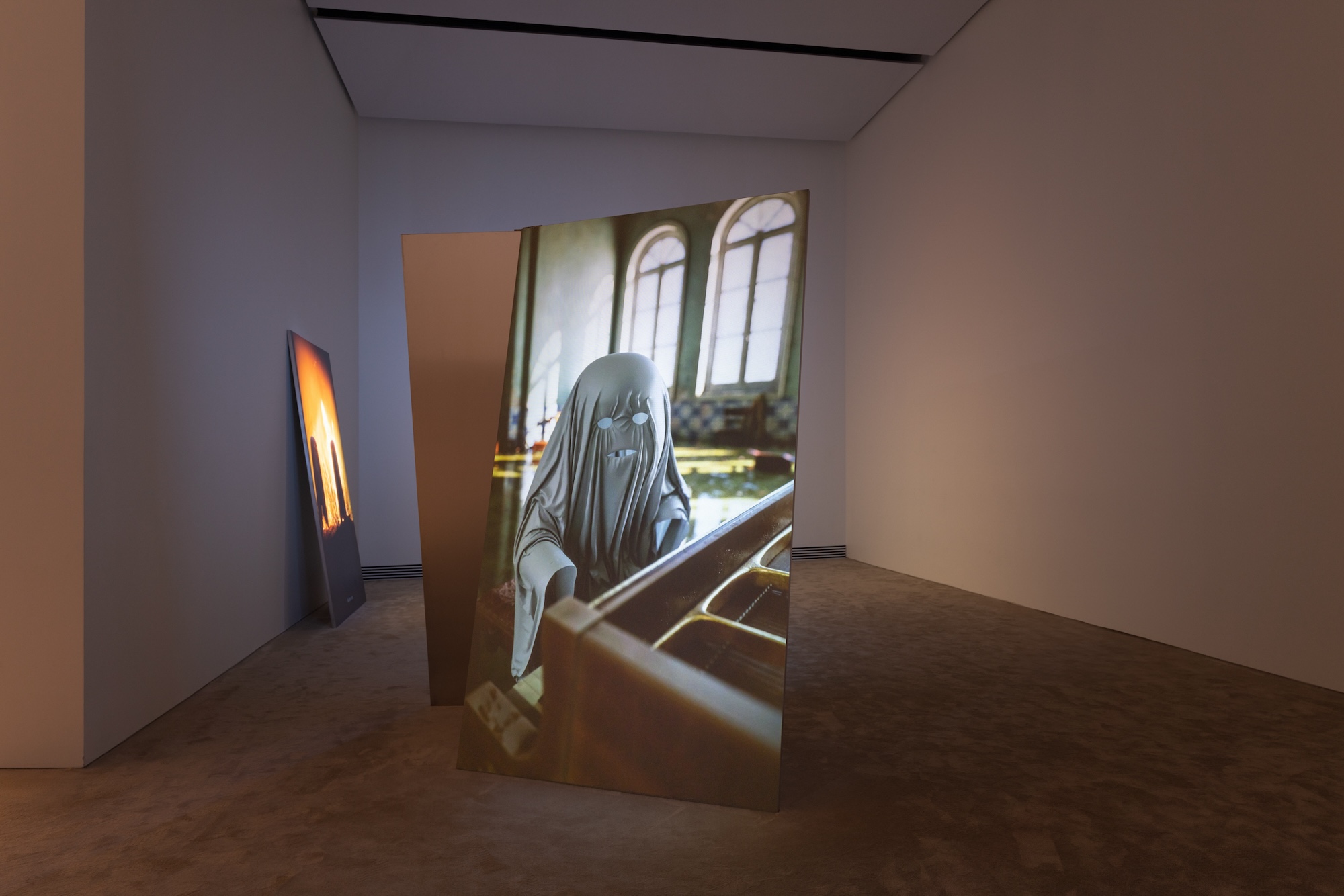
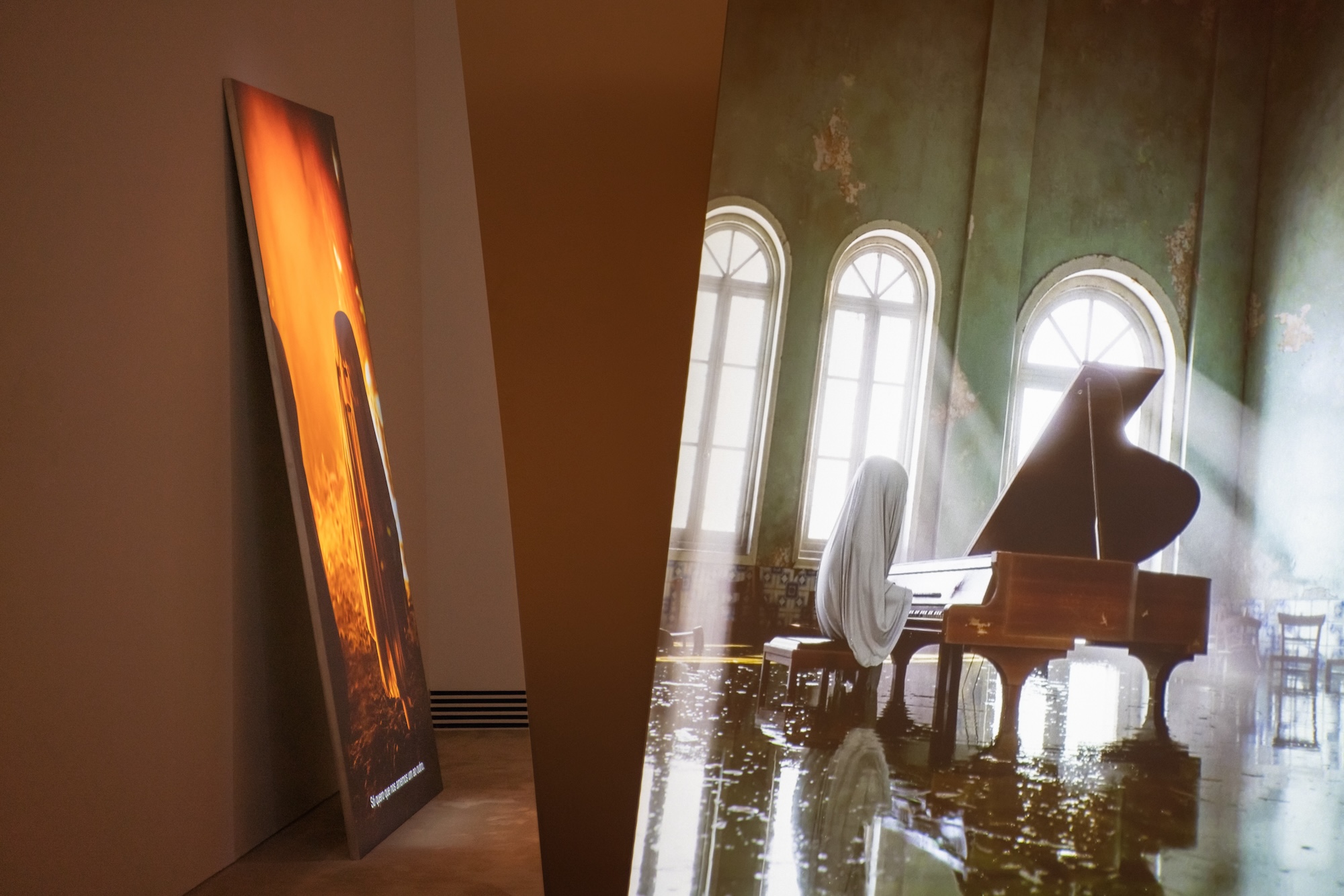
Gabriel Abrantes, Bardo Loop (2024). Exhibition views at CAM — Fundação Calouste Gulbenkian, Lisbon, 2024. Photos: Carbonara Studio. Courtesy of the artist and Francisco Fino Gallery.