
Vivian Caccuri: Febre da Selva Elétrica
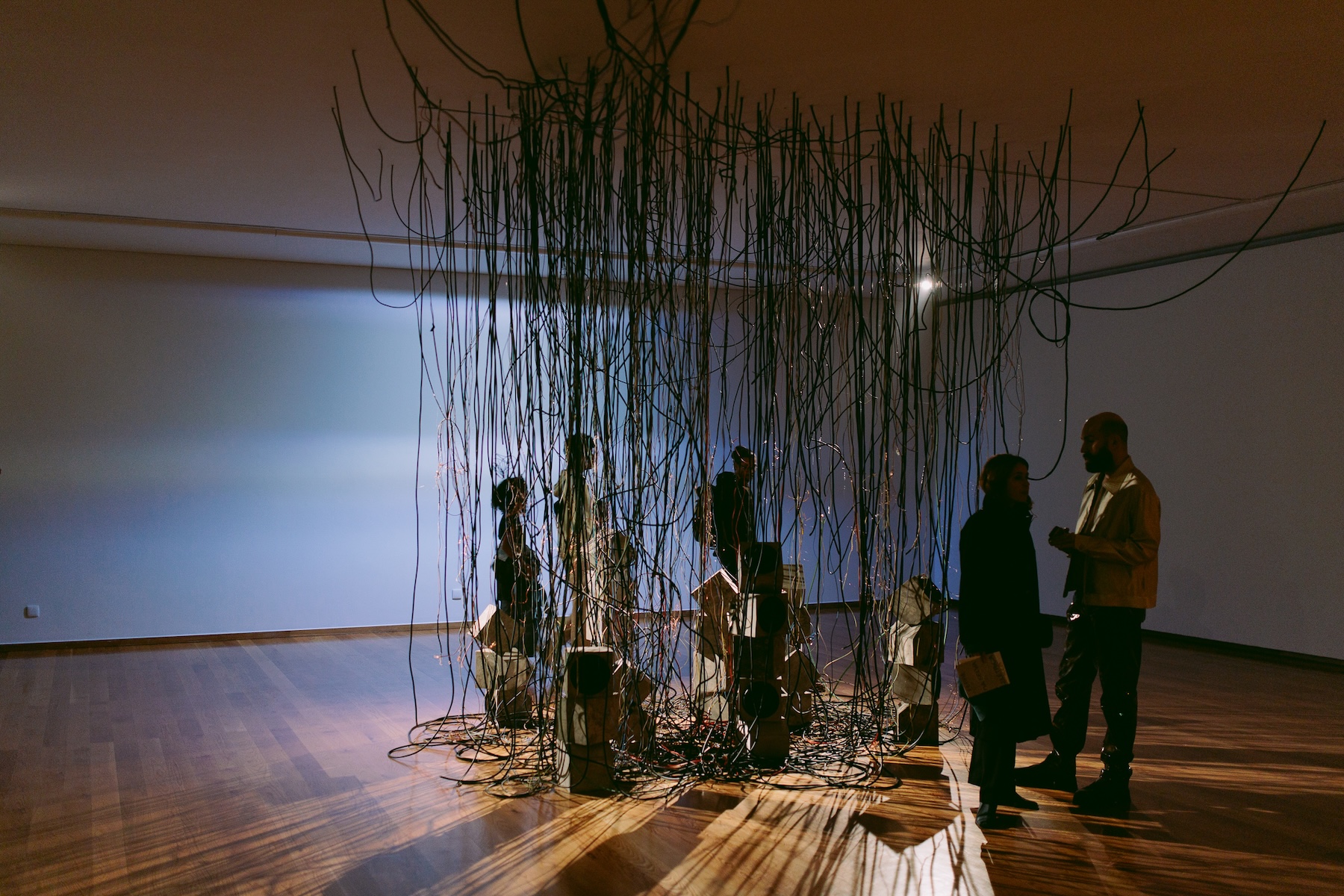
When stepping into Electric Jungle Fever, the exhibition conceived by Vivian Caccuri for the first floor of the Galeria Municipal do Porto, viewers enter a space in semi-darkness, charged with tension.
They are forewarned by the exhibition’s curator, Bernardo José de Souza, who, in the introductory text, defines the artist’s intervention as an atmosphere rather than a simple installation. The sensation is one of immersion, advancing through the space into an “other” atmosphere—a dense and enveloping environment pervaded by a buzzing sound, at once familiar and alienating, which transitions from being almost inaudible to bombastic. One is undecided whether to attribute this noise to the buzzing of mosquitoes or the hum of electric cables, suggested by their tangled presence recurring in several works in the exhibition. These elements embody this contemporary “selva”—the electrified jungle evoked in the exhibition’s title—where technology and nature, as well as human and wild environments, seem contiguous, if not intertwined.
The installation Gatonet-mor (2024), composed of loudspeakers mounted in concrete blocks and electrical cables hanging from the ceiling and tangled like lianas in a forest, propagates this buzzing throughout the environment. It is a sampling of the hum emitted by real and fictitious mosquitoes: some tracks are recordings of real mosquitoes, sourced from a scientific archive in Brazil; others are mosquito sounds generated by artificial intelligence.
Woven together by the artist to construct harmonies and disharmonies, the sound waves of these compositions are visualized in Skin Shield (2024), an installation consisting of a mosquito net set up in the form of a Canadian tent. Onto this net, the artist has embroidered the precise shapes of the sound waves generated by the mosquitoes—both real and virtual—heard in the exhibition.
Whilst the wavy pattern of the embroidery, combined with natural hues, evokes camouflage fabric, the tent-like form suggests the means by which humans venture into wild environments, providing protection against insect bites (the title of the piece underscores this connection), particularly those of mosquitoes, carriers of infamous diseases. It is easy to imagine the tent as part of the equipment that accompanied explorers on Western colonial expeditions into rainforests—a link that reveals the political and critical heart of Caccuri’s practice.
The works brought together in this exhibition align with broader research the artist has been conducting for years, focusing on the mosquito and its relationship with humans based on historical and contemporary perspectives through sound, performance, and visual pieces.
Mixing biology, sound theory, the history of tropical diseases, empirical or invented theories, and the history of colonialism, Caccuri uses the mosquito as a metaphor to recount the European colonisers’ attempts to conquer and domesticate tropical nature.
Mosquitoes proliferated, circulated, and became more deadly precisely because of certain human actions, including the construction of poorly designed man-made dams, the expansion of sugar or rice plantations, and the transatlantic slave trade. Arriving from the African continent aboard slave ships, mosquitoes brought several diseases to the Americas, including yellow fever, dengue, and malaria—plagues that remain relevant today.
Native to forests, mosquitoes ultimately found cities the perfect breeding environment. Through the history of the spread and lethality of this insect, Caccuri explores the relationship between tropical nature and urbanisation, as well as indigenous peoples and European settlers, across secular history.
However, in Electric Jungle Fever, the social and cultural analysis shifts away from the more narrative tendencies of works such as the embroidery series The Mosquito Shrine (2020) or the lecture-performance Mosquitos Also Cry (2018), favouring drier, minimalist, and more enigmatic works.
As a counterpoint to Skin Shield, the diptych Fantasia da ordem (2024) features the artist’s embroidery and colour interventions on a mosquito net, drawing the keyboard of a piano with its recognisable alternation of black and white keys. The fluid, vibrating movement of sound waves in the former work transforms in the latter into a rigid geometric grid representing the piano, an instrument originating in 18th-century Italy and subsequently spreading globally. The piano symbolises the tonal system, sealing the Western distinction between noise and musical notes, thereby rendering the entire audible range of the natural world foreign to musical production.
The lighting also makes these ethereal, almost intangible installations seem surprisingly sculptural, as their shadows are cast on the gallery walls. The earliest of these mosquito net installations, Fantasma poeira (2018), even features a negative weaving technique, with patterns created by unthreading parts of the net. Here, the drawing replicates the form of a real-size street sound system.
A fundamental element of Caccuri’s practice, sound, whether emitted or represented in drawings, constitutes the unifying principle of the exhibition. It permeates the space with the spectral density of white noise and creates echoes among the works punctuating the elongated, asymmetrical gallery. As the curator writes: “Whether audible or otherwise, the sound waves that she produces explore the permeability of human perception when affected by sensory fields that politically and emotionally stimulate our imagination.”
Through the story of mosquitoes, distilled into rarefied sounds and porous surfaces, Caccuri’s work invites us to reflect on the global dimensions of movement, the circularity of things, the butterfly effect, and nature’s resistance and transformation in response to human attempts at domination—all conveyed with acumen and irony. This reflection is not voiced outright but instead entrusted to an indecipherable buzz––familiar and threatening at once––where the natural and virtual converge. In Vivian Caccuri’s Electric Jungle Fever, the deepest forest and the most advanced technology keep their “heart of darkness” intact.
Sara De Chiara is an art historian, critic and curator of contemporary art. She received her PhD in art history from Sapienza University of Rome in 2022. Since 2019, she has been in charge of publications at the Centre d'Art Contemporain Genève, where she also collaborates on some exhibition projects as a researcher and curatorial assistant. She has contributed essays to numerous catalogs and monographs, collaborates with several art magazines, including Contemporânea, Frieze, Flash Art International and writes on the cultural supplement of the Italian newspaper Il Sole 24 Ore.
Proofreading: Diogo Montenegro.
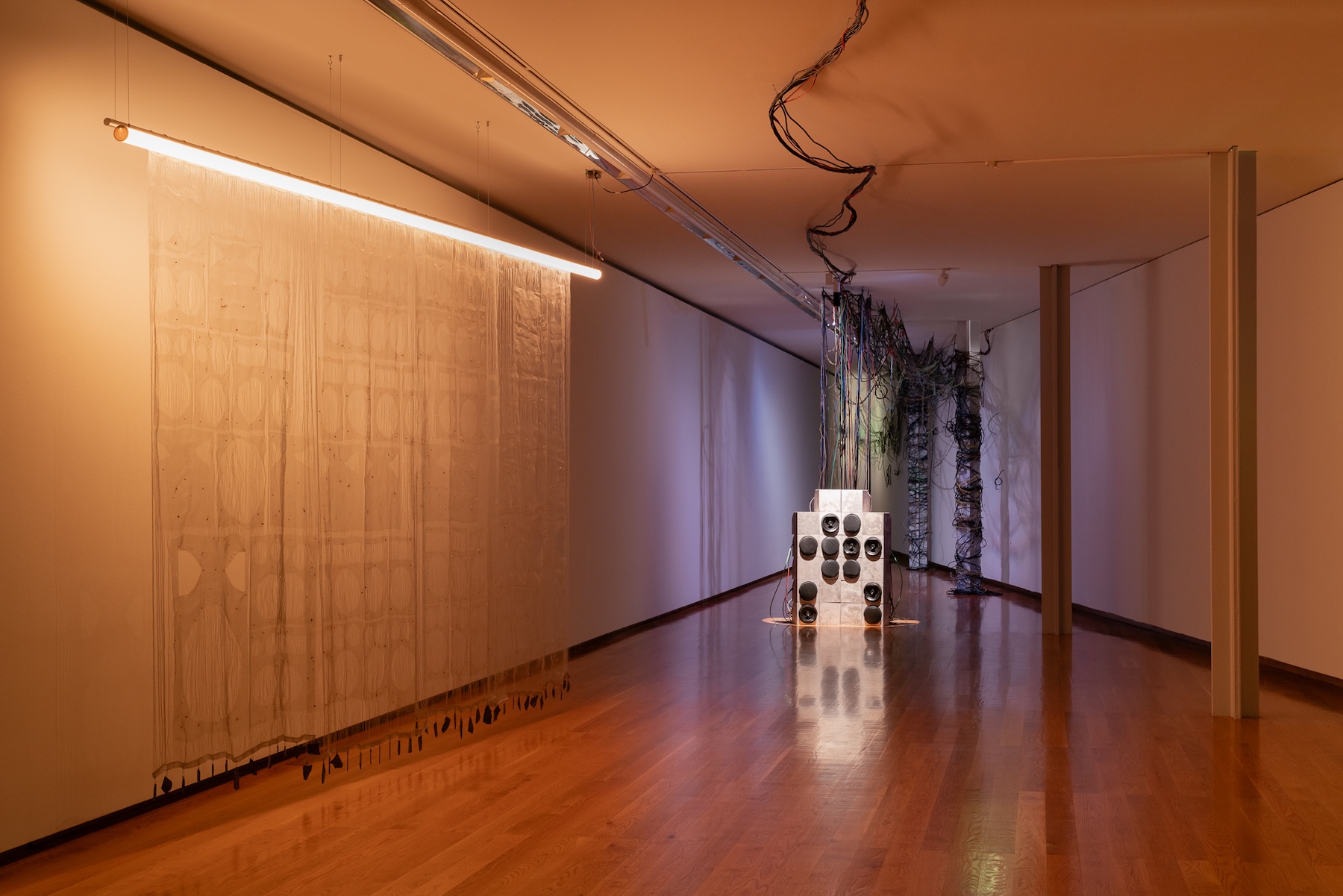


Vivian Caccuri: Febre da Selva Elétrica. Exhibition views at Galeria Municipal do Porto, 2024-2025. Photos: Dinis Santos. Courtesy of Galeria Municipal do Porto.