
Saodat Ismailova: As We Fade
The current exhibition As We Fade by Uzbek artist and filmmaker Saodat Ismailova, on display at the Kunsthalle Lissabon, has stayed with me. In my mind, I keep returning to the exhibition space at the Kunsthalle Lissabon, aware of how my experience there has become a memory that I revisit, ever changing with each return.
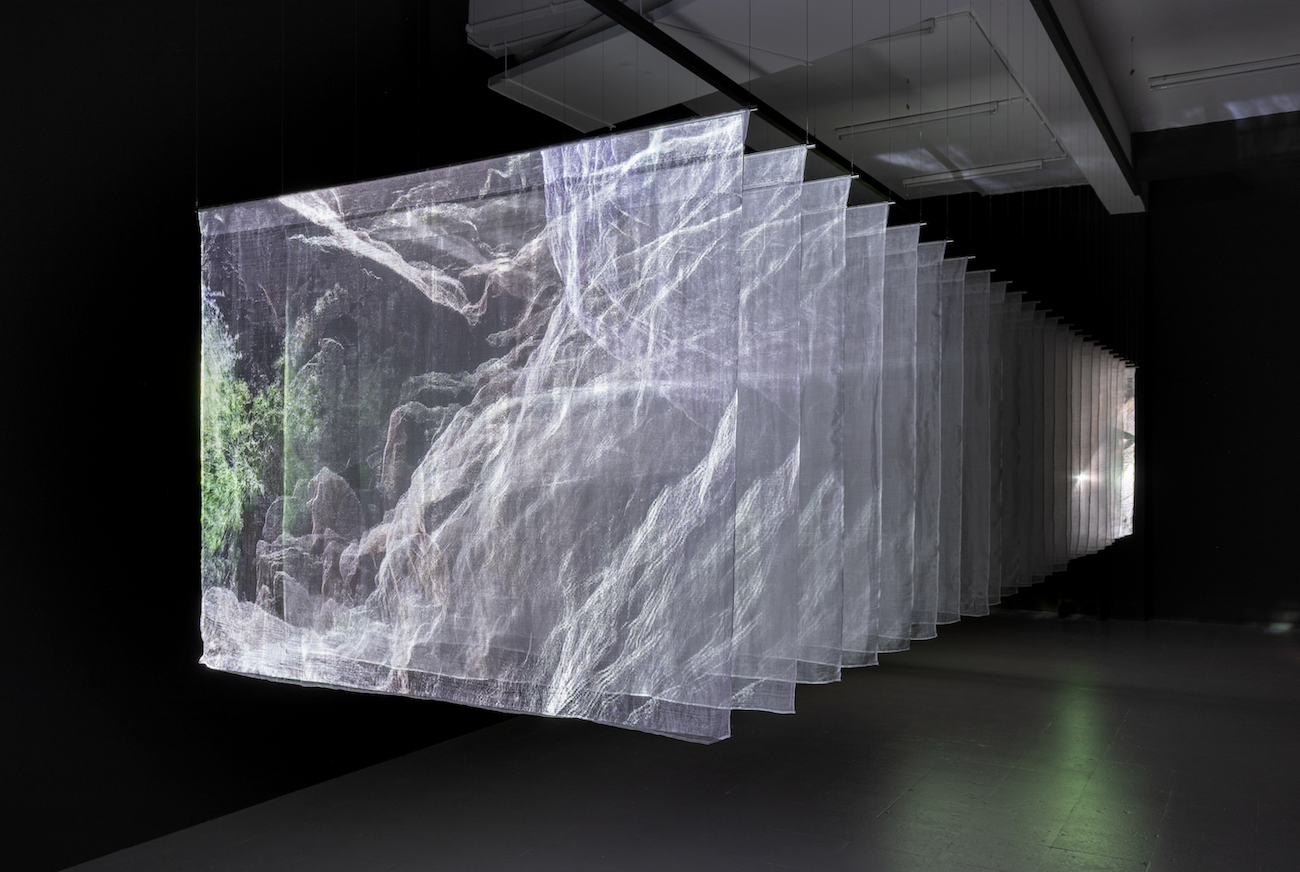
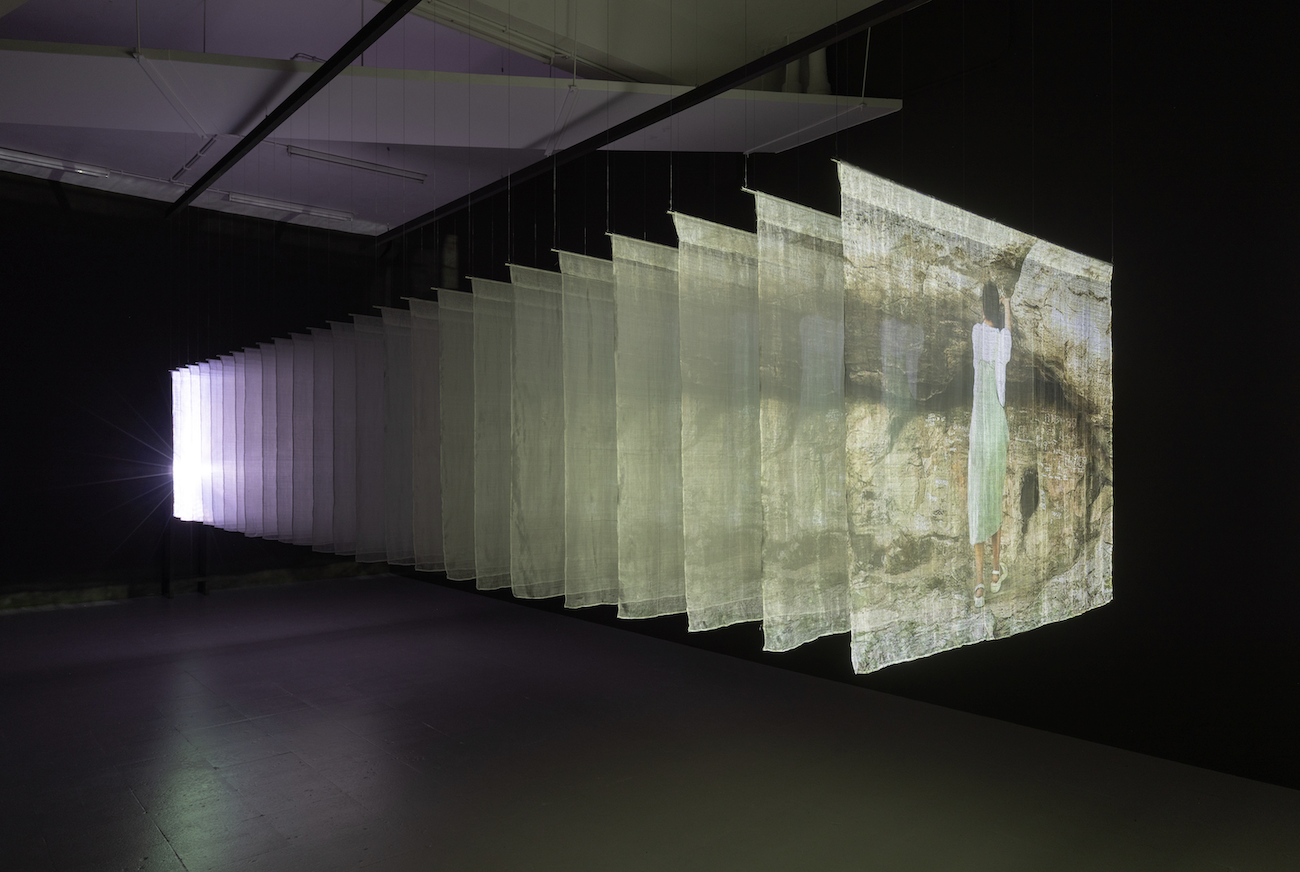
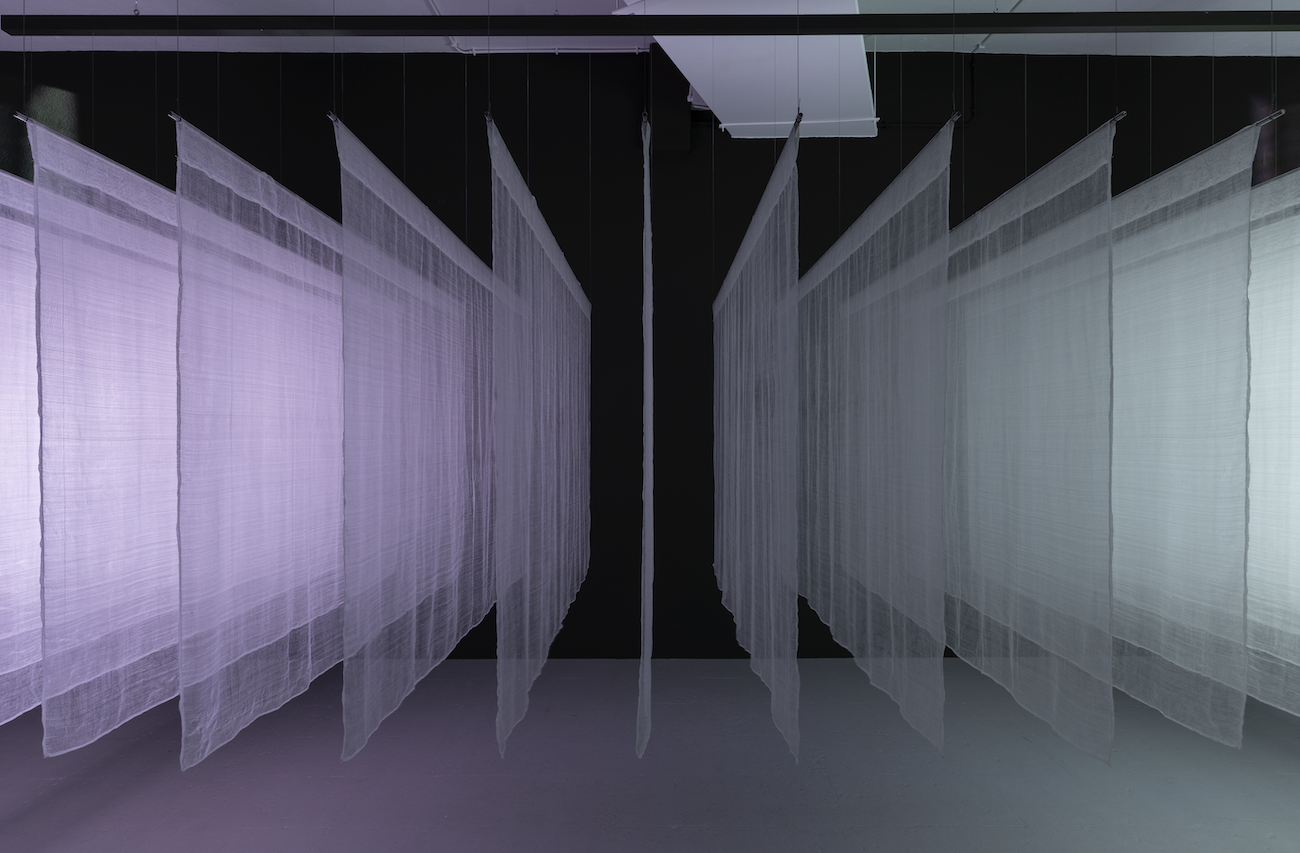
The exhibition space at Kunsthalle Lissabon is dark, with the walls and ceiling painted black, but the feeling of the room is not a gloomy one, because in the middle of the room is an installation by Saodat Ismailova, illuminating the dark space with its shimmer. The light source consists of two projectors located at opposite ends of the room, facing each other. However, the projections do not meet, but instead hit the respective ends of a series of silk pieces hanging evenly, one after another, in a linear formation in the center of the room. There are 24 pieces, as I later read in the exhibition text, for 24 frames per second of film, a direct reference to the material rhythm of cinema itself, and to the pulse that sets still images in motion. The projection of these images onto the silk creates a glimmering effect in the room and bathes it in a soft atmosphere.
As I move along the pieces of silk, they move slightly with the wind created by the passage of my body. The images I see change, slowly fading or becoming more apparent depending on where I am in the room. Through each layer towards the centre, the imagery becomes increasingly discontinuous; at the middle, only the silk remains visible, no longer a projection.
Those were my first impressions of the exhibition, as I recall them right now. I didn’t immediately understand what I was seeing, but I felt it. Ismailova has created a visual language that reached me first through the presence of my body in the space rather than through contextual knowledge and understanding. There is something fragile about this initial encounter, because it somewhat resists being named. Attempting to describe these moments in retrospect means already losing parts of them, as translating them into concrete words only reveals their already faded presence. It makes me wonder how much our memory can truly hold, what it is that we can share through the act of remembering, and, perhaps more importantly, what form of language can carry a memory without fixing it in one place? Is the opposite of remembering really forgetting? Or do the memories that no one recalls continue to exist somewhere, waiting to be reawakened?
This difficulty, or rather vulnerability, seems to be part of the artwork itself. As We Fade explores the tension and interdependence between memory and the act of remembering, both in itself and in relation to the medium of film. Ismailova does not locate these themes in abstraction, but anchors them in a specific geography: the Sulaiman-Too Mountains in Kyrgyzstan, a sacred site along the Silk Road whose layers of meaning have been repeatedly rewritten, from pre-Islamic ritual space to Soviet tourist attraction and museum. The mountain, with its caves, rock carvings, and places of worship, bears the traces of time not only in its rock but also in the lives of those who have wandered through it, and whose gestures, stories, and rituals have become part of its surface.
Ismailova's film gives shape to these layers of endurance, not by explaining them, but by allowing them to appear and fade away before our eyes. In her work, memory is not a stable narrative, but a texture that oscillates between presence and disappearance, and the medium of film becomes its delicate bridge. By weaving together ethnographic archival material from the 1920s, showing a group of women in the mountains, with quiet contemporary images of the place, she does not follow a linear representation of history. Instead, her film stages memory as a process, something you have to meet again and again, and that changes over time because our perspective on it changes as well.
The artist does this while not erasing this history, nor does she favour or judge it. Rather, she listens to overlapping temporalities by layering images that speak across decades, allowing histories to surface without asserting ownership or authority over them. The aura Ismailova creates through the images on the silk panels reminds me that vision alone cannot contain memory, that what I see is only the visible trace of something still unfolding elsewhere.
Encountering Ismailova’s work in this way brought to mind Laura Marks’ text The Skin of the Film, where she writes about a “haptic cinema,” an embodied spectatorship defined by “a vision that yields to the thing seen.” Ismailova’s installation recognises the viewer’s body in a similar way; it responds to movement, breath, proximity. As I walk through, the silk trembles, the image shifts, and the work seems almost like it is in-and exhaling. Through this movement, I become aware not only of the layered histories of Sulaiman-Too—with the traces of rituals, gestures, and lives folded into its stone—but also of how these memories inhabit the mountain even as it lives on in the memories of those who return to it. The experience of viewing As We Fade thus becomes an act of reanimation, leading me to believe that these memories were never fully forgotten, but quietly waiting to be remembered. Film here is not a transparent record, but a tactile medium that catalyses this reawakening.
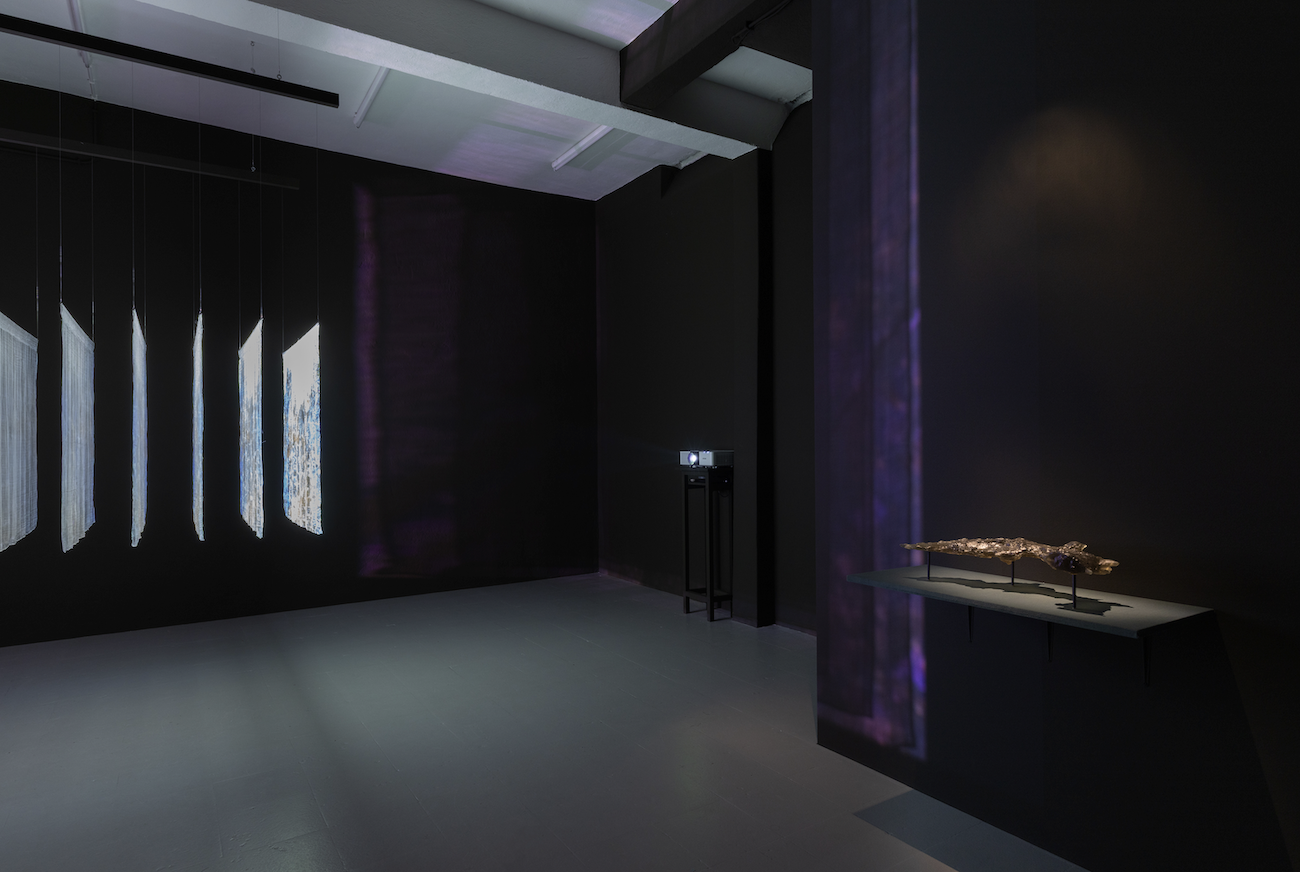
The film installation is not the only work on display. Alongside it, there is a second gesture of remembrance, one that is not made out of air and light, but of resin and data. Standing to the side of the room, like a counterpoint to the temporal and ephemeral materiality of silk and film, is a grounded presence: a cast of the mountain itself. Printed using LiDAR technology, it captures the surface of Sulaiman-Too in meticulous digital detail. Where the film moves and fades, this sculpture remains static, preserving in its form what the images can only suggest.
As Ismailova presents it, Mount Sulaiman-Too becomes a living archive. The mountain and the film are two registers of memory—one tactile and solid, the other fluid and light —that together articulate how memories survive transformation. Memory here is not equivalent to history, it is not a factual record but rather a living negotiation with time. Moreover, cultural memory differs from individual recollection because it belongs to no single subject: it is enacted and maintained through collective togetherness and stories. In this sense, cultural memory is a form of resilience, a continuous reconfiguring of how communities relate to the past and position themselves toward the future.
Seeing this work in Lisbon also means being congruent with a sense of distance. The stories told by the artworks are largely unknown in the West; they reach us filtered through geography and language, mediated by the exhibition space itself. But with As We Fade, Saodat Ismailova does not ask me to fully understand or master the history it presents. It does not impose a single narrative of the Sulaiman-Too Mountain, or of Uzbek and Kyrgyz culture. Instead, it creates a space for attention, for inhabiting these memories without claiming them, leaving room for ambiguity and acknowledging that what is shown is only one fragment among countless stories.
Perhaps this is what I take with me from this exhibition: the quiet proposition that memories left untold are not forgotten, but latently existing, waiting for someone, or something, to reanimate them. They persist in landscapes and bodies, in materials, rituals and gestures of togetherness, even when unseen. To remember, in Ismailova’s work, is not to recover a fixed past, but to listen for what continues to resonate beneath the surface of the present.
Valerie Rath is an Austrian cultural producer and curator with an academic background in art history and art and cultural management. She is currently living in Lisbon. Since April 2024 she is working as an in-house Curator for DUPLEX_AIR. Her curatorial practice is driven by a deep curiosity about the influence of past narratives on our collective and individual abilities to imagine future worlds — and how artistic interventions can expand that imagination.
Proofreading: Marta Espiridião
Saodat Ismailova: As We Fade. Exhibition views at Kunsthalle Lissabon, 2025. Photos: Bruno Lopes. Courtesy of the artist and Kunsthalle Lissabon.