
Saodat Ismailova: Melted into the Sun
This talk, with Saodat Ismailova and Leonardo Bigazzi, moderated by Contemporânea — Sara Castelo Branco—, took place during the opening of Melted into the Sun, at Batalha Centro de Cinema, in Porto, followed by the screening of the film.
Guilherme Blanc
The Melted into the Sun exhibition borrows its title from the most recent work by Saodat Ismailova—from our point of view, one of the most important artists working in contemporary art and moving image today.
Batalha Centro de Cinema joined the co-production of this film following an invitation from Fondazione In Between Art Film. The work was part of an exhibition titled Nebula, composed entirely of filmic works, and presented by the Fondazione In Between Art Film on the occasion of the 2024 Venice Biennale. This film was one of eight works featured in the exhibition, which is widely regarded as one of the most relevant biannual projects for artist film. The foundation’s work is indeed extraordinary and has supported the creation of key filmic works—including those by artists such as Jonathas de Andrade or Ana Vaz, with whom we have already engaged in dialogue here at Batalha through new commissioned films.
We then developed a slightly more ambitious idea: to complement the presentation of this new film with installations in other spaces of the film centre, including Zukhra (2013) and Her Five Lives (2021). The idea was to bring it together with two other works by Saodat, offering a more comprehensive perspective of the artist’s ongoing practice, which, in very brief terms, revolves around memory and historiographical reflection on Uzbekistan and Central Asia’s culture. Through these historiographies—some grounded in fact and others more mythological—, Saodat has proposed cinematic, and at times sculptural, exercises that explore the political and social context of Uzbekistan through the lens of its political and millennia-old stories.

Sara Castelo Branco: I would like to ask you, Saodat, to give us an overall presentation of the film. And I would also like to ask Leonardo to speak about how this film fits within the context of the Nebula exhibition, and within the work developed by the Fondazione In Between Art Film.
Saodat Ismailova: I think this film was a very complex one for me. I was working with a character who left behind an uncertain and contradictory legacy — there is nothing concrete written about him. His story exists like an echo upon an echo, reverberating through time. That places you in a position where you must decide what you want to bring forward in the film.
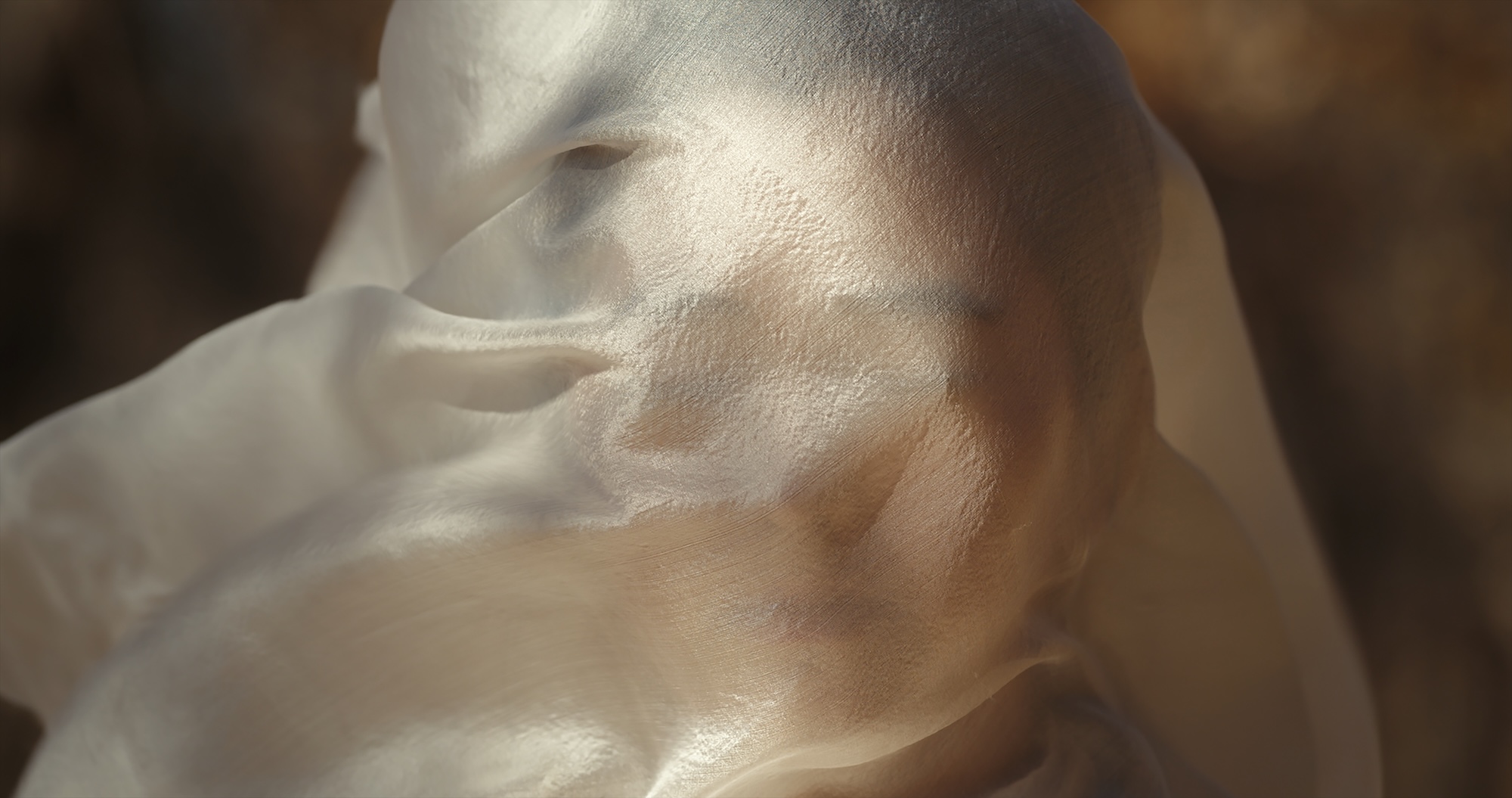
This complexity allows to open up incredible layers: he was a dyer, an alchemist, an optical illusionist, a preacher, a prophet, and interpreted sometimes as the first revolutionary figure. The moment I realized the direction I wanted to take was when I asked myself how I could connect his story to recent times — to the context I was born and raised in.
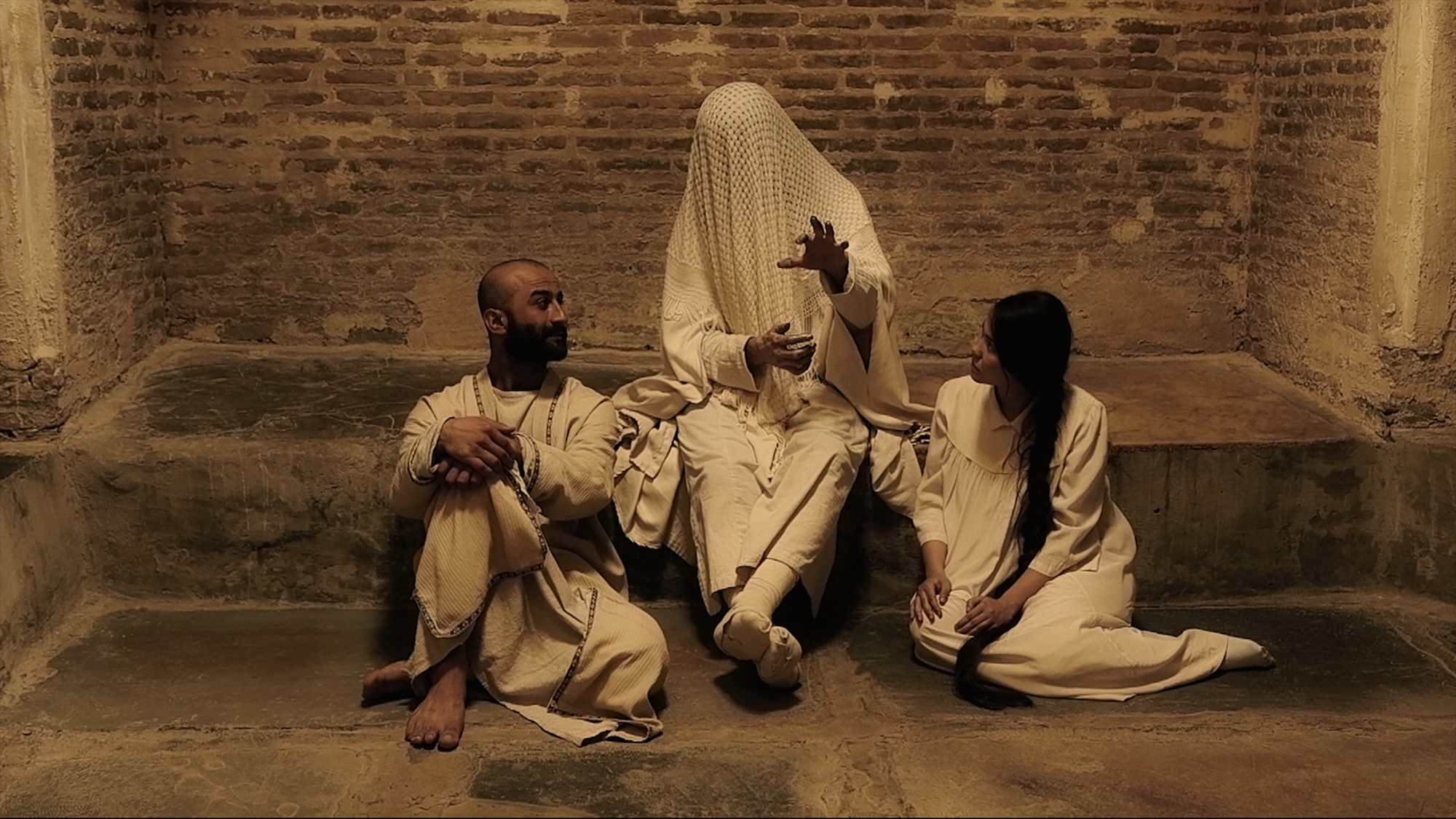
I was born during the Soviet era, and first encountered The Veiled Prophet followed by people in white in the Soviet history books of Uzbekistan. Back then, every discipline was manipulated and shaped according to the narrative of the center — which, for us, back then was Moscow. He was presented as a kind of proto-socialist, as if socialism had originated in bigger Central Asia. That idea intrigued me deeply.
Also, the fact that his face was never shown creates a vast imaginative space — there is nothing visual to hold onto, which allows for a broader field of interpretation and dialogue. So yes, the film touches on many different layers, and that is essentially how I came into it.
Leonardo Bigazzi: The Fondazione was founded by Beatrice Bulgari in 2019 to create connections and build bridges between contemporary art and cinema. Our programme is dedicated to commissioning, producing, and exhibiting the work of visual artists who experiment with the language of moving images. I had been following Saodat’s work for some time, and the second exhibition we organised in Venice, Nebula, was the perfect opportunity for us to collaborate for the first time.
The exhibitions in Venice now form a trilogy and we are currently working on the third chapter, which will open in 2026. The idea behind these exhibitions was to give tangible form to our commissioning practice, bringing these works into dialogue within a single environment and exploring how the moving image can be spatialised and experienced in a three-dimensional exhibition context.
This series of commissions originates from an ongoing dialogue between myself, Alessandro Rabottini, co-curator of the exhibitions, and Beatrice herself. But, above all, it begins with the artists. I always start our conversations by asking: What ideas are you working on right now? What projects would you like to develop but haven’t yet found institutional support for?
Saodat shared two ideas with us, but at one point I asked her: Which project feels most urgent to you? The work that emerged from that question, I believe, truly encapsulates that sense of urgency. I’ve long admired her earlier pieces, but this one, in its complexity and in the way it engages with the layered and intricate history of her country, represents a significant step forward.
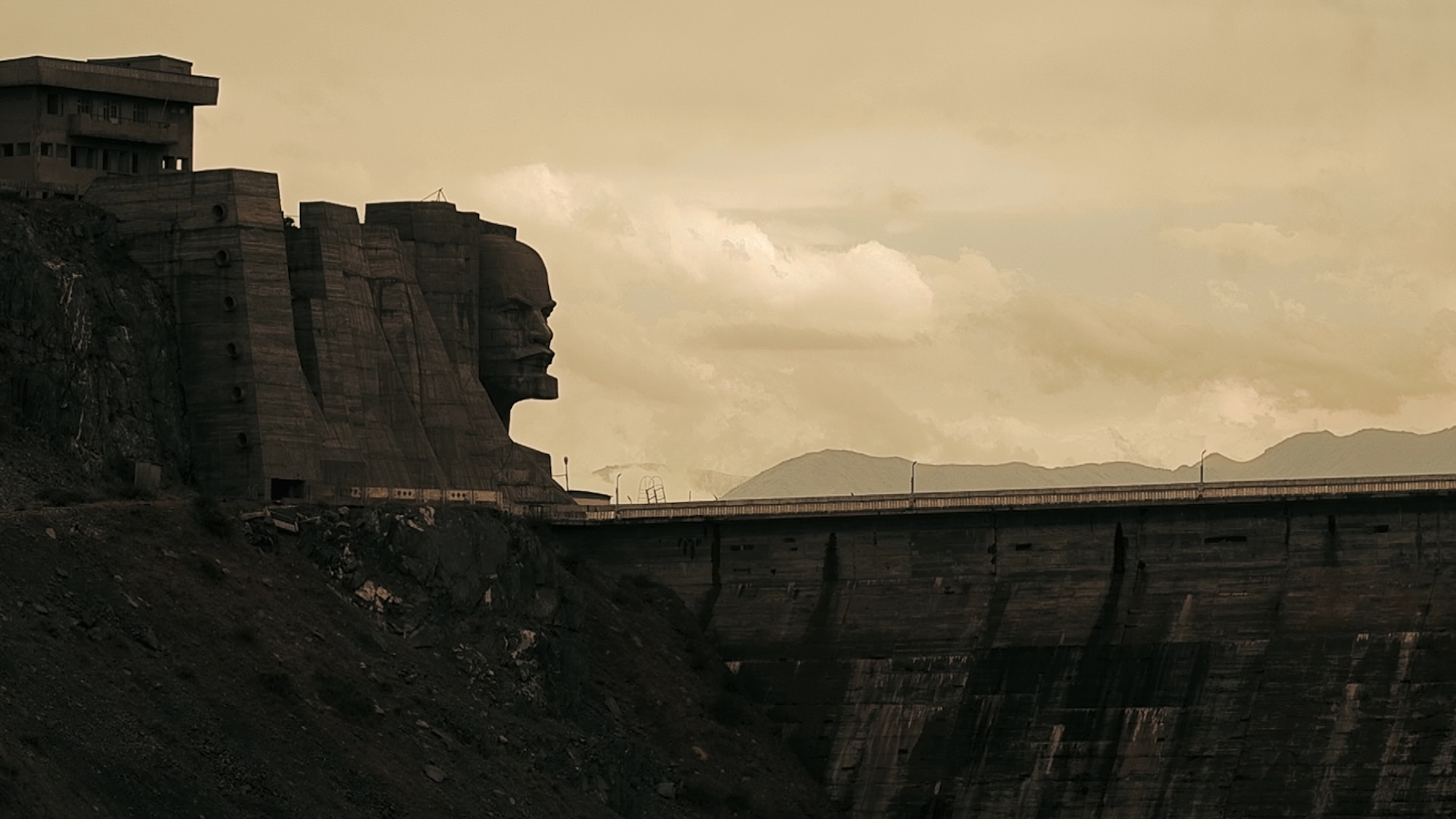
Sara Castelo Branco: A very present subject in your work, which you also mentioned earlier, is that Uzbek and Central Asian traditions and knowledge are not reduced to the past in your films, but can somehow be translated into our contemporary lives. On the other hand, your practice also touches on issues such as the impact of human activity on the environment or on cultural heritage. So, could you both speak a bit about the dynamics of temporality in the film, that is, the connections between past, present, and perhaps even the future in Melted into the Sun?
Saodat Ismailova: I think it was, in a sense, clear—because the character was Zoroastrian, and the Zoroastrians worshipped the Sun. And the Sun is timeless — at least for us, within this solar system. So it became natural for me to layer different notions of time, approaching them through the lens of solar worship.
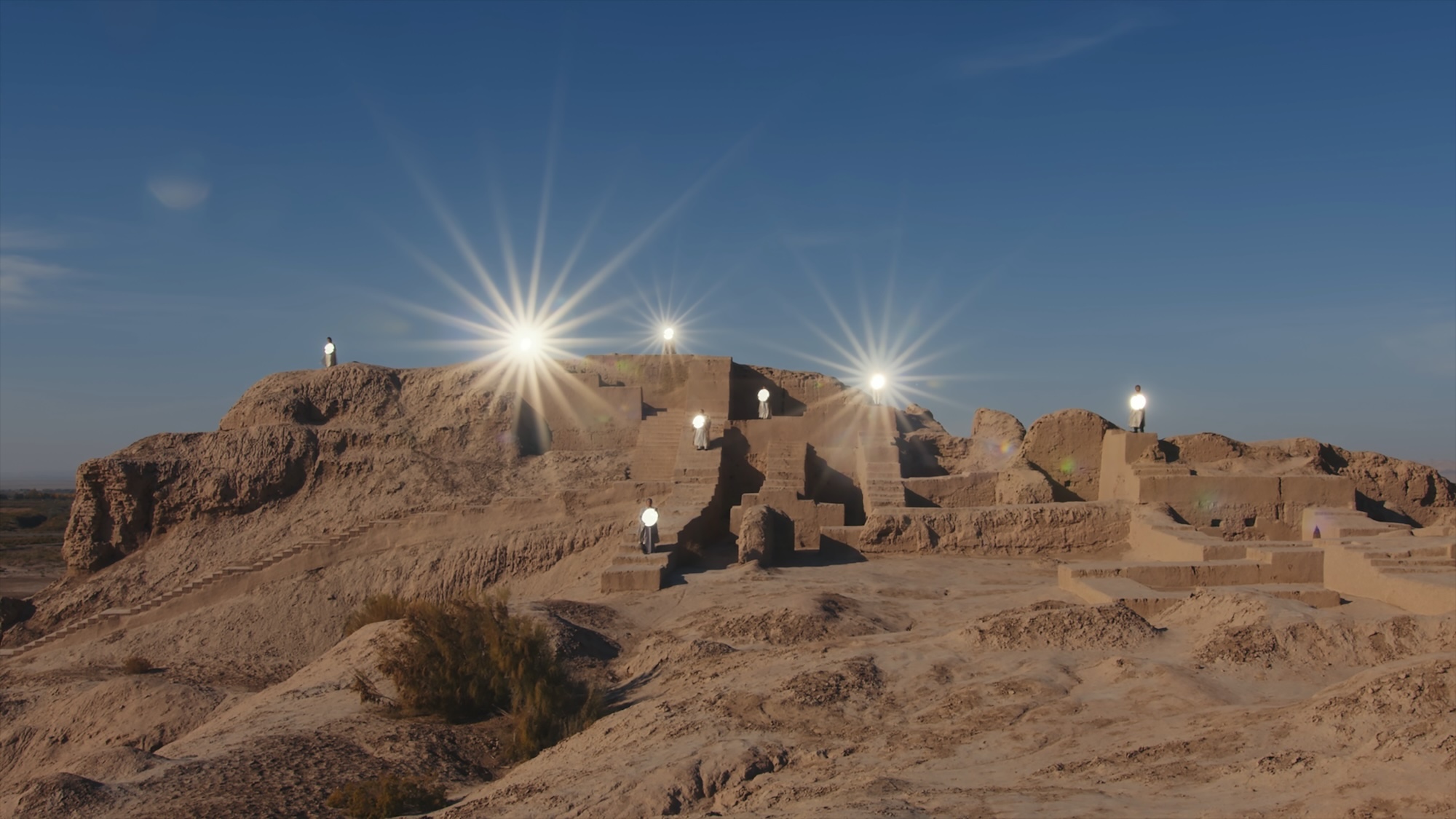
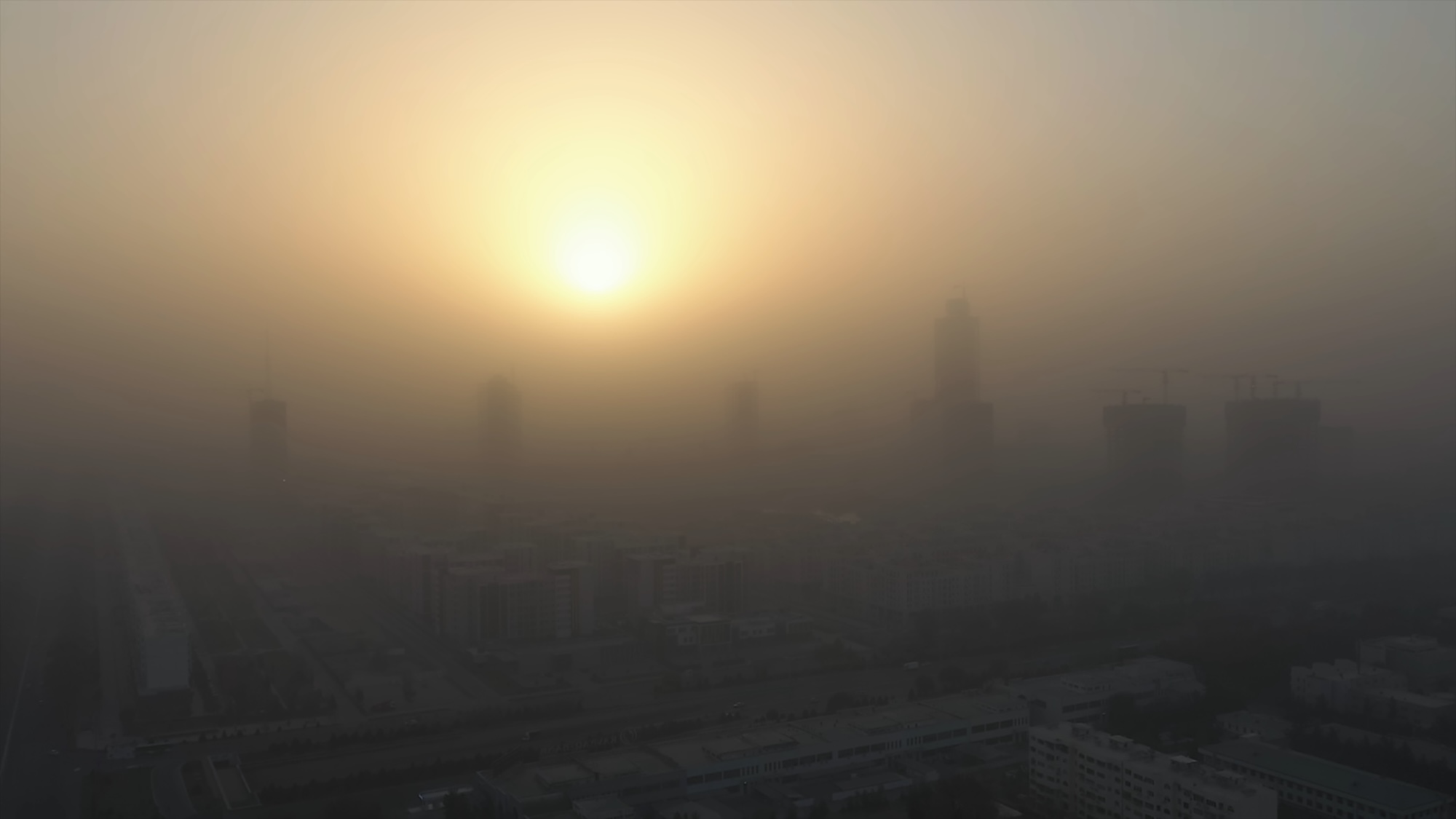
I explored the pre-Islamic period, the Soviet era, the Islamic period, and the contemporary moment—a kind of hyper-capitalist age. I also reflected on the scientific heritage created during the Soviet period. In the film, there is a sequence shot at the Helio Complex—the Solar Furnace that harnesses the Sun’s heat to melt metals.
Working with these locations, each corresponding to a different historical layer, became both a visual and ideological journey—tracing the systems of thought and belief that each era left behind. These layers also point toward imagined futures that have existed within every type of society humanity has tried to construct.
But the question remains: is humanity truly capable of building a just society, or does it remain within the realm of imagination, dreams, and theory? Can a “solar society” be aligned with our deepest nature? Thinking from this perspective helped me move fluidly through layers of time—allowing temporality in the film to unfold in its own distinctive narrative rhythm.
Leonardo Bigazzi: My perspective was that of someone who has never been to Uzbekistan. Yet I think Saodat’s work has an extraordinary capacity to connect you to profound ancestral meanings that, in a curious and almost uncanny way, also resonate with ancients pagan cultures of Italy, for example. If you look back through archaeology, you find in many civilizations prayers to the sun, or a fascination with particular elements of the landscape. Rivers, mountains, and other geological forms that carry a spiritual or symbolic weight.
Al-Muqanna, whom Saodat chose as a kind of Virgil, is a figure who moves fluidly through all these spaces. We travel from a Soviet-era solar research lab to a dam that recalls Mount Rushmore, only with a monumental Lenin figure, or to two castles from the 4th or 5th centuries that were destroyed and later rebuilt. The work carries you across different strata of time, spanning two millennia of history, and even further, if you also consider the timelessness of the natural forms. Suddenly, you feel deeply connected to the vast expanse of historical time itself.
The work unfolds as a loop, often returning to the same images. You’re drawn into a flow that invites you to let go, to surrender to this stream of consciousness and imagery, where time feels dense and significant, yet never tied to a specific date or place. You find yourself immersed instead in a profound sense of what we might call deep time.
Sara Castelo Branco: Regarding this idea of temporality, I think there’s also a theme that is very present in your work: that of the transmission of memories, knowledge, and stories, which, in Central Asia, is also strongly associated with female domains. Your films are also very closely tied to Uzbek traditions and elements that are, in some ways, at risk of disappearing.
Saodat Ismailova: I think film is the strongest and most enduring form of transmission for me. And when it comes to the need to engage with memory and local knowledge, it’s essential to consider the period I grew up in. I was a teenager when the Soviet Union collapsed, so I lived through a time when red turned to green, white became black, and then back again—several times over. It was a climate of constant change, where perspectives shifted overnight. This blurring between reality and illusion was something we experienced physically, as the country we knew dissolved around us.
There are two reasons why this experience has remained central to me. The first is deeply intuitive. I remember the years of Perestroika vividly, when everything began to drift — when there was nothing solid to hold onto. The only anchor that remained was what came from within the family. That is why I continue to return to these questions; they must be understood within the frame of that historical moment.
As for cinema itself, my father was a filmmaker. He studied in Moscow and belonged to the generation of Soviet Uzbek cinema. I grew up surrounded by film, so it became a natural language and space for reflection—it was simply, “This is what I’m going to do.” Looking back now at those films, I see an extraordinary heritage that has largely disappeared from view. Even within such a powerful ideological system, there existed a second or third layer of truth — something that could not be controlled. That, I believe, is the true power of cinema: its ability to preserve what is real, even under manipulation.
Leonardo Bigazzi: I think you, Sara, make a very good point: transmission is indeed central to Saodat’s work. This is evident, for example, in her decision to cast a real contemporary poet in the role of Al-Muqanna for the film.
She is engaging with a history that has no written form, one that has been passed down orally through generations and centuries. For this reason she wanted to be in dialogue and co-write the text with someone who has inherited a certain urgency to express through words and voice those ancestral narratives and intangible cultural memories.
Cinema arrived in Uzbekistan in the 1920s, and it became a means of fixing some of these stories and traces by capturing them for the first time in a tangible medium that could circulate and be transmitted. Once again, as an observer, I find these choices in Saodat’s work to be very deliberate and deeply meaningful.
Personally, as a curator, I’m extremely interested in working with artists whose practice is inherently political. I often find myself reflecting on the idea of “translation”, on how cinema allows us to connect with worlds and experiences that are not our own. Through images, words, and text, it offers a way to engage with histories such as the one Saodat is sharing with us through her work.
Sara Castelo Branco: There is also a strong connection to this idea of cultural and spiritual transmission in relation to feminine worlds in Central Asia. One of the works in the exhibition, Her Five Lives, also addresses the cinematic representations of women in Uzbek films within the broader context of social and political transformation, and is based entirely on archival material. What were the criteria for the editing work you did?
Saodat Ismailova: I worked on Her Five Lives during COVID, in a year when filming was not possible. That limitation pushed me to create a film entirely from archival materials. The initial inspiration came from a text by the scholar Marianne Kamp, who studies Soviet policies around bringing women into the workforce. Traditionally, as Muslims, women stayed at home and were veiled, but under the Soviet Union there was a strong political drive for emancipation—bringing women into factories, onto tractors, and multiply labour to industrialize the region.
Marianne Kamp wrote a short and striking essay titled The Three Lives of Saodat, in which she interviews a politically active woman at the moment of the Soviet Union’s collapse. The woman recounts three completely different life stories, as she was interviewd few years apart—each time convincing herself she is revealing the truth. What fascinated me was how, although the ideological framework remained constant, the meanings shifted. That was the moment I thought: I want to make a film about one woman—but one whose life transforms as the political landscape changes. Hence, the film unfolds in chapters.
I was also thinking about the “chapters” of cinema itself—how cinematic language evolved across historical periods. There are around thirty silent films from the early Uzbek cinema that we knew nothing about during Soviet times. Then came the Stalinist period, focused on nation-building: Uzbekistan, as a republic, was constructed then, emerging from the larger Turkestan region divided into five republics.
Then arrived Khrushchev’s era—the Thaw—which is visible in cinema, art, music. Political pressure remained, but it softened. Uzbek cinema began to take poetic form; cinematography became distinctive; extraordinary actors emerged. Cinema began to breathe. Then came Perestroika, a fascinating period in Soviet cinema that still deserves exploration—a time when everything hidden for seventy years suddenly surfaced: politics, crime, prostitution, drugs. It was a turbulent, revealing moment full of hope and deep grief at the same time.
Finally, there is the post-independence chapter, when iron hand of ideology seems to disappear, and as if there is vague line to hold on. Watching films from that period, you often see women crying—as if something essential is missing. That sense of disorientation shaped the film’s structure. It became a kind of collage, a study—imagining one woman living through different lives as the political climate around her continuously shifts.
Sara Castelo Branco: The exhibition here at Batalha features three films: this film which we are going to see, Melted into the Sun, but also Zukhra and Her Five Lives. There is a common historical, cultural, and evocative dimension in all three films, but they are somehow different in form. Were any specific reasons behind the particular selection of these three films for this exhibition at Batalha?
Saodat Ismailova: We discussed this with Guilherme, and our intention was to offer, as you said, different perspectives and points of entry into my practice. Zukhra is from 2013, and Melted into the Sun is from 2024—so there’s a clear sense of evolution across that ten-year span. I think that was precisely the idea.
I think the three films are connected by a shared sense of survival set against the backdrop of political and social shifts—each expressed through a different cinematic language. Zukhra may appear inactive, yet her act of sleeping and awaiting an unknown future becomes a quiet gesture of resistance. Her Five Lives explores the concrete historical case of Uzbek cinema and the radical transformations of society, once again arriving at an uncertain space that asks: what is the next chapter? Meanwhile, Melted into the Sun portrays an ambitious figure—a local prophet who sought to build a society rooted in equality, non-hierarchical power and non extractivism of the land, but ultimately becomes trapped in his own fears. This, too, echoes questions that resonate deeply with our present time.
I believe these shared undercurrents—of survival, transformation, and the search for meaning amid change—are what connect the three films and shaped their selection.
Fondazione in Between Art Film
Editor's note: This conversation was broadcast live at the Batalha Cinema Center, transcribed and edited, while maintaining characteristics of the original oral conversation.
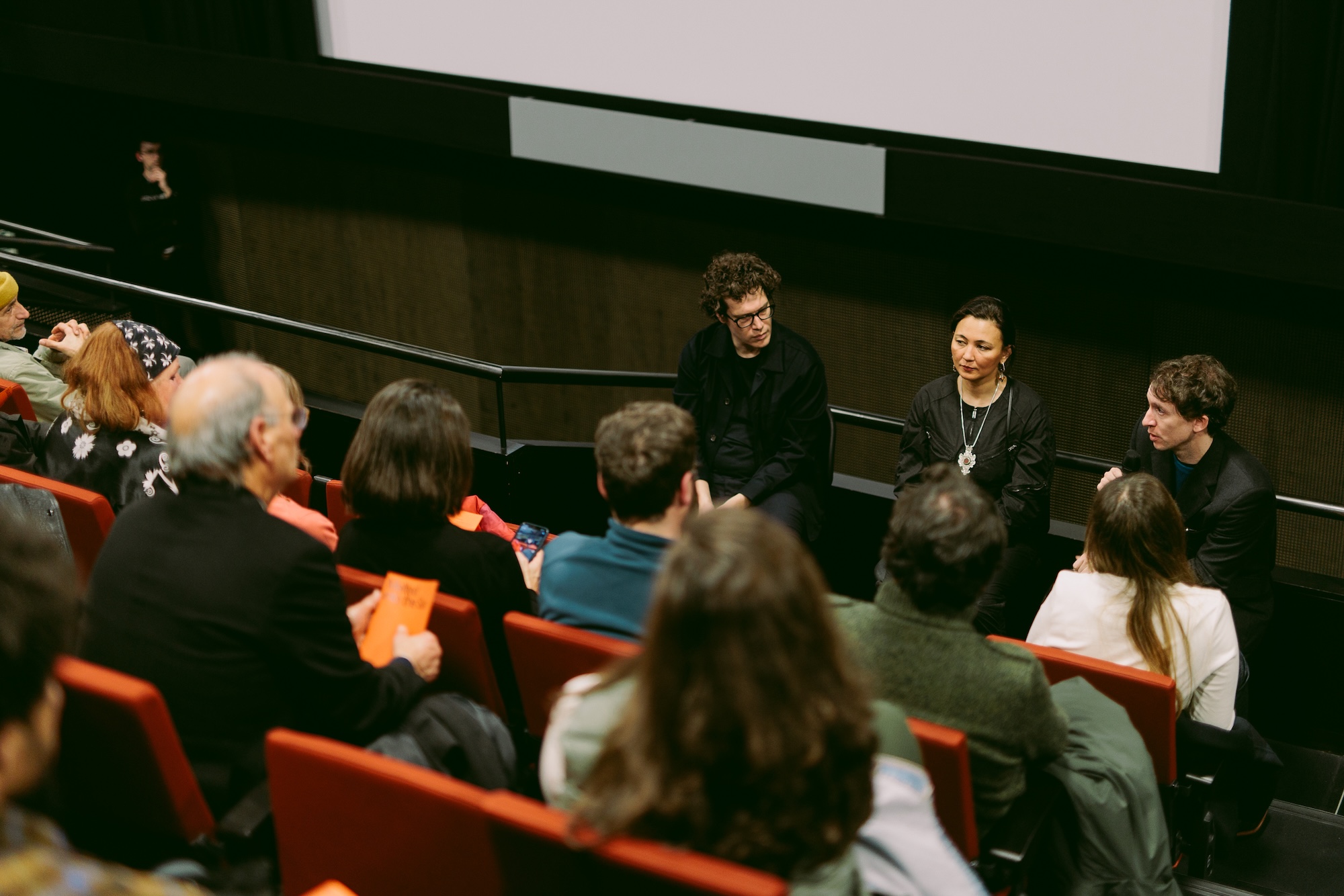
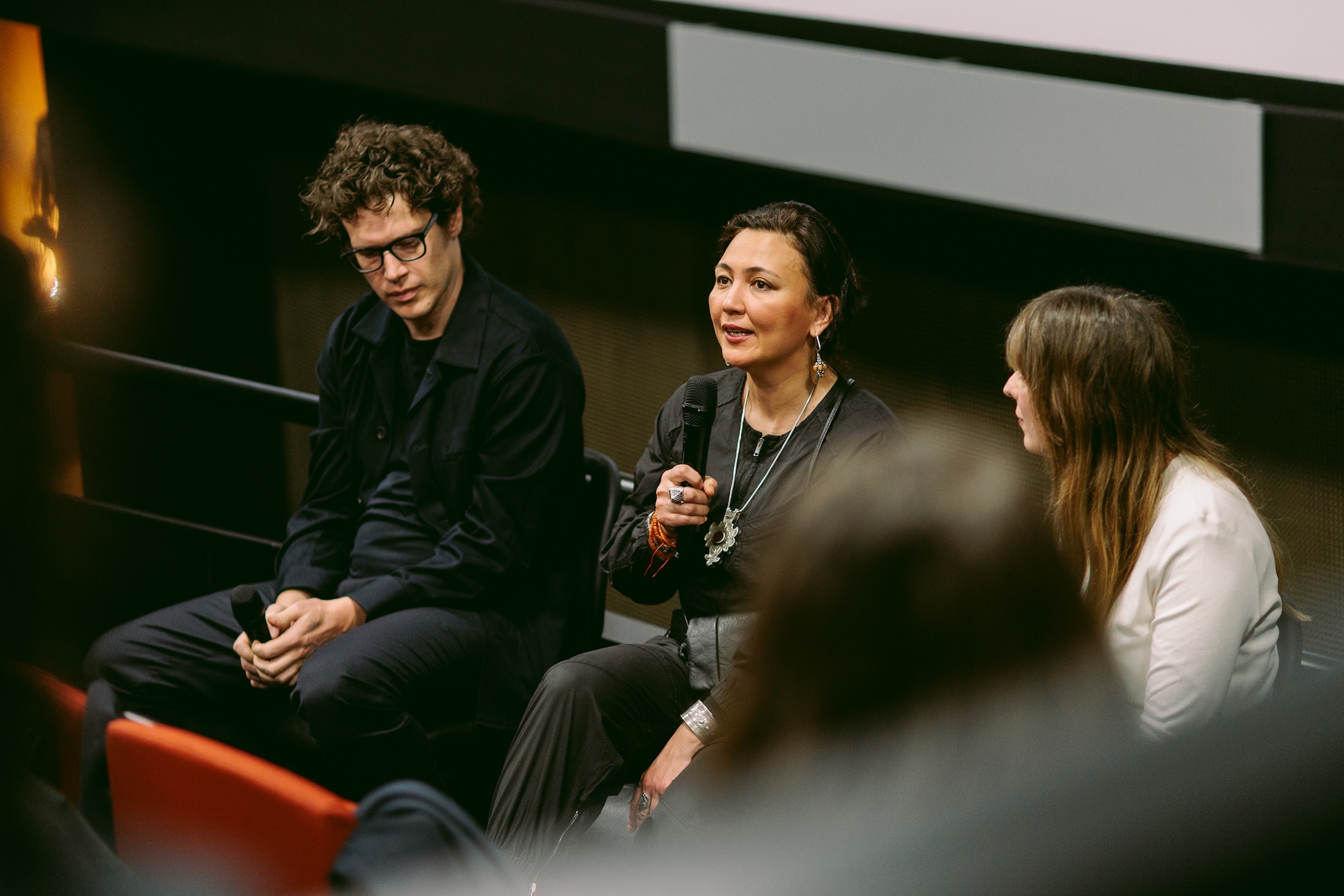
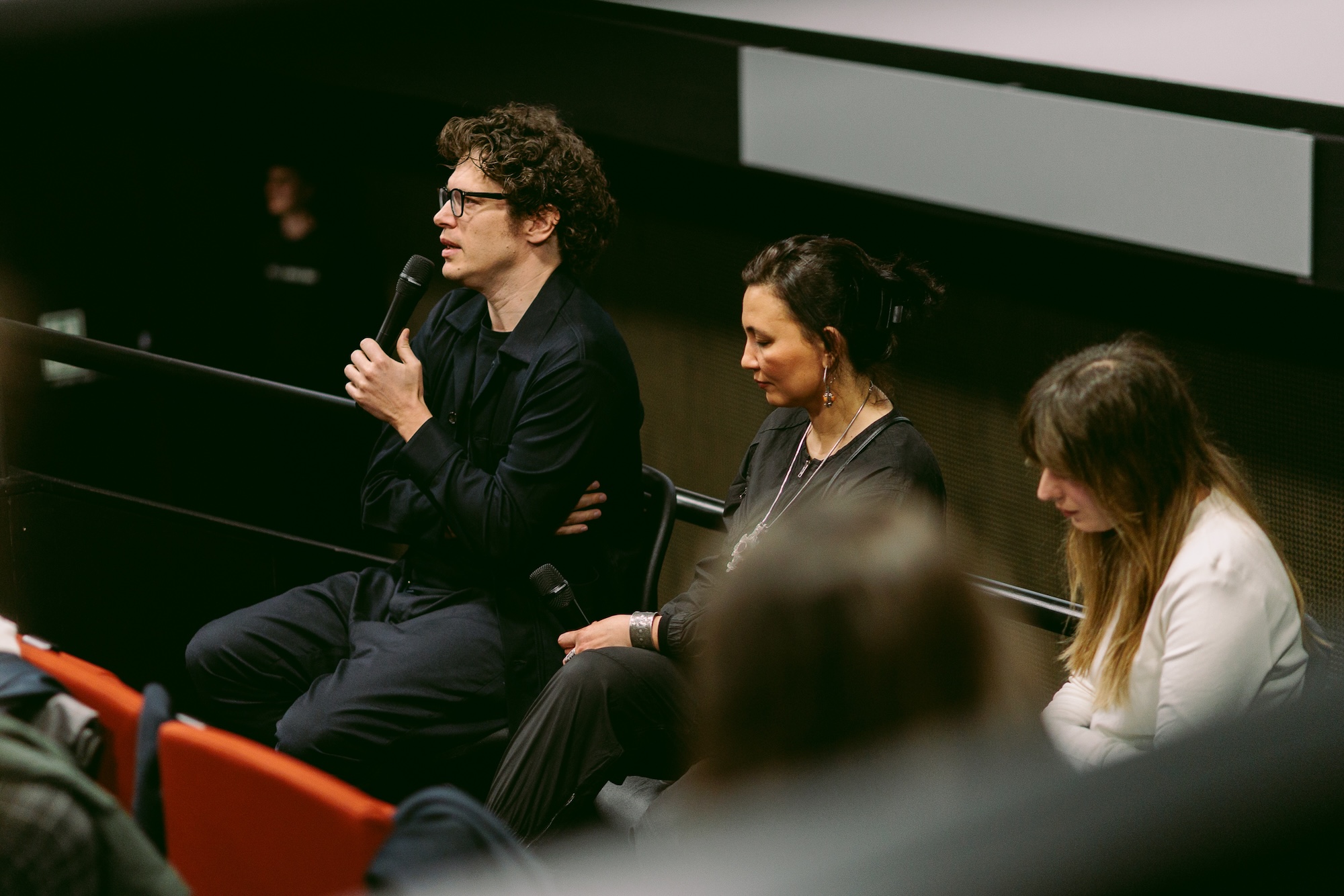
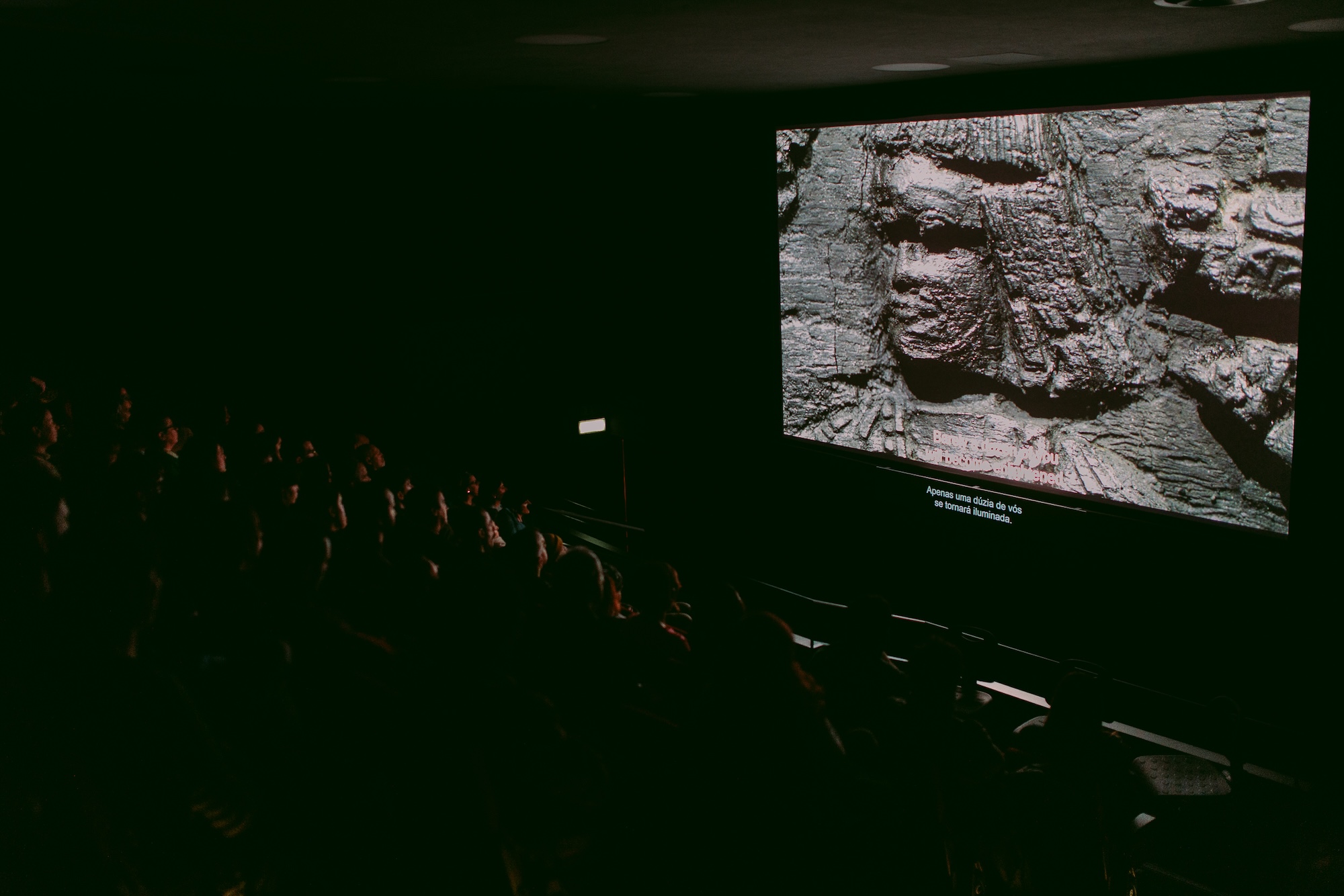
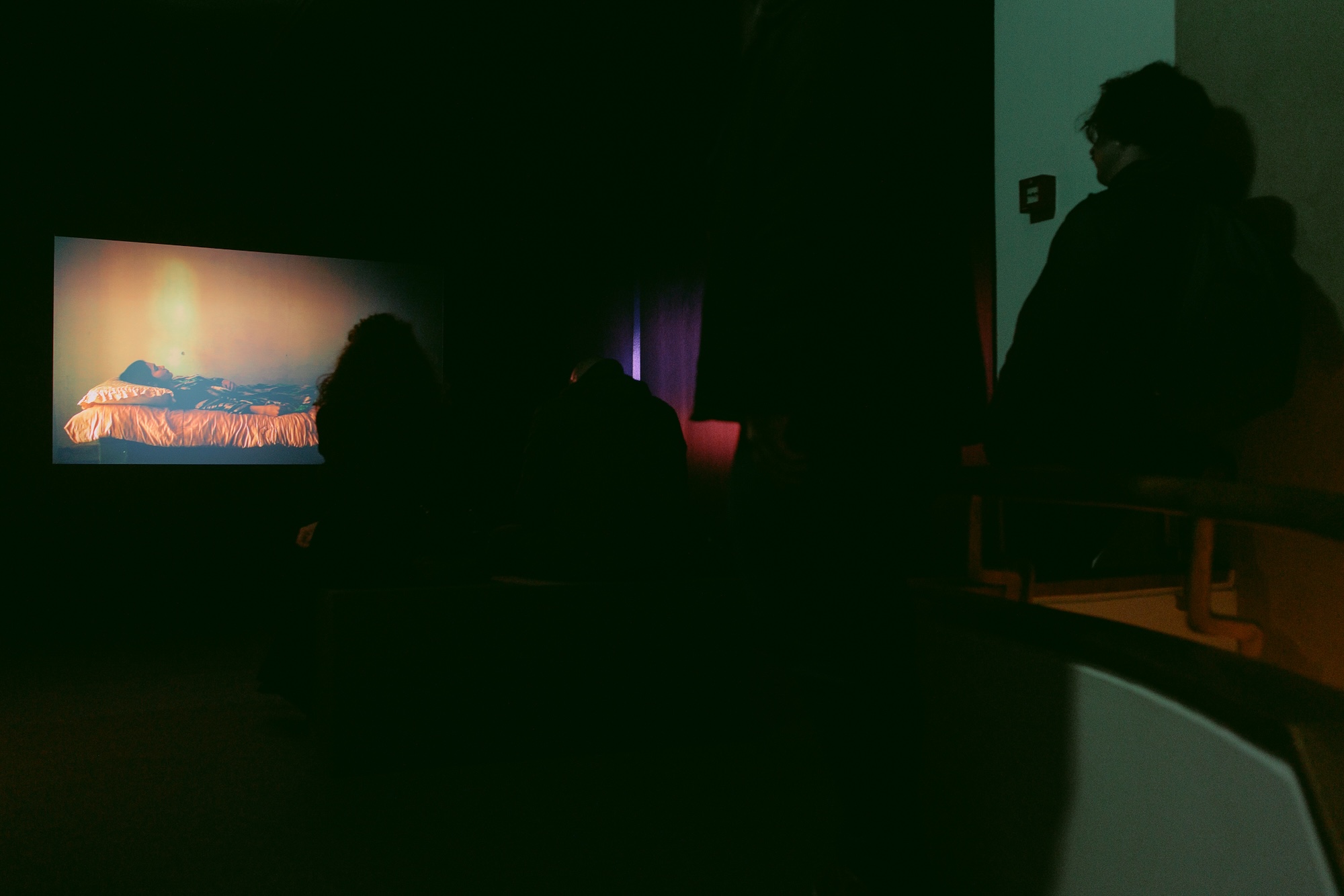
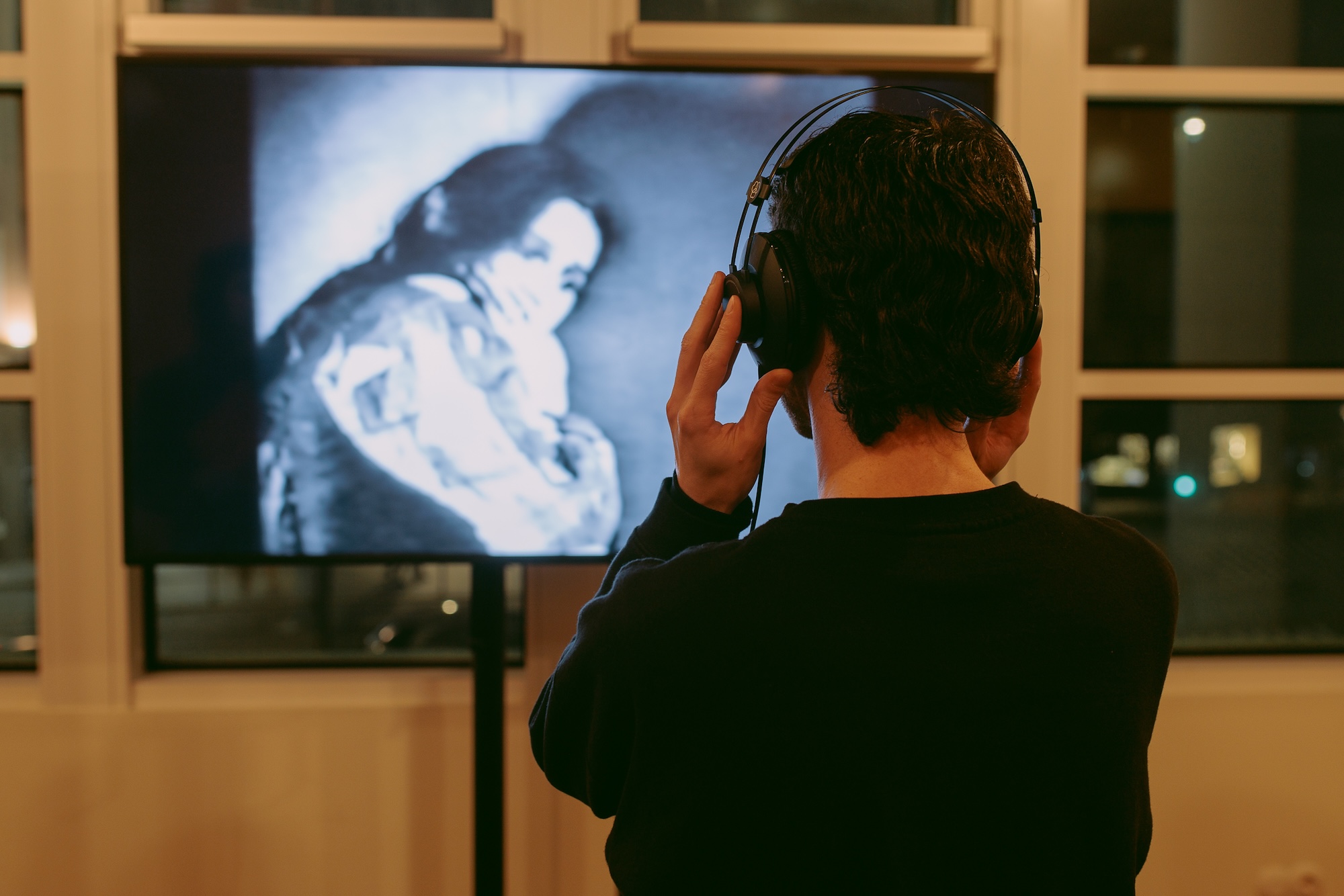
Saodat Ismailova: Melted into the Sun. Movie Stills. And images of the conversation at the opening and screening of the film and exhibition at Batalha Centro de Cinema, Porto, 2025. Courtesy of the artist, Batalha Centro de Cinema and Fondazione in Between Art Film. Photos: Renato Cruz Santos.