
Palestine Here and There
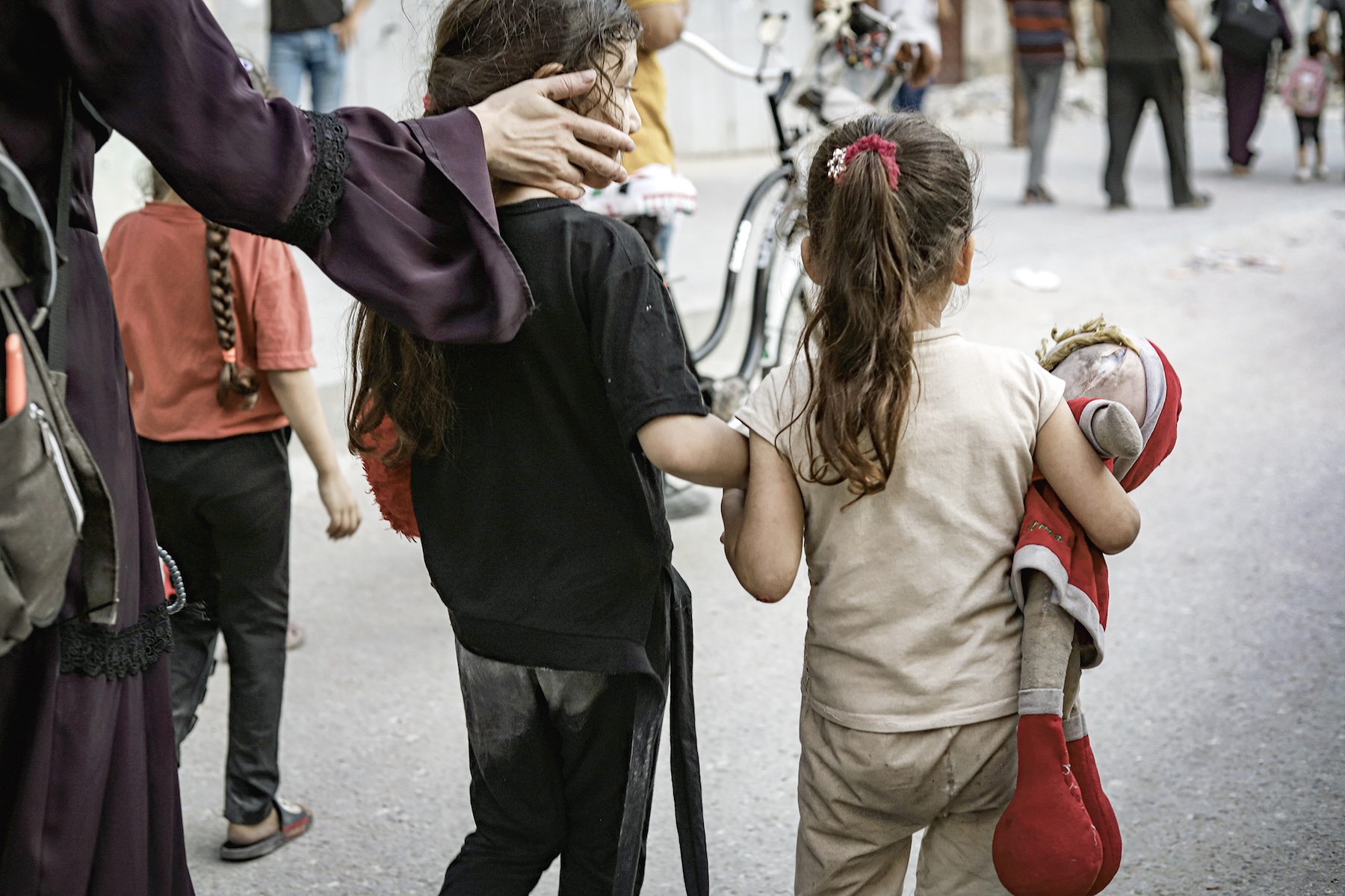
The urgency of the image and the fragility of human life, a few words on the Exhibition Palestine Here and There at Rampa
"(...) politics is now the meeting of the visible and the unspeakable”
Nicholas Mirzoeff[1]
As I was asked to write about this exhibition I found myself torn between having no words to start the text and at the same time feeling certain that silence is not a place to be, because, as I read from John Berger's accounts, there is a silence that is "worse than bullets"[2]. And so, how does one talk about an exhibition that resonates suffering and war and death? How to speak of images when the reality they portrait is unspeakable? My own sense of justice and belief in equity and the protection of cultures and of human life, was what made me proceed, albeit aware of my privileged position as a European. I struggled to find the words to encompass the harshness of a people, and more poignantly the sudden killing of Fatma Hassona one of the artists in the exhibition, just after the opening. What this means is that my ways of looking at the images could not be framed by most of what I have learned about ways of looking at images, even if my learning is aimed at unmounting the still-established traditions of the Western gaze. Moreover, I have to recognise that the well meaning current discourses of a post-colonial guise have also left me with no ground because they declaredly have failed (are still failing) to impact on society at large. This text will not attempt to offer relief for that recognition but will hopefully contribute to amplify the will not to loose hope in the face of a cynical world. Or perhaps it will simply help understand the contexts where the images in Palestine Here and There come from, and hope to connect them with our own reality.
I wanted (hoped) to be able of looking at the photographs and films in the exhibition in control of the emotional and baffled state myself and everyone involved were left, after the news of the Israeli air strike that killed Fatma Hassona and her family. So I waited a few weeks. I knew that this was not going to be a text about the exhibition in the usual art media terms, offering a critique of the display and a historical framing of the works and the artists' careers. But the fact that the photographs and films are in a gallery means that they are inserted in a space from which that amplification can occur, and Ahlam Shibli herself, whom I met for tea a few days before the opening, gave me reassurance for this. So I start this text with this encounter because the rules for writing about an exhibition do not apply here in the same manner.
Ahlam Shibli has had her photographic and video work widely exhibited in important Bienals international Museums. With a documentary aesthetics Shibli denounces oppressive policies in the contemporary world and in her country of origin in particular. I wanted to meet her, not for an interview but for an informal conversation. Paula Parente Pinto, the curator of the exhibition, enabled the encounter. I remember feeling a strange sense of peace crossing the grass towards the Performing the Archive studio. I knew that it was a valuable peace. I did not want to take it for granted. So, I wanted to put the privilege of a peaceful walk in a sunny afternoon to some form of solidarity. For me, the most striking surprise from that conversation was the deep optimism Ahlam transmits. She remains confident that art and its circulation through the art system make a difference to the destiny of her people, she believes in coexistence between Israelis and Palestinians, she emanates resistance and hope. Ahlam extended the invitation to exhibit to a group of five artists, thus enabling their to voices to reach us too, as Paula Parente Pinto puts it in the exhibition text, in order to "avoid a single, univocal reading (...) (a)n example of the value of action in the cultural sphere". They are Aref Massalha, Fatma Hassona, Mohamed Harb, Monther Jawabreh, and Rehaf Al Batniji, of whom I will speak further down.
Speaking of photography as evidence seems entirely appropriate to this exhibition. There is no space to prejudicial stances on the notion of evidence associated with photography, particularly documentary photography within a Western tradition from at least mid 20th Century, because these images speak of a very specific truth and we need to understand them outside an association with the usual circulation of images in the media (and the art media specifically). And if documentary photography is meant to be a record of the past, looking at the photographs and the videos in the exhibition I found myself constantly thinking about the present: the rubble that has likely already taken over a certain street corner, a building that may in the meantime have collapsed, the children that may no longer be... and... where is Madeleine now?
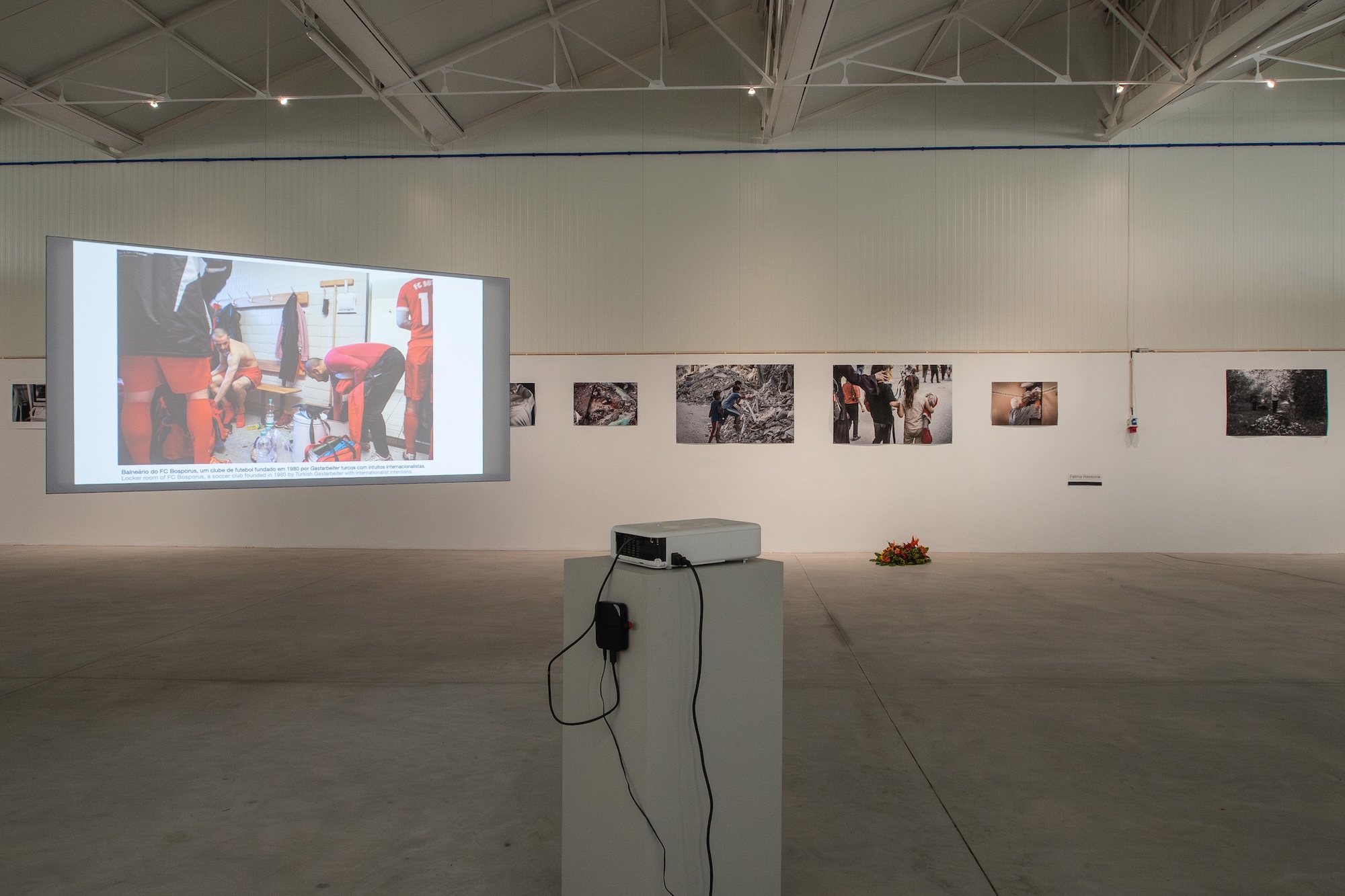
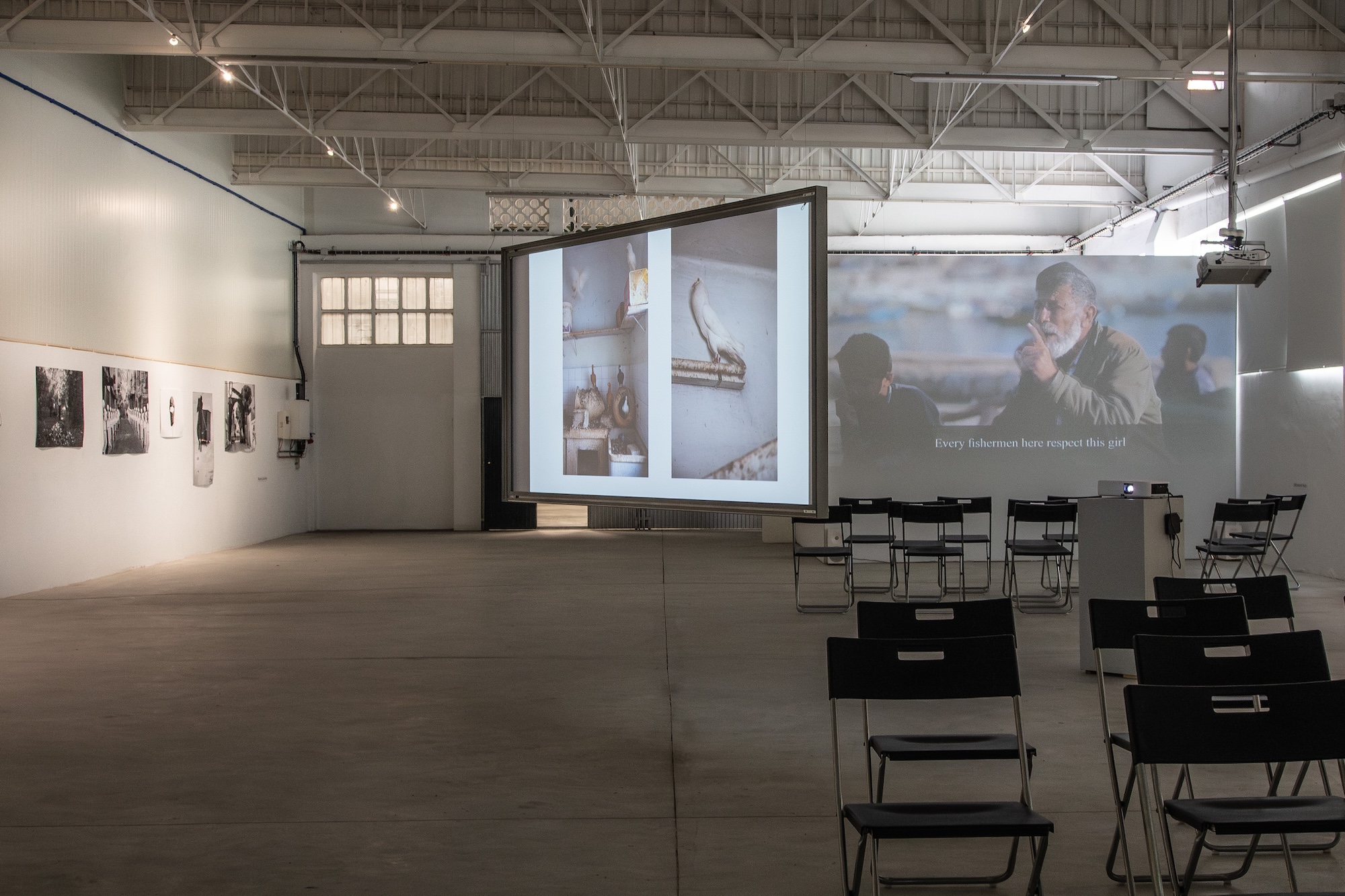
Madeleine is a Palestinian girl who, challenging social conventions, decided to start a life as a fisherwoman in order to provide for her family after the injury of her father in sequence of an attack by the Israeli sea patrol to his boat. The film, Broken Dreams, 2015, by Mohamed Harb, offers several insights into an oppressed, and oppressive in its own terms, society. From the gratuitous violence of powerful waterjets disrupting a fishing boat's working day, to Madeleine's complaint of the weight of her traditional clothing drenched in salt water that could have meant her demise after her boat has been capsized! The most immediate origin of the violence is the same but her position as a woman in a man's profession adds a remarkable level of courage that eventually propels acceptance from the man in the community. Mohamed Harb also shows a group of photographs in the exhibition The Artist’s Family and Studio (2023-25) that bear witness to the destruction of his studio by Israeli bombing. We can see some paintings still leaning against the wall, markers of an interruption from where there's no certainty to move forward in the future. In other photographs we see the present, his children painting, sheltered by the tents in which the family currently lives. That fragile intimacy is, nevertheless, evidence of a strength that points towards the possibility of a better future.
Rehaf Al Batniji a self-taught photographer and visual artist based in Gaza City with an international career, has, during 2023, recorded simple moments of the everyday life of her family with her mobile phone. They are exhibited under the suggestive title These Are Not Images. There is a background of war perceived in the silence of the images, a glimpse into small but meaningful gestures and moments that the use of colour enhances. And there is a drawing as image. It is a photographed drawing that alludes to the fragility of records in the life conditions in Gaza. What documents will survive to bear witness of a culture and the livelihood of a people?
Aref Massalha is a specialist nurse in Jerusalem. His photographs Floating in a Toxic Space, offer a poignant portrait of the struggle of care inside an ICU, intensive care unit. Made during the Covid period, and initially made as analogue photographs, the use of black and white amplifies a silent resilience contrasting with the reverberation of war and destruction that ravage through the Palestinian territory. The bodies in the pictures are suspended, deprived of motion, such as is the Palestinian people in its territory.
Monther Jawabreh use of montage generates fictional situations. These are perhaps the most symbolic works in the exhibition. The images combine photography and digital collage. In their attempt to represent absence, they speak of traces, of death and resistance.
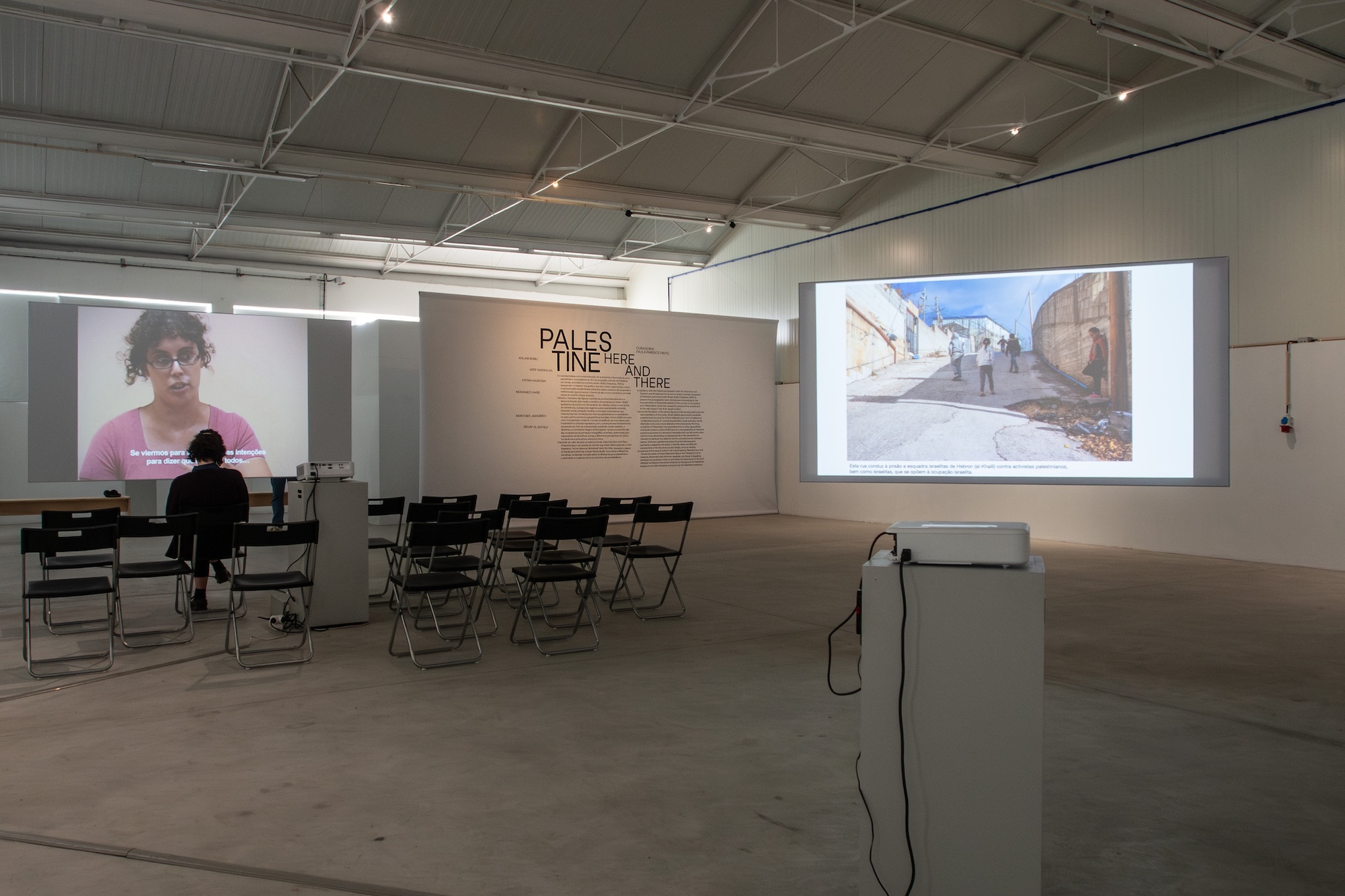
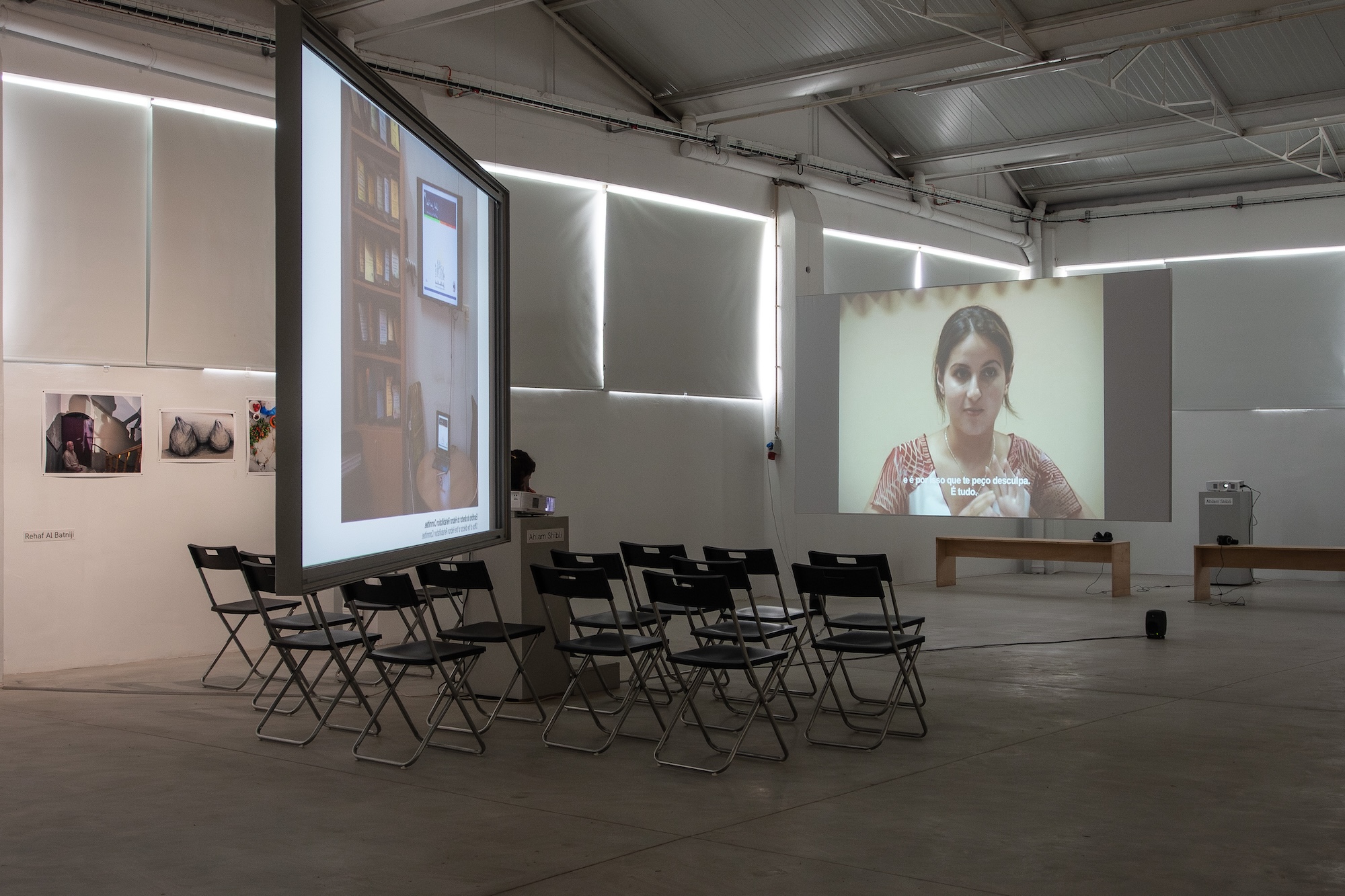
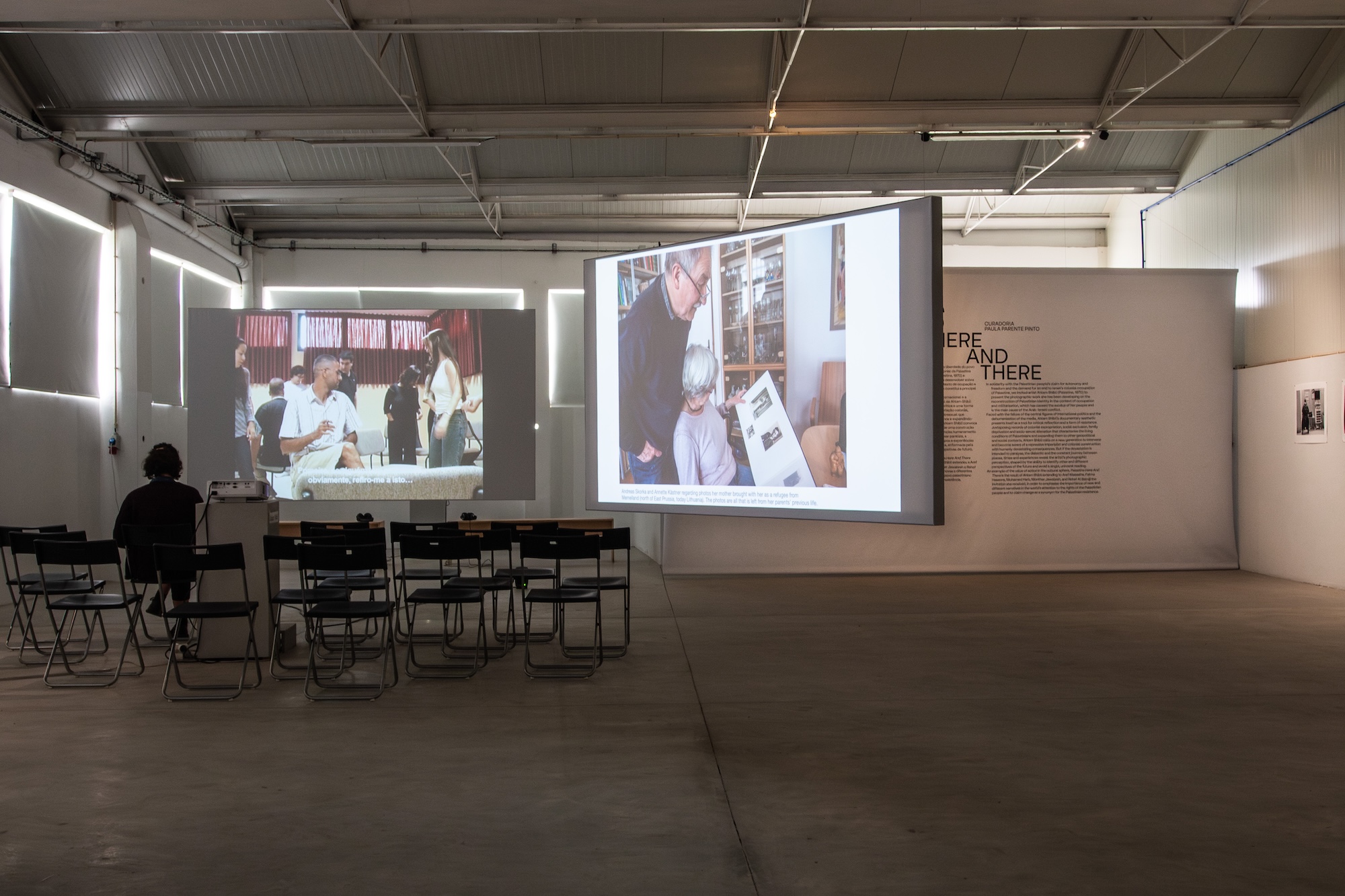
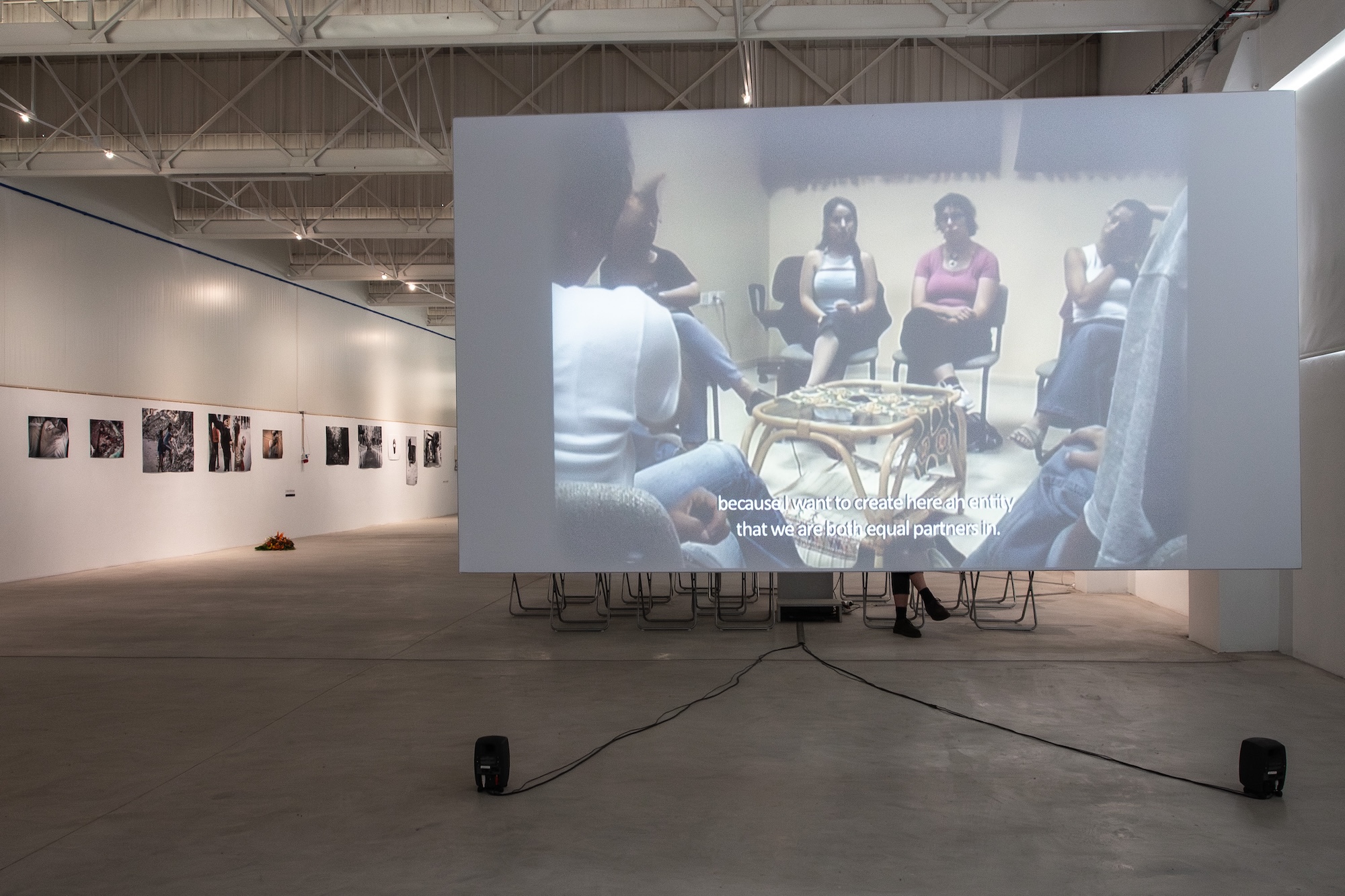
In her international career Ahlam Shibli has addressed the politics of documentary representation, particularly of the notions of home and belonging through video and photography. Besides a slide show entitled Staring developed from previous 2016-17 work, te artist is showing Nine Days in Wahat Al-Salam, 2010, a record of the mediated encounters between young Palestinians and Israelis. My first thought even before the film started was: what language will the group be speaking? And in fact the issue opened the debate underlying the preponderance of one of the languages over the other: Arabic was not understood by all. Isolated in their language Palestinians have to cross over to speak Hebrew. This is not a detail, it is the domination process becoming apparent. The dual condition of the territory is constantly evident, but the singularity of the identities of the participants leaves a sign of progress from prejudice that they all have to battle from in each culture and background. It becomes clear that when identity sinks into the question of loyalty rather than flourishing in coexistence, individual identities become trapped in fixed principles that do not correspond to they inner aspirations[3]. A question remains in the air: is it so terrible, a bi-national state? And from the comment one of the participants in reference to the 2003 attack we move to the present again. He says, and I loosely quote, that he does not want to name it genocide because if it gets worse he will not have a name to call it.
It is difficult to speak of Fatma Hassona's Daily Notes Under Bombing as the images confront us with a vulnerability that acts as a corroboration of the artist's disappearance. Her awareness of the dissemination of grief and the possibility of dying contrasts her lively commitement to documenting Gaza's daily life under siege. She was killed with her family having just been announced to be featured in a documentary in Cannes. I reproduce her voice in social media: “If I die, I want a loud death.” In her fight against the wiping out of evidence she left us with "timeless image(s) that cannot be buried by time or place.” Hassona was also involved in educational activities and programs to support women's voices and her disappearance is still being echoed around the world.
These artists often develop a broad and cross-disciplinary way of working, combining the roles of documentary photographers, painters or in general image-makers, with educational and socially commited roles. In the Western fast-moving, flexible economy, this multitasking is often seen as a response to the pressures of capitalism. But in a war-affected area, the pressure is of a different kind. It comes from a lack of support for the arts but, mainly, it is driven by the need to counteract the suppression of a culture.
The space of art must be a space of freedom. John Berger says of freedom that it does not exist without action. No other sentence could be so adequate to the reality of the world at the moment. Paraphrasing the author, the desire for freedom is not a desire to possess a given, but an aim to changing the conditions in which that given — freedom — does not exist in reality. Particularly this is the case for Palestinians, for whom a passage through prison or a continuous impediment of movement are part of daily life. The longing for a normal life becomes a fleeting flame in the horizon of immediate survival but it also fosters resilience and is fed by courage. I believe that the point is not about 'taking sides' but is about dignity because the value of human life is above sectarism. This is about the Palestinian people but not simply, this is about humanity.
By showing these works in its gallery, Rampa is inserting them into a conversation about the influence of photography in contemporary critical discourses and the motivation (and the reality) of the photographers to create their images. I cannot hope with this small text to contribute to interrogate the contemporary function of documentary photography, but, in view of the specific conditions in which these images were made, I ask: can we establish alternative frameworks for seeing, documenting, and comprehending the events and conditions that shape Palestinians reality and, in consequence, our unstable global realities?
This art is not symbolic, because through its relationship to conflict, modes of representation and reference to historical conditions, it aims at being instrumental in a sense that perhaps the Western tradition, although it may try to assimilate, does not truly accept at least without a concession to fiction. It is irrelevant if these practices are operating within the aestheticised space of art, what matters in fact is the revelations they bring to light in the face of the sophistication and resources in the exercise of power of a state committed to dismantle evidence of a culture and suppress those who bear witness to that suppression, such as Fatma Hassona. But as my own training taught me that that same aesthicised space has advocated for its own critique, and, so, I returned to 1995's Nina Felshin, Is it art? The spirit of art as activism[4] to confirm how much inefficient activist art has been along the years and to attempt to frame the consequences of this exhibition in a wider critical context of activism in order to strengthen these artists' agency [5].
There were two reasons for that inefficacy. One, activist art was inward looking as most of those practices were attempting to address problematic and important issues in society, but were then still not addressing issues outside a Western scope; and two, it somehow became institutionalized very quickly in the following decade. Today, it is no longer about dethroning formalism as it was in the 70's and 80's of last century, it is no longer about establishing a practice in a counter process to some previous aesthetic current. Today, the recognition of the imbalance of voices and means of representation in a society that manipulates the circulation of information, has made the art world aware of the importance of identifying and addressing the threats to freedom and human dignity. And this has been for sometime now a driving force within the art world.
Nina Felshin wrote then that activist art as a "cultural form, is the culmination of a democratic urge to give voice and visibility to the disenfranchised, and to connect art to a wider audience."[6] But this is a process that needs to be constantly revived because, as the late Okwi Enwezor declared, democracy is an open process, "a project under constant reinvention". And in face of a society that is mostly run by oligarchs to whom the educational, cultural and art worlds represent a threat, resistance becomes the only way to avoid caving in, because the manipulation of narratives (within agendas driven by economic interests, politics, religion or identity issues) by those interested in expanding their power, will also resist and attempt to prevail. Identity is normally forced to be something that it may not be if there would be no pressure from those agendas.
Activist art embodied over time an intersection of aesthetic and sociopolitical stances that wanted to interrogate, disrupt, or reconfigure the conventional boundaries and hierarchies imposed by dominant cultural narratives and power structures. But the power stances we are dealing with within the violence of the Israeli oppressive regime in Palestine are of a very different kind because they consistently act upon the whole livelihood of a people. There is no space for neutrality in the world of today, there is no space to find excuses for violence and domination. Post-colonialism seemed for the past decades to offer a place from where to speak of historical injustices, but, in an increasingly militarised world, too many colonial processes of domination and oppression are taking place.
And they are taking place within a generalized disempowered public mode that needs to be counteracted. Too many agendas are trying to frame unjustifiable events with identity and cultural markers. I once wrote that identity cannot be a means to frame and freeze cultural processes, much to the contrary, cultural processes move identities forward. I move on to say that identity (religious, cultural, territorial...) cannot be a means to justify violence and that a violence exerted over the culture of a people, its livelihood and everyday practices, will forcibly pressure their identity into increased resistance.
I finish this text with a question: if art is where our[7] fragility is exposed, isn’t it history where we have to find our humanity?
Gabriela Vaz-Pinheiro holds a Degree in Sculpture from the Faculty of Fine Arts, University of Porto, and a PhD by project at Chelsea College. Key Visiting Lecturer at Central St. Martins College of Art & Design, London, between 1998 and 2006. Her artistic work has been shown in varied contexts. Responsible for the Art and Architecture Programme for Guimarães 2012 European Capital of Culture, she has been producing curatorial work with several institutional collections and in diverse exhibition contexts. Her editorial work has also been continuous with several published books, texts in catalogues, as well as artist's books. Lectures since 2004, at the Fine Arts Faculty, University of Porto, where she is Integrated Member of i2ads, Research Institute in Art, Design and Society.
Notes:
[1] Berger is reporting a Palestinian mother's referring to the Israeli bullets: "For us (...) the silence of the West is worse (...) than their bullets." John Berger, Hold Everything Dear, Dispatches on Survival and Resistance, Verso, London & New York, (2007) 2025, p.8.
[2] For an account of the problems arising in dual identities see Amin Malouf, In the Name of Identity: Violence and the Need to Belong, Arcade, 2012. Translated from the French edition Les Identites Meurtrieres.
[3] Nina Felshin (ed.), Is it art? The spirit of art as activism, Bay Press, Seatle and Washington (1995) 2006.
[4] Felshin, p.10.
[5] See also Nicholas Mirzoeff, To See in the Dark, Palestine and Visual Activism Since October 7, Pluto Press, London & LA, 2025.
[6] And a final disclaimer. I very rarely use the pronoum WE/OURs to refer to lived experiences, increasingly and in this text, I concede in using it because I believe some form of collective cohesion (and responsibility) needs to be fostered in today's world.
[7] And a final disclaimer. I very rarely use the pronoum WE/OURs to refer to lived experiences, increasingly and in this text, I concede in using it because I believe some form of collective cohesion (and responsibility) needs to be fostered in today's world.
First image: Fatma Hassona, Untitled, from the series Daily Notes Under Bombing, Gaza, Palestine, 2023-25. Courtesy of the artist © Fatma Hassona.
Images: Palestine Here and There, exhibition views at Rampa, Porto, 2025. Photos: Cortesia de Rampa.