
Margarida Mendes in conversation with Taloi Havini
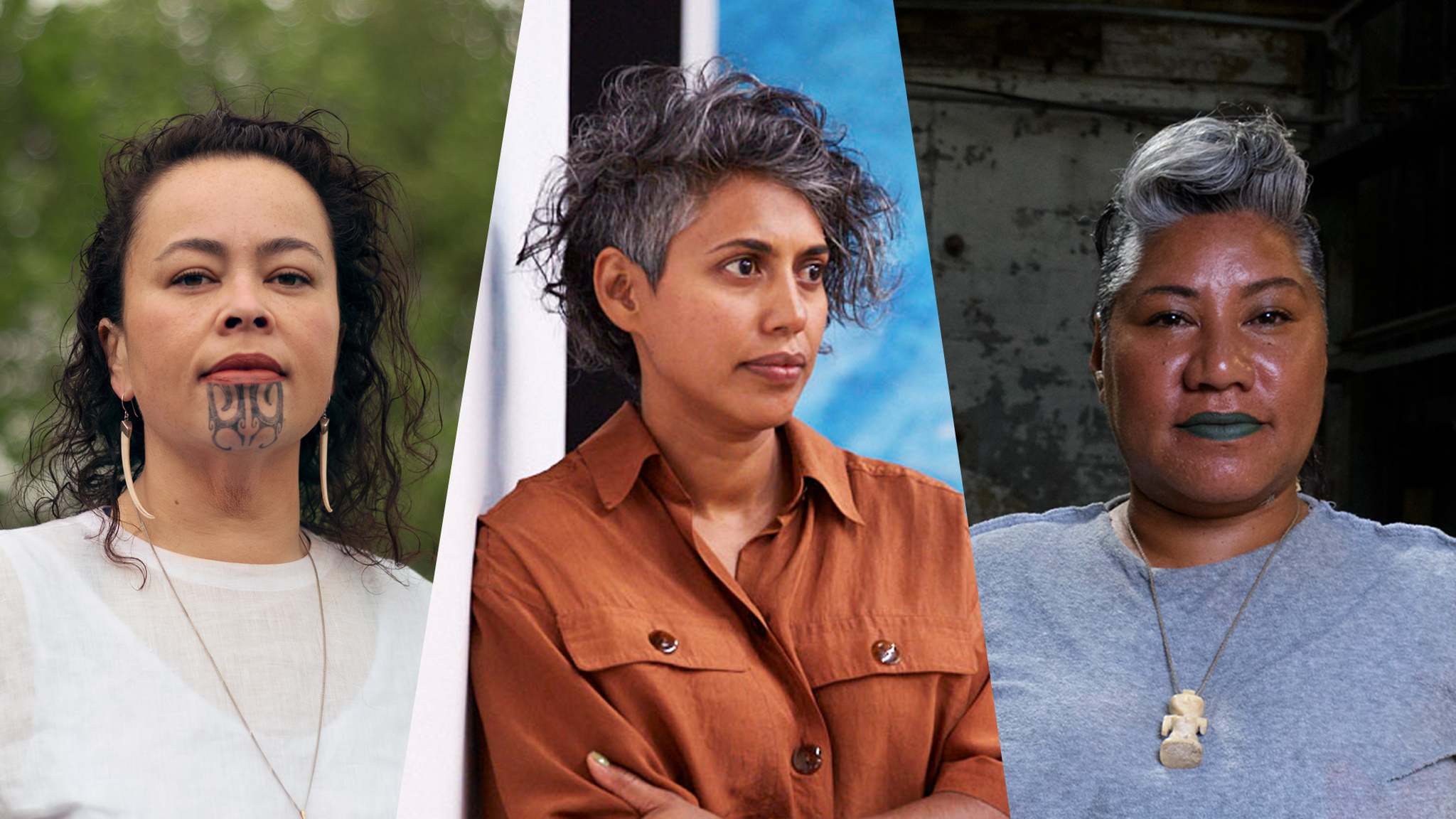
Displaying works by Indigenous practitioners from the Pacific Latai Taumoepeau and Elisapeta Hinemoa Heta, the exhibition Re-Stor(y)ing Oceania embraces the medium of the oratory, the song, genealogy, performance, and embodied knowledge as pivotal. It explores how ritual practices and communal spaces may reconnect one with a deeper sense of custodianship.
Margarida Mendes (MM): Can you speak about how this intention has shaped the exhibition's curation?
Taloi Havini (TH): Through the lens of two Indigenous women from Oceania, Latai Taumoepeau and Elisapeta Hinemoa Heta, I had the opportunity to reconnect with our Indigenous meanings of custodianship. I admire them for the knowledge and respect they each have for Oceania and their deep connections with their ancestral belief systems, and how this translates into preserving marine life for future generations. The intention was to include many more voices from the Pacific; and in some ways, this was achieved in an online capacity through the Ocean Uni titled Culturing the Deep Sea. During the April programmes, we held a two-day event with readings, reflections, and talks to discover the knowledge and worldviews of the Indigenous Oceanic people. The text selected for reading was INDIGENOUS PACIFIC ISLANDER ECO-LITERATURES, edited by Kathy Jetñil-Kijiner, Leora Kava, and Craig Santos Perez.
MM: The exhibition opens up performative, discursive, and poetic spaces that weave counter-colonial Oceanic perspectives through Pacific cosmological sharings. Its premise stems from the ancestral “call-and-response” method, which was also the originator of your previous exhibition at Ocean Space, where you held the installation Answer to the call. Could you tell us how this will to weave responses to Oceanic matters emerged?
TH: Being a landowner in the sense of being from the Oceania comes with a huge responsibility to care for and maintain our environment as best we can for our future generations. Oceanic perspectives vary greatly, as we are linguistically diverse across the “Pacific” region. Cultures who invest in their own relationships to the sacred nature and bodies of water will not harm but care for them as you would your own family. Oceania provided my ancestors with a vast open network of intersecting highways, and this knowledge passed down through song, chants, and in oratory practices. Call and response requires a form of deep listening, embodying intimate knowledge of a place—from understanding the changes in the seasons to studying the night skies that have guided us over expansive waters since time immemorial and continue to teach us in contemporary society, way-finding through space-time travel.
MM: Latai Taumoepeau’s installation Deep Communion sung in minor (ArchipelaGO, THIS IS NOT A DRILL) honours the ancient Tongan ceremonial practice of the Me’etu’upaki through a durational performance that takes place in an amphitheatre comprised of sound and standing paddle machines and is activated by different local communities. It is also a poetic gesture of resistance against deep-sea mining. How have anti-extractive gestures shaped your and Latai’s practices?
TH: Latai Taumoepeau centres her practice on her Tongan philosophies of relational vā (space and time). Across her practice, she makes visible the impact of the climate crisis in the Pacific, and what is most alarming for her are the threats to life from deep-sea mining. She is responding to the urgency of environmental actions needed to save Oceania.
Her work is concerned with deep-sea mining, which happens to be the most recent and alarming form of extraction being explored by multinational corporations and politicians who are placing immense economic pressures on the people of her homeland in the Kingdom of Tonga. This kind of extraction will cause irreversible damage to the marine life and have broader consequences. Such harm is in direct opposition to her ancient cultural obligations of keeping the cosmogony of her ancestors alive—keeping the sacred Kele (sea sediment) and Limu (seaweed) unharmed.
Facing the altar in Ocean Space, she orchestrated an amphitheatre where her artwork references congregational worship. Here, she invited the public to engage in a durational performance for her commissioned work Deep Communion sung in minor (ArchipelaGO, THIS IS NOT A DRILL), where groups powered the standing paddle machines (an audio chant would amplify) for Taumoepeau’s people’s ceremonial Me’etu’upaki. Months earlier, she had spent time on her island of Tonga communing and recording the many spiritual and ritualistic practices through faiva (body-centred) durational performances of her people. The underlying message is that their teamwork contributes to the resistance against deep-sea mining (DSM). Taumoepeau asks: who is willing to do the labour in this exercise of ecological responsibility?
MM: Elisapeta Hinemoa Heta’s architectural installation The Body of Wainuiātea conveys a space where Indigenous women's stories may be shared, as one seeks balance in relationships with both human worlds and the environment. The dimensions of storytelling and place-making make a crucial intersection here. Can you share some thoughts about the artist’s intention?
TH: Elisapeta Heta’s ancestral lineage includes Ngātiwai, Ngāpuhi, Waikato Tainui, Sāmoan, Tokelauan—her kin are her greatest support, and she collaborates with her family and community to make Māori and Pasifika stories visible, many of which have been hidden by colonisation. The Body of Wainuiātea is a beautiful structural installation that embodies ritual and ceremony by re-establishing a sense of tapu (sacredness) to Oceania. In the same way that the people of Venice used to enter San Lorenzo for spiritual guidance through religious ritual, here Elisapeta’s intention for Ocean Space (a contemporary art organisation dedicated to Ocean literacy) was to invite and remind the public that this transformation of the human experience is even more relevant today.
The installation is composed of a karanga (Māori women's spiritual call), gourds, sensual coconut oil fragrance, timber, bricks, textile, and stainless steel. Earthen bricks are laid in a formation speaking to ancient ceremonial sites for acknowledging atua (gods). It symbolises a place for stillness and reflection, and when activated, it commands respect for the Ātea (Polynesian cosmology). The ritual component comprises sixteen charcoal wooden seats that are placed in a circle to represent the cardinal directions, these lay on top a rather large, low-lying earthen brick semi-enclosed platform. For many Pacific Islanders, stone and rock formations are signifiers of sacred sites and remain a deeply spiritual connection for Islanders all over Oceania. Above are twelve rolling folds of fabric that honour Ranginui/Rangi/Lagi and the twelve levels of the heavens. Guided by the Māori concepts of kawa and tikanga from Aotearoa New Zealand, a karanga (a Māori women's spiritual call) is amplified daily in the exhibition. It is played in the morning (11 am), when the exhibition opens, and again in the afternoon (6 pm), when the exhibition closes.
MM: Poetic activism emerges as a powerful operative tool to defend Indigenous points of view, gathering practitioners from across the Pacific region. May you share how this has infused the practices of both Latai, and Elisapeta?
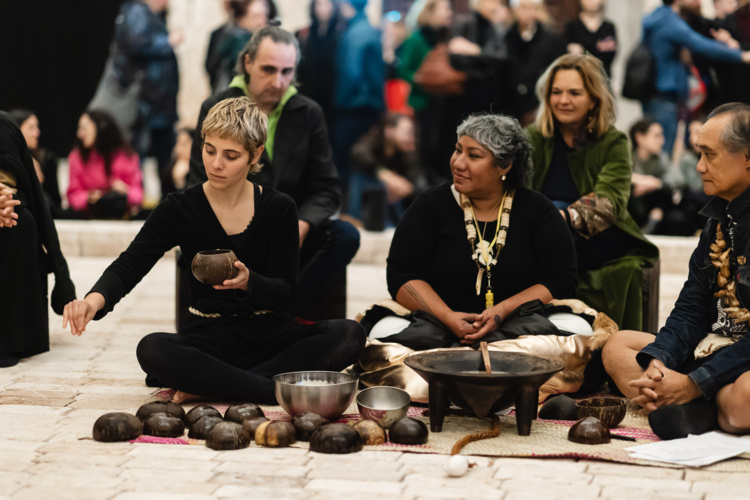
TH: Re-Stor(y)ing Oceania led to many exchanges over the course of the exhibition, and especially for the opening programmes in March. Latai and I were in Venice installing, and Elisapeta was at home as she had just birthed a beautiful new-born baby. Her collaborator, esteemed Dr. Albert Refiti, attended on her behalf. We were all so grateful to have his presence to lead us in a traditional ritual. The Kava ceremony involved participants from the Venice public sitting in the alofisā, or circle of chiefs, where the kava is prepared and served in the tanoa, a carved wooden bowl, by a ritual person called the tou’a or taupou. An orator, who is a ritual specialist, announces and acknowledges those gathered, including the land and ancestors of the place where the ceremony takes place. Then, each participant in the circle is served a cup and is invited to dedicate their portion to a deity, ancestor, or place of worship before the kava is drunk. The ritual appoints those sitting in the circle as conduits for ancestors and other beings to participate in events in the present—the deep past and the present co-mingle in the ceremony.
Honouring the ancient ceremonial practice of the Me’etu’upaki ritual, Latai’s sister, Oceanic Orator Songwoman Sēini "SistaNative" Taumoepeau, joined us in an invocation seeking guidance towards the collective care and protection of Moana (Oceania). Sēini SistaNative awakens the voices of the deep-sea sediment. Sadly, she passed away after returning from Venice. My island sister’s last performance coincided with the Venice Biennale opening of Re-Stor(y)ing Oceania, titled LOTU: kumi Hina (translated as PRAY/ER: seeking Hina). She collaborated with Saia Tu’itahi, who played the Fangu Fangu (Tongan Noseflute). They created Song Ceremony: An Art of Socio-Spatial Activation in reverence to the Tongan Deity Hea Moana ‘Uli’uli, whose realm is comprised of the deepest and darkest mysterious parts of our Great Ocean. Our currents connect us—Light in the mysterious Dark—where no humans go. LOTU is a call-to-action Prayer, chanted to kumi HINA, the magnetic divine white light of Māhina Moon with her pull, push, counter currents in the Dark Oceanic depths where bioluminescent creatures live. Hina also appears as a giant Great White Shark of the Ocean depths or a coastal Divine Feminine Island Woman of the Reef.
Margarida Mendes is a curator and investigator. Her research — with a focus in the environmental humanities, experimental film and sound art — exploring the dynamic transformations of the environment and it's impact in social structures and in the field of cultural production. Integrated the curatiorial team of the 11th Gwangju Biennale "The 8th Climate (What Does Art Do?)", 4th Istanbul Design Biennial "A School of Schools", and 11th Liverpool Biennale "The Stomach and the Port". Consultant of environmental ONGs that work on the mining on the deep ocean, and worked with various educational platforms like escuelita, an unformal school in Centro de Arte Dos de Mayo - CA2M, Madrid (2017); The project space The Barber Shop in Lisbon, dedicated to transdiciplinary research (2009-16); and the curatorial research platform on ecology The World In Which We Occur/Matter in Flux (2014-18). Margarida Mendes holds a PhD in the Centre for Research Architecture, Visual Cultures Department, Goldsmiths University of London.
Proofreading: Diogo Montenegro
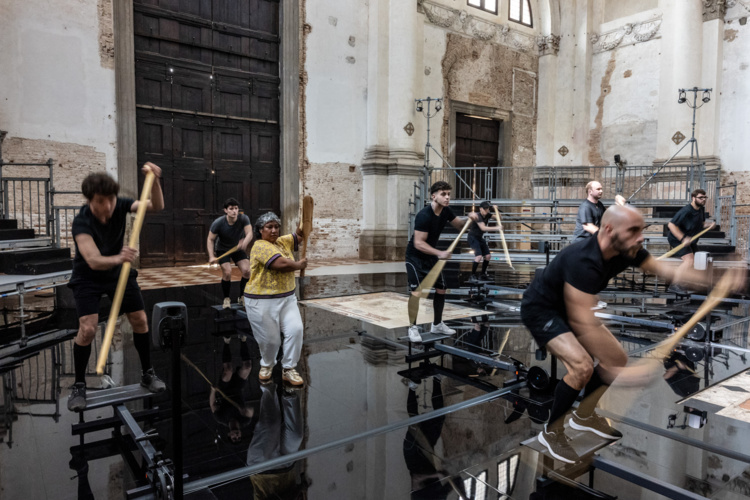
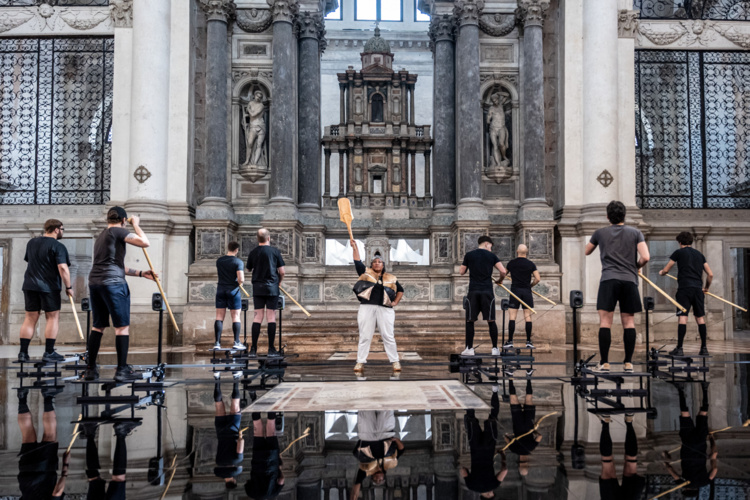
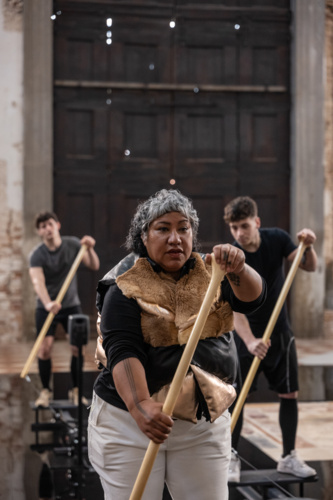
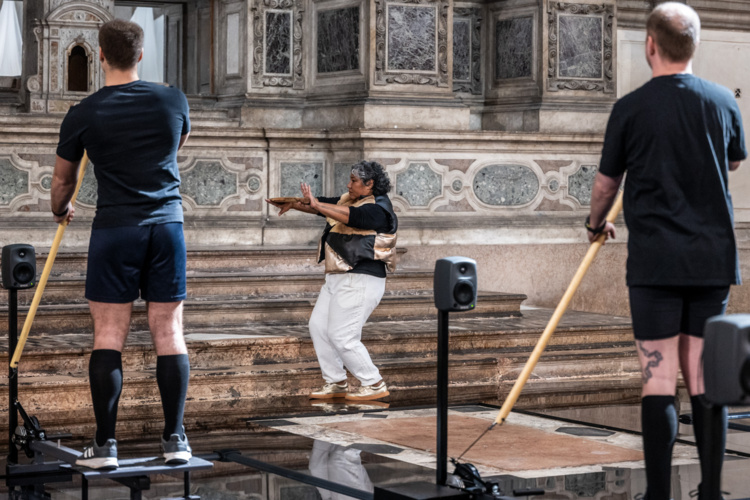
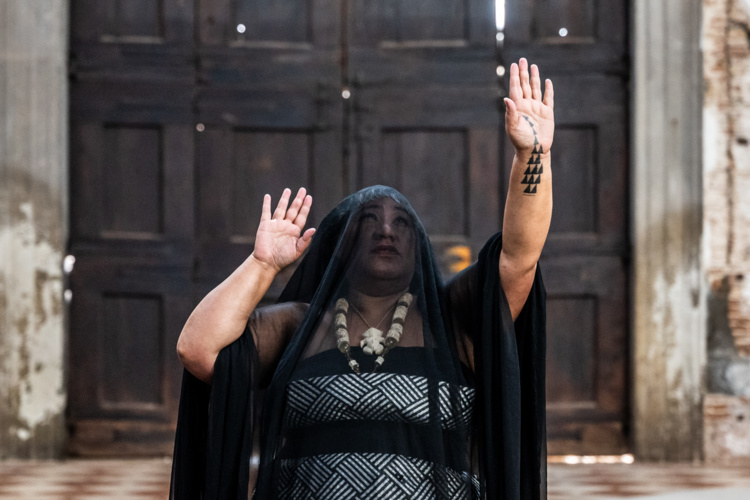
Latai Taumoepeau, “Deep Communion sung in minor (ArchipelaGO, THIS IS NOT A DRILL)”, 2024. Exhibition view of “Re-Stor(y)ing Oceania”, Ocean Space, Venice. Co-commissioned by TBA21–Academy and Artspace, and produced in partnership with OGR Torino. Photo: Giacomo Cosua
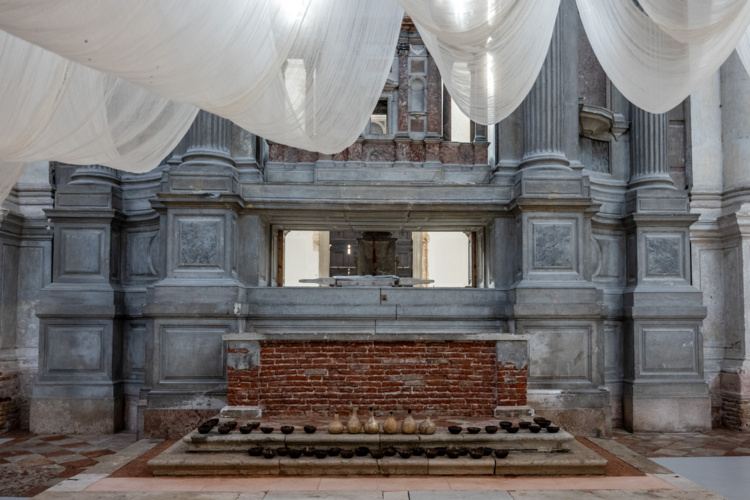
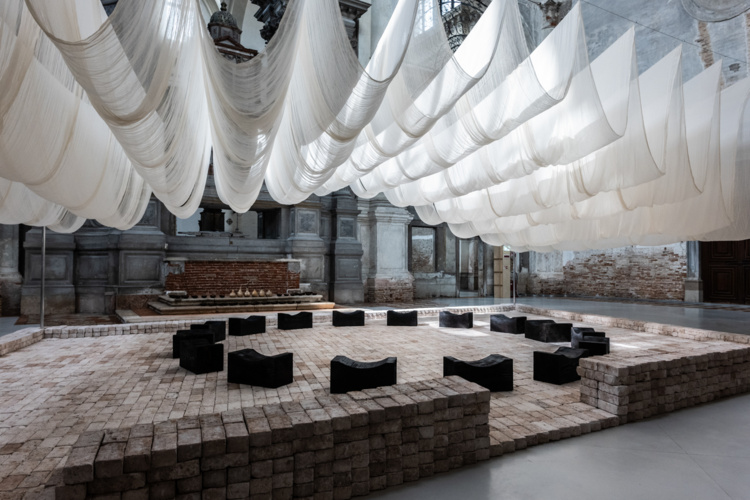
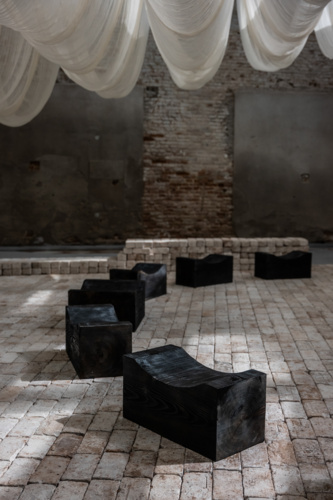

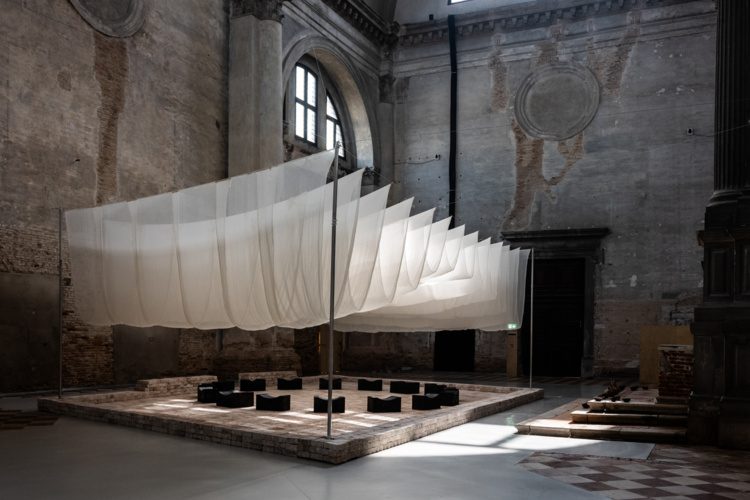
Elisapeta Hinemoa Heta, “The Body of Wainuiātea”, 2024. Exhibition view of “Re-Stor(y)ing Oceania”, Ocean Space, Venice. Co-commissioned by TBA21–Academy and Artspace, and produced in partnership with OGR Torino. Photo: Giacomo Cosua
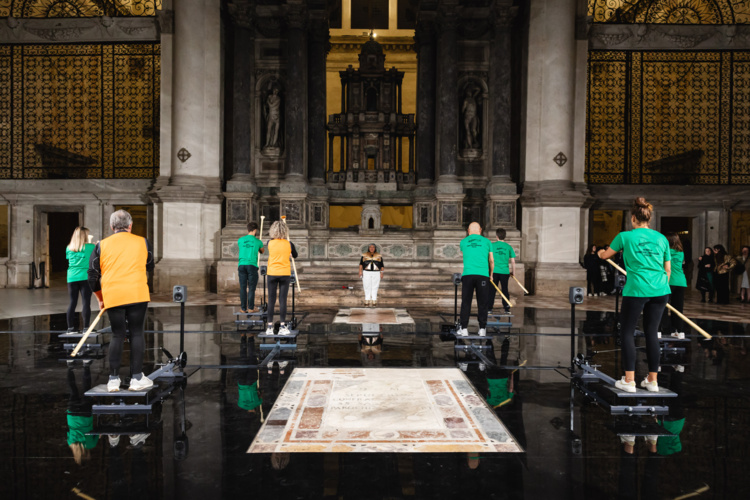
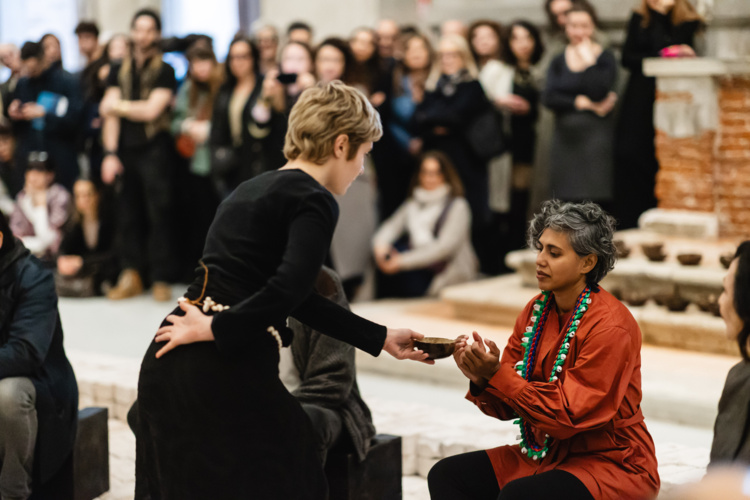
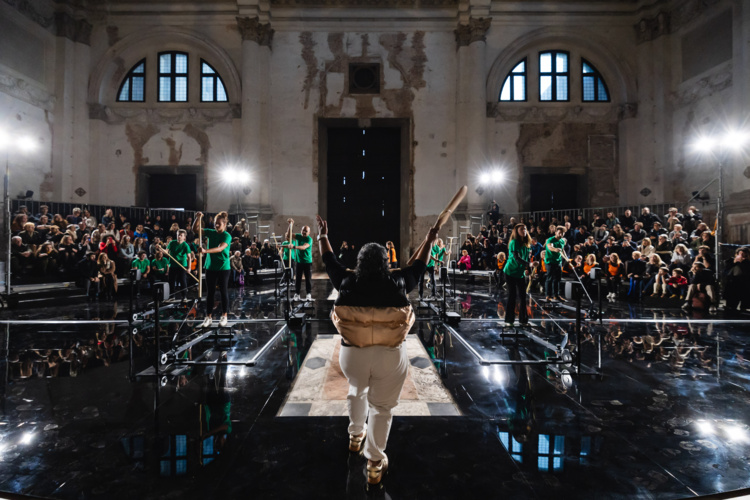
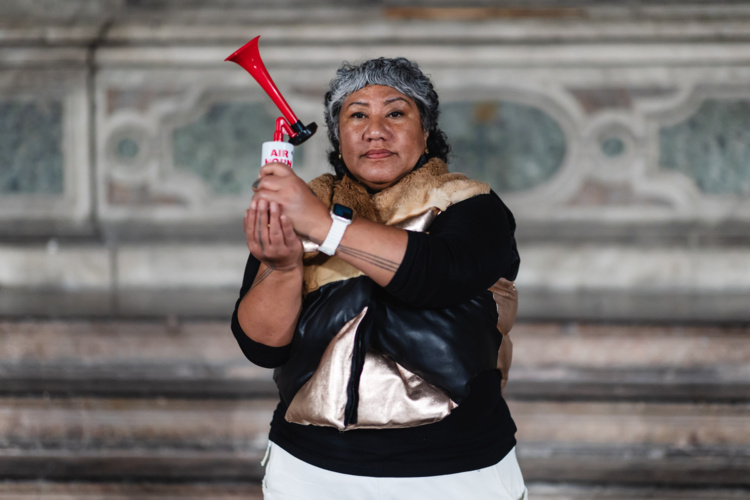
1-2-3: Latai Taumoepeau, “THIS IS NOT A DRILL”, 2024. Durational performance part of the exhibition “Re-Stor(y)ing Oceania”, Ocean Space, Venice. Co-commissioned by TBA21–Academy and Artspace, and produced in partnership with OGR Torino. Photo: Nicolò Miana
4-5: Elisapeta Hinemoa Heta, “The Body of Wainuiātea”, 2024. Cerimonial performance part of the exhibition “Re-Stor(y)ing Oceania”, Ocean Space, Venice. Co-commissioned by TBA21–Academy and Artspace, and produced in partnership with OGR Torino. Photo: Nicolò Miana