
Tony Cokes: Testament E: MF.slow.cancel.2014
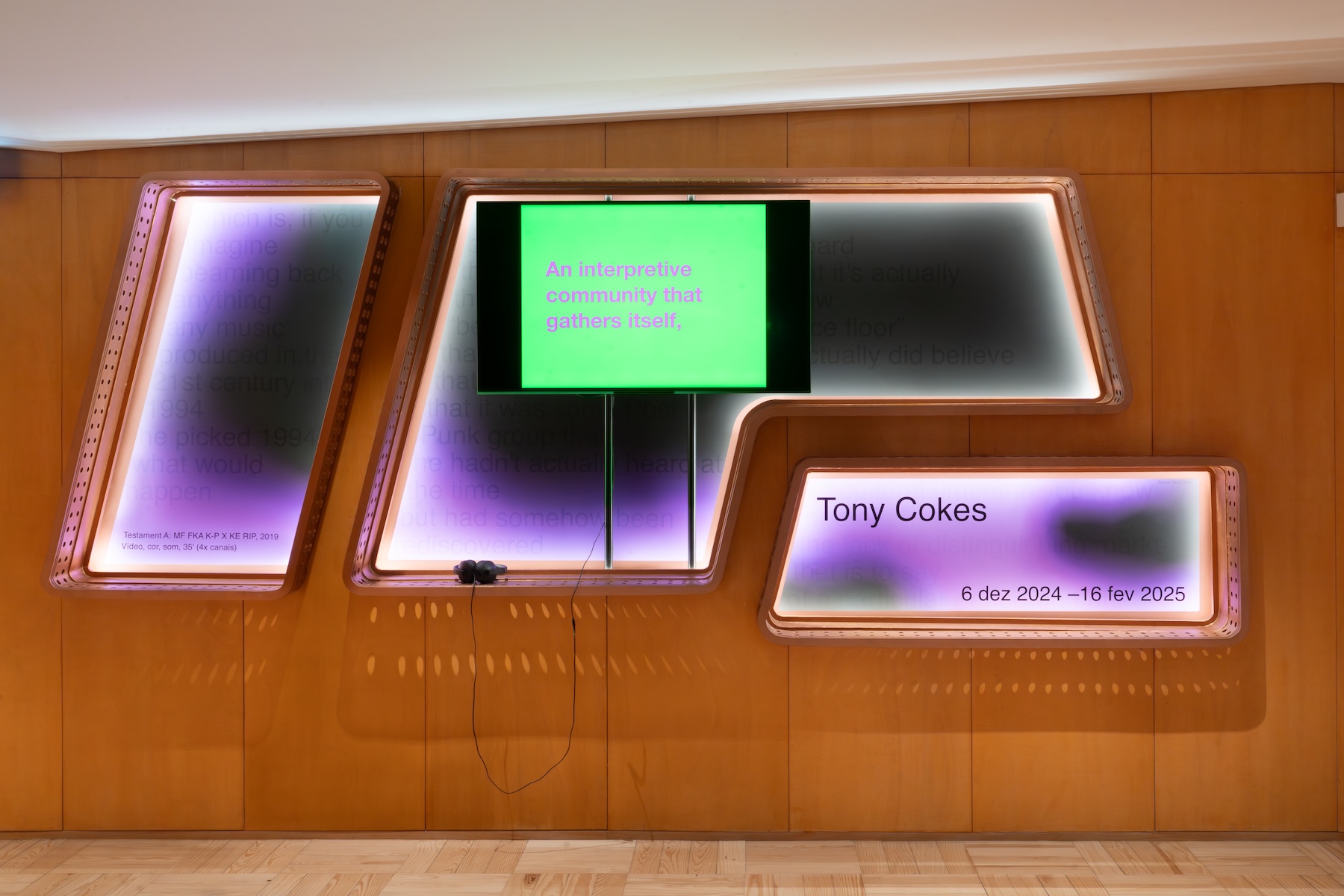
The video essays of American artist Tony Cokes (1956, Richmond, Virginia) frequently unfold through a self-reflexive movement, stripping film down to its essential components—text, sound, and image—to subvert cinematic codes and interrogate the political and ideological complexities disseminated by contemporary media. This process of reduction, rather than merely subtracting, engages in an act of regrouping or redoing—that is, reassembling disjunctive elements into a new critical order of repositioning through fragmentation. It is within this self-referential tension that Testament E: MF.slow.cancel.2014, Cokes’s first solo exhibition in Portugal, curated by Guilherme Blanc at Batalha Centro de Cinema (Porto), takes shape, featuring a new commissioned work alongside other key videos from the artist’s oeuvre.
Since the late 1990s, Cokes has developed a distinctive intertextual body of work, creating video essays that appropriate fragments from academic, philosophical, and journalistic texts, as well as from popular culture, which are superimposed on monochrome backgrounds and paired with soundtracks spanning soul, hip-hop, punk, and techno. This unconventional disjunctive dynamism—blending, for instance, philosophical writings with techno—generates new modes of reading, listening, and viewing, with the resulting trans-discursive, bodily experience focusing on issues such as pop media culture, structural racism, capitalism, consumerism, gentrification, and other systems of power. By complexifying the vastly mediatised, commodified values of text, sound, and image, Cokes’s juxtapositions openly prompt viewers to reposition and redeploy their intellectual and emotional interpretations.
Tony Cokes's video essays establish a discursive space where the private intimacy of reading transforms into an openly communal action. His work imposes two concurrent experiential layers: just as the viewer cannot control film time, the reader has no command over the recursiveness of reading. And beyond this intersection of elusive temporalities, while both reading and film viewing typically demand bodily inactivity, here they foster experiences which invite free movement within the space.
As such, by challenging the regimes of the visible and the sayable to dismantle the visual subjugation inherent in contemporary culture (whilst acknowledging that the written word is also visual), Cokes employs text instead of representative imagery as a spark for exploring alternative imaginative visualities. This methodology allows him to displace and recontextualise texts from a diverse array of authors (ranging polyphonically from Aretha Franklin, Louis Althusser, and Malcolm X to Public Enemy, Mark Fisher, James Baldwin, Édouard Glissant, and William Burroughs) within a multimedia framework, thereby generating a fragmented totality where elements of text, colour, and sound coalesce into new meanings. Whereas music often reflects social transformation, the body is a political agent that produces emotions, critical thoughts, and relationships; and in this sense, Cokes's work seems to critique the relationship between these devices and the commodification and categorisation of pop culture while simultaneously exploring how the latter might open up new political and social possibilities. Built from these diverse, seemingly discordant layers, his film essays thus find coherence in their dissonance, inviting deeper critical reflections.
Some of the artist’s films directly address musical heritage, such as the video installation Mikrohaus, or the black atlantic? (2006–2008), presented in Foyer 2 of Batalha Centro de Cinema. In this work, Cokes draws on the writings of music critic Philip Sherburne, who coined the term “microhouse,” to trace connections between European minimal techno and its roots in Afro-American musical traditions, such as Detroit house and soul. Blending interviews with German techno/house producers and techno artists, the video essay also incorporates excerpts from The Black Atlantic: Modernity and Double Consciousness (1993) by British cultural theorist Paul Gilroy, raising questions about the history of minimalist electronic music and its affinities with socio-political power.
On the other hand, the video installation SM BNGRZ 1 + 2 (2021), displayed in the Film-Room, examines the significance of community spaces of resistance and liberation tied to club and rave culture. Deploying references to the academic works of Jeremy Gilbert and Ewan Pearson to trace the transatlantic evolutionf of dance music back to its roots within the history of social oppression through, Cokes questions the potential loss of these liberatory, resistant, pleasurable spaces in the post-pandemic era.
The titular film installation of the exhibition, specifically conceived for Batalha Centro de Cinema, is Testament E: MF.slow.cancel.2014 (2024). Shown in Foyer 2, the video stems from a 2014 lecture by writer, critic, cultural theorist, Marxist philosopher, and professor Mark Fisher at MaMA Zagreb. It probes “the cyclical nature of 21st-century pop music and the malaise of the current time in contemporary culture,”[1] unfolding into a reflection on cultural shifts and continuities over the past decade. Fisher’s influence also manifests in Testament A: MF FKA K-P X KE RIP (2019), displayed in Foyer 1, which draws on Kodwo Eshun’s elegiac text from the Mark Fisher Memorial Lecture, delivered at Goldsmiths University in 2018, a year after Fisher’s passing, thus extending his legacy in examining capitalism’s impact on artistic and pop culture.
Tony Cokes’s persistent meditation on 20th- and 21st-century history approaches recurring echoes across different eras in a non-linear fashion. Building on this line of thought, one of his seminal films, Black Celebration (A Rebellion Against the Commodity) (1988), shown in the Film-Room, depicts urban riots in Black neighbourhoods during the 1960s. Using footage from television news reports on protests in Watts, Boston, Newark, and Detroit, Cokes, however, replaces the original commentary with appropriated texts by cultural theorist Guy Debord, artist Barbara Kruger, and musician Martin Gore, alongside industrial music by Skinny Puppy. With this, the artist manipulates the official narrative, exhibiting an alternative way of reframing these events as rebellions against racial and economic injustice in the United States.
Anchored in a discursive friction between diverse cultural vehicles and dynamics, Cokes’s essayistic structure consistently reveals how certain systems of power structurally reverberate across historical periods. His polysemous messages aim to expand expressive and imaginative possibilities, thereby paving the way for potential alternative futures.
Sara Castelo Branco [1989, Porto]. She holds a PhD in Arts et Sciences d’Art and Communication Sciences from Université Paris 1 — Panthéon Sorbonne [Paris] and Universidade Nova de Lisboa [Lisbon], while holding a scholarship from FCT. Researcher at ICNOVA — Culture, Mediation and Arts [FCSH-UNL]. In 2022, created Solarity Prospects.He has curated exhibitions and experimental film series such as Back of My Hand [Carpintarias São Lázaro, Lisbon, 2022], Blinding Light [CRIPTA 474, Turin, 2021], To Film With One Hand My Other Hand [Galeria Zé dos Bois, Lisbon, 2021], Under the Ground [Galerias Municipais de Lisboa, Lisbon, 2020] Off Nature [Arsenal — Institut für Film und Videokunst, Berlin, 2019]. He has a master's degree in Artistic Studies — Theory and Criticism of Art from the Faculty of Fine Arts of the University of Porto, and a degree in Communication and Cultural Sciences from the Lusófona University of Porto [ULP]. In the area of research and criticism on contemporary Portuguese art, he regularly contributes articles and essays to magazines and catalogues.
Translation PT-EN: Diogo Montenegro.
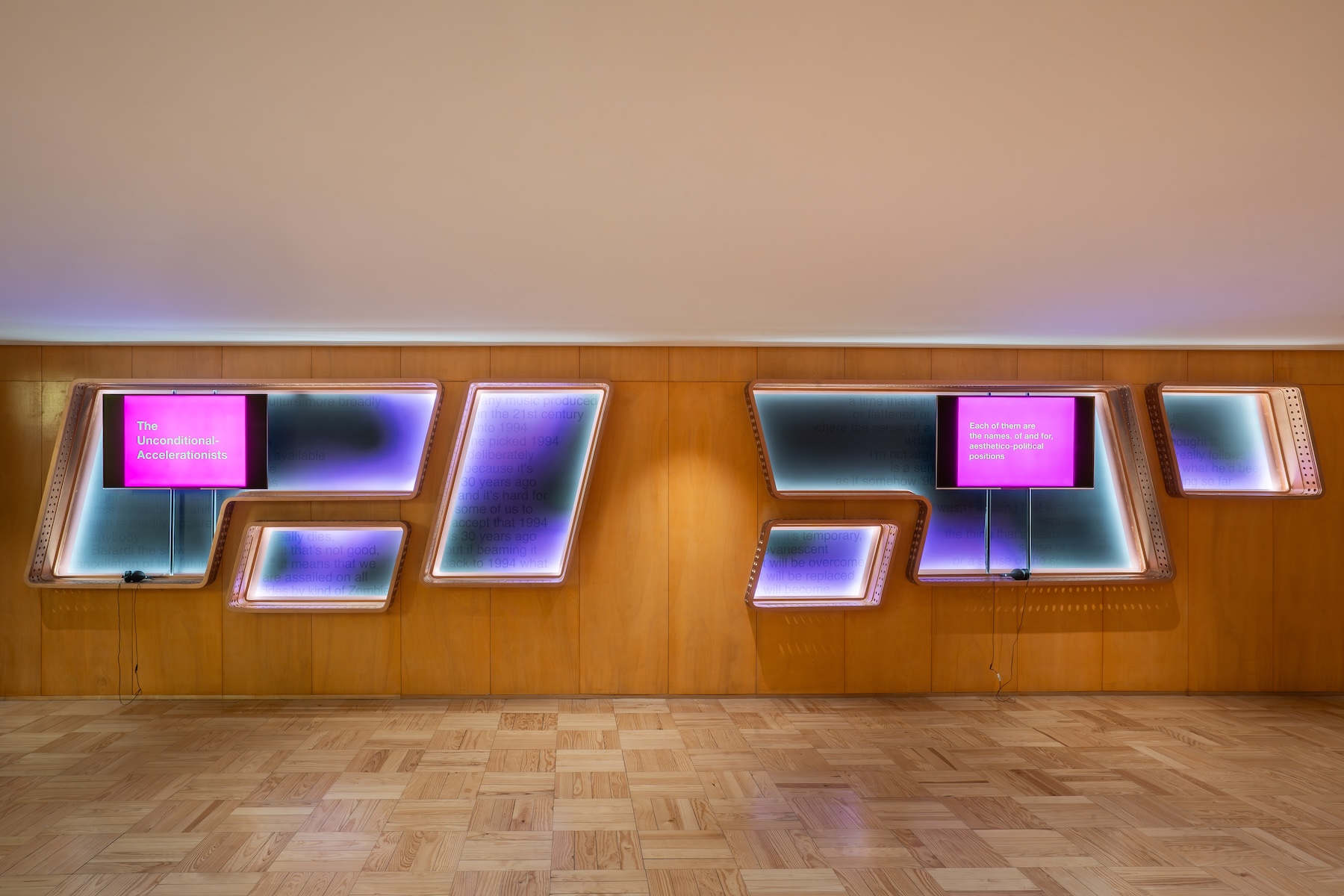
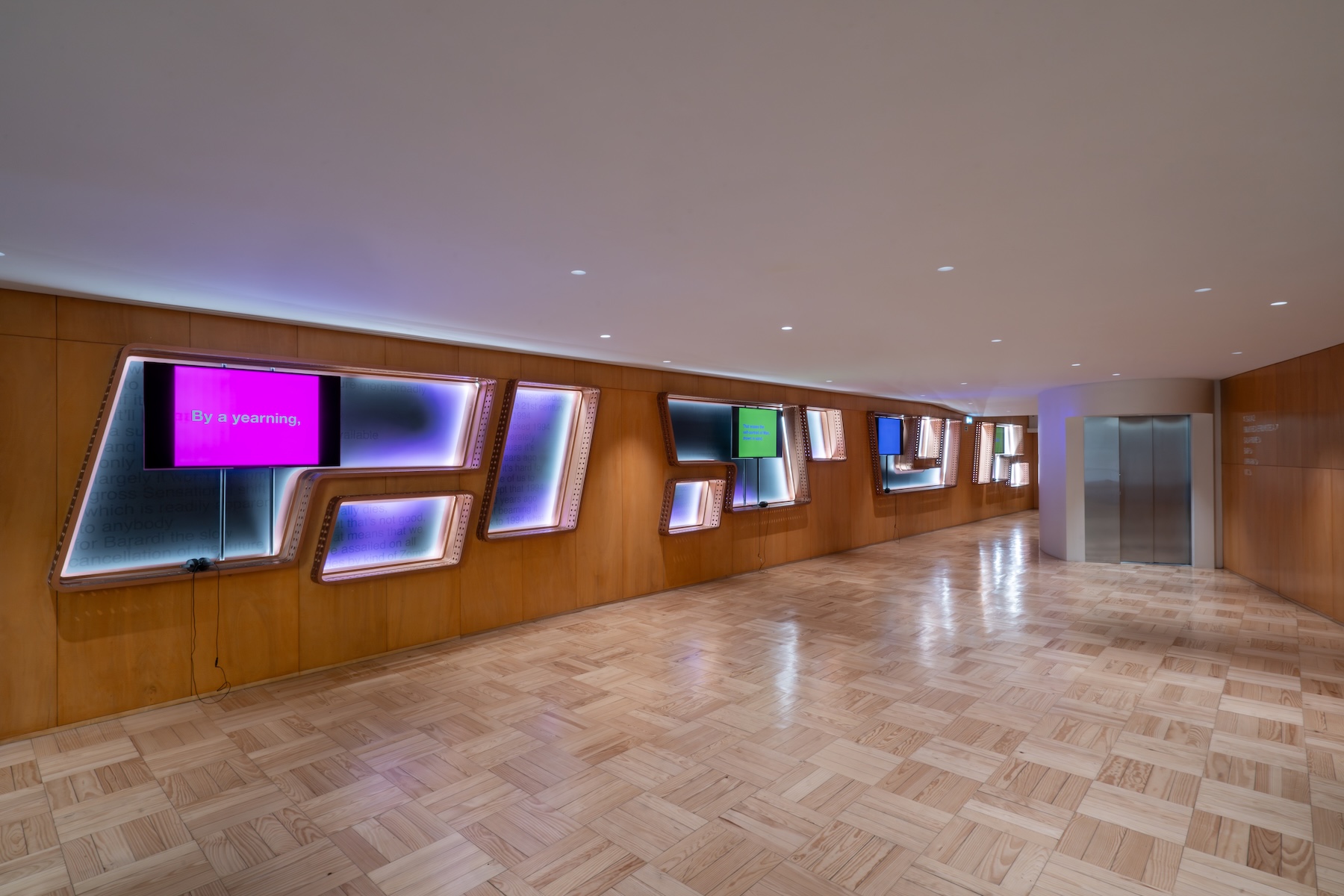
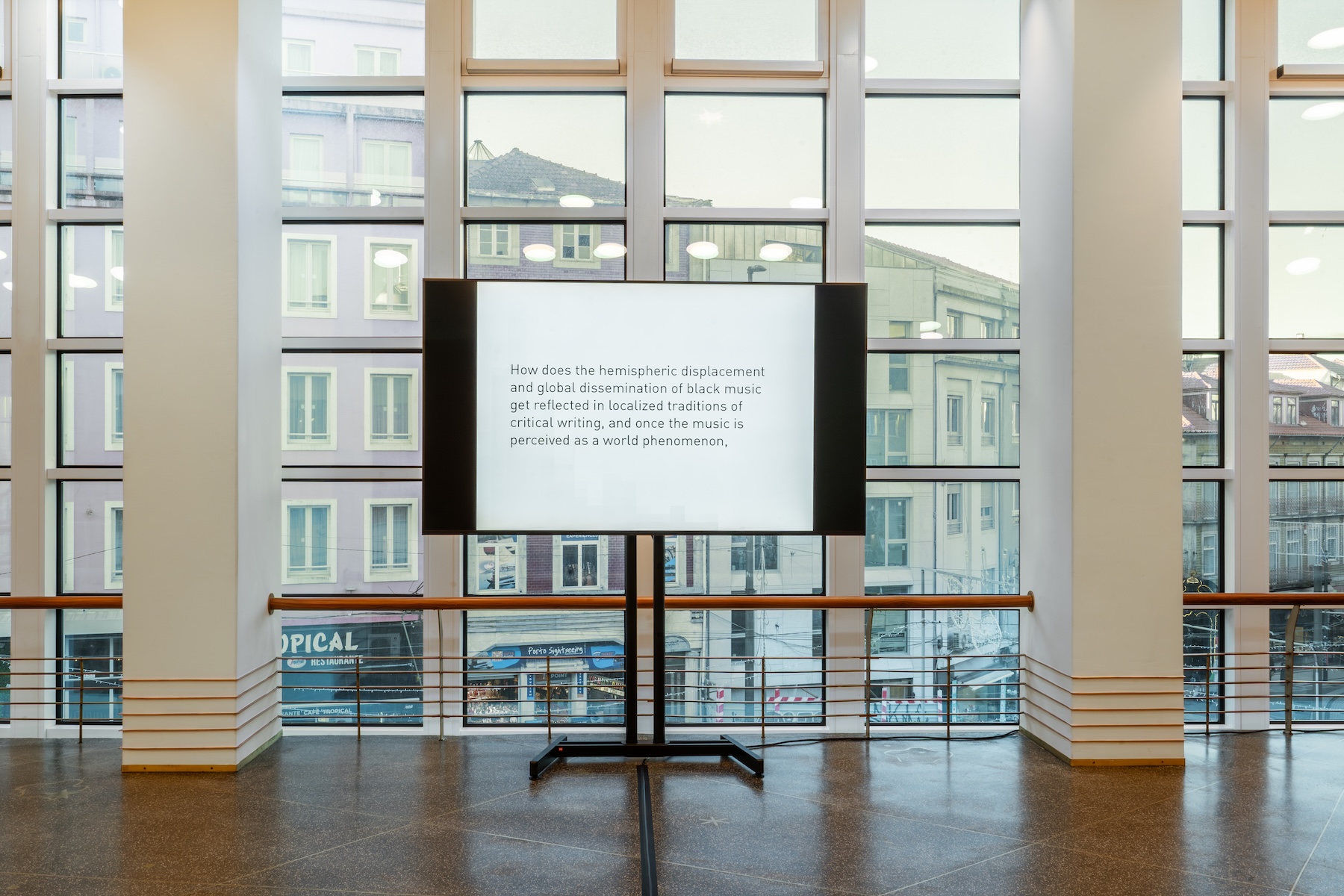
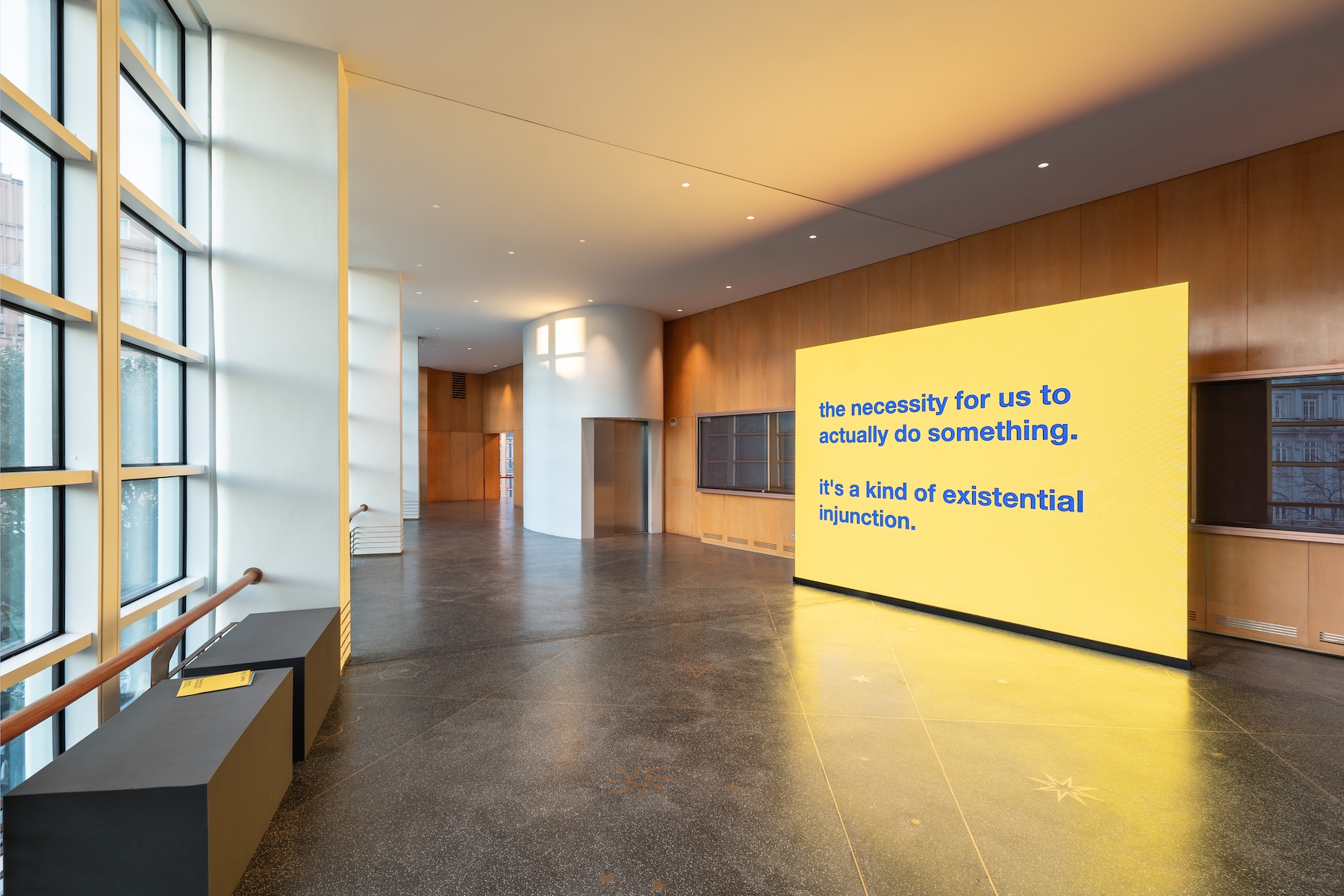
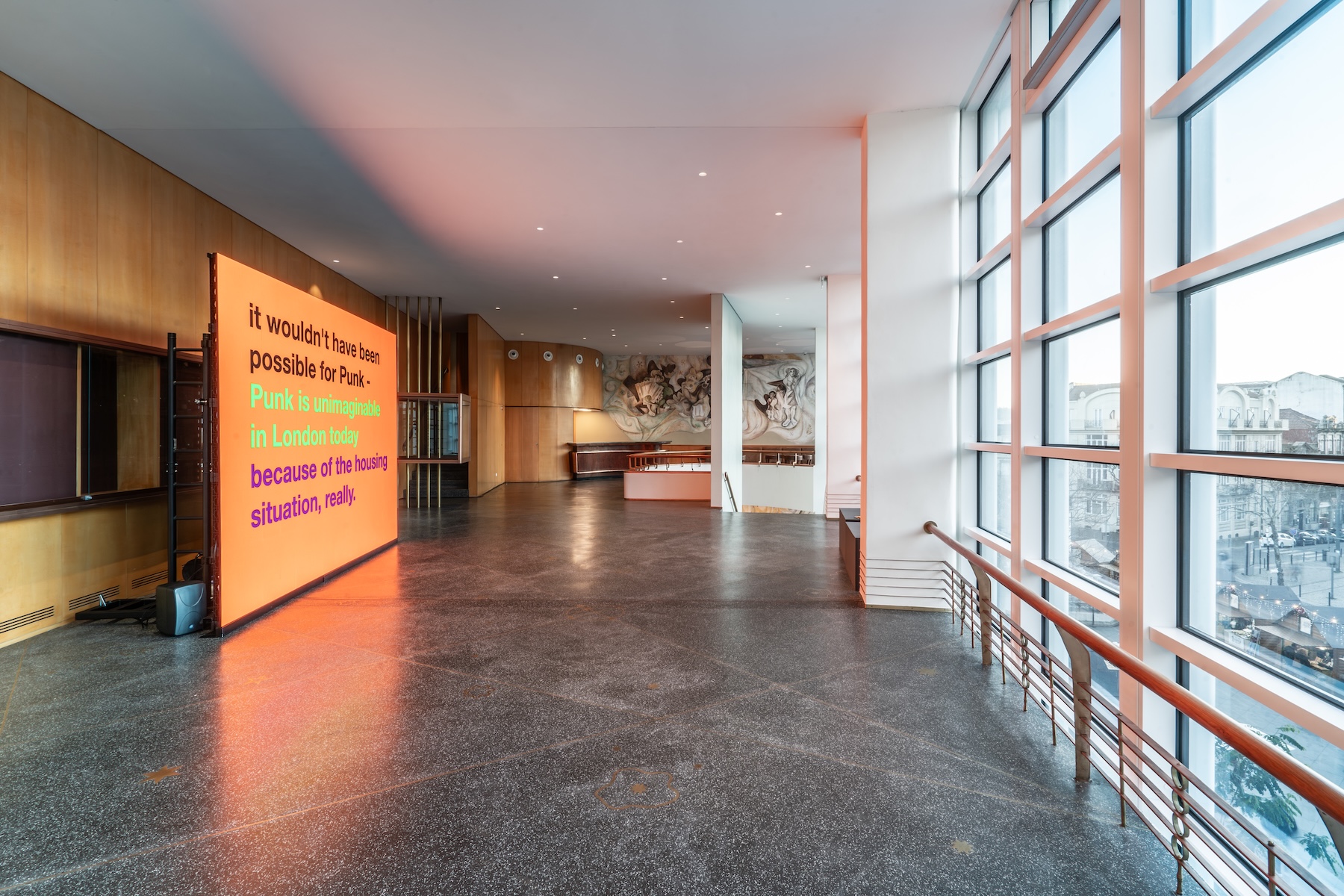
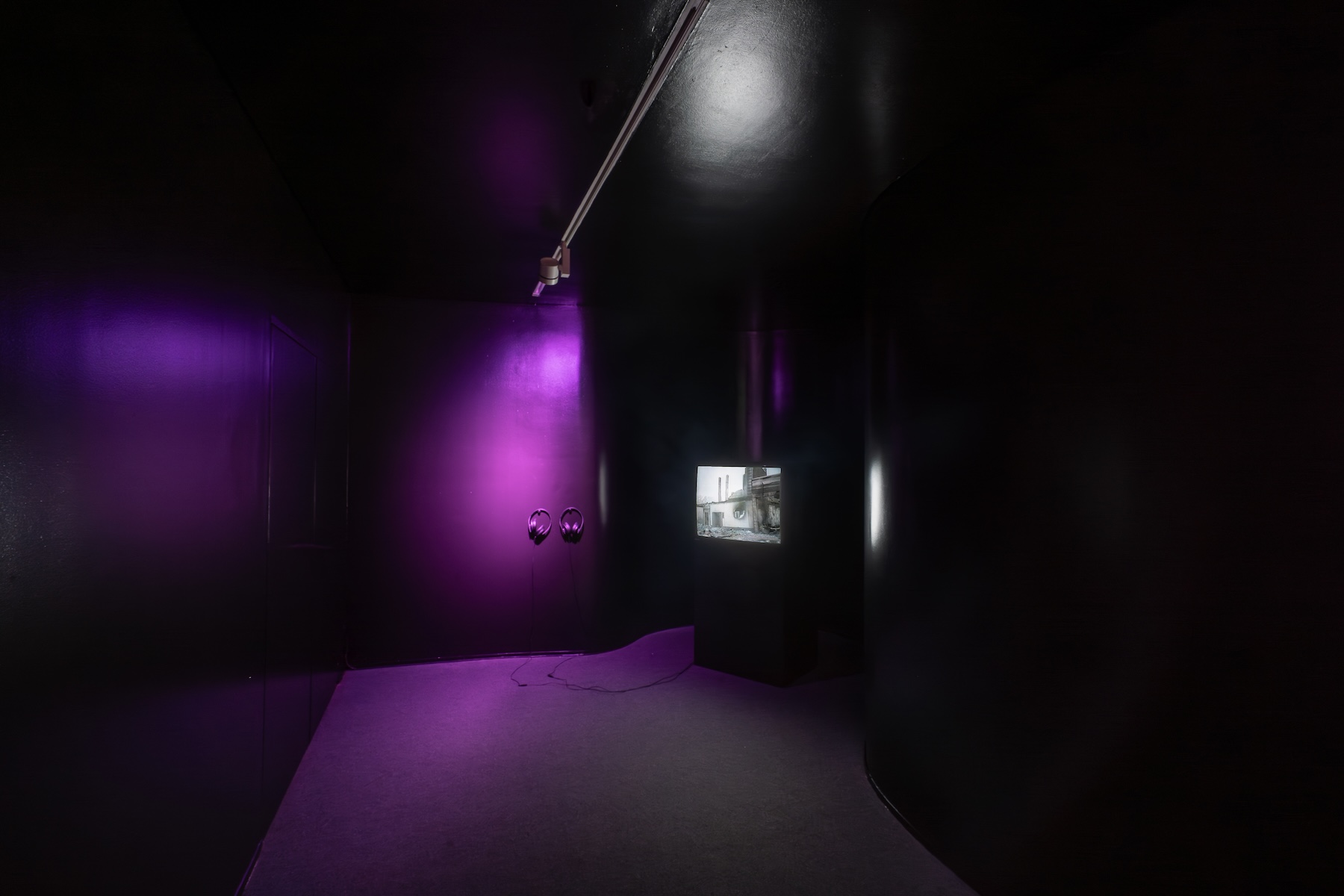
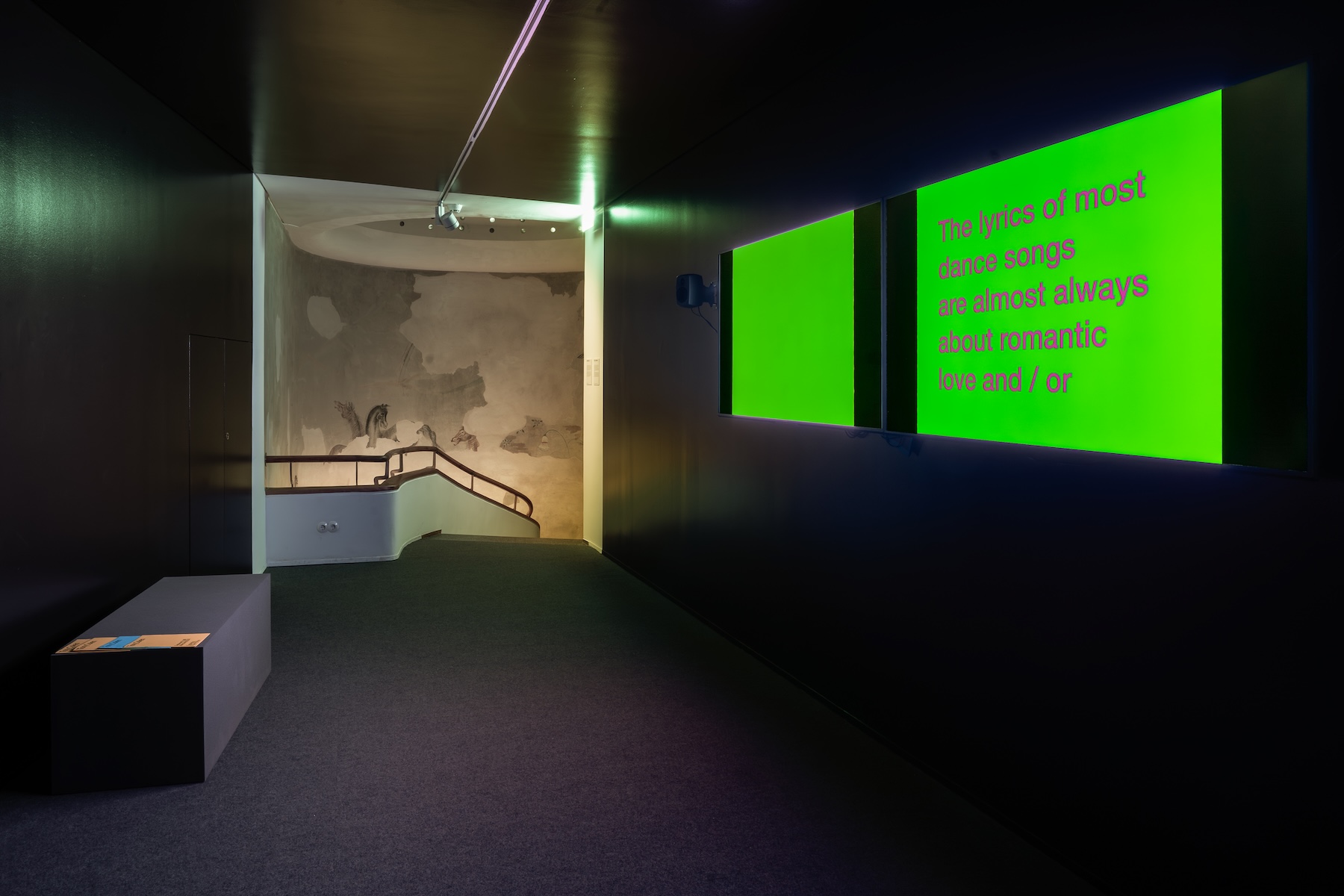
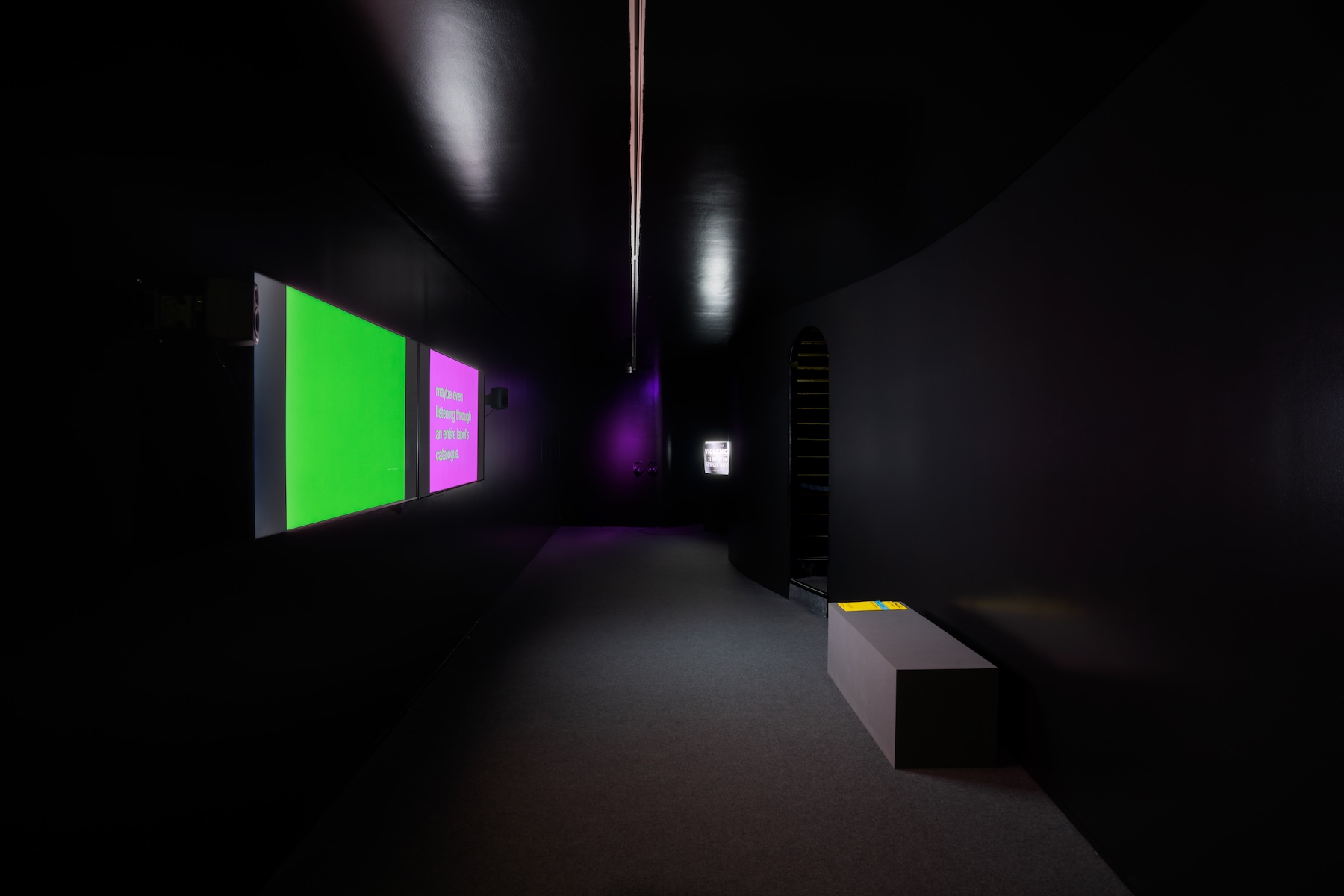
Tony Cokes: Testament E: MF.slow.cancel.2014. Exhibition views at Batalha Centro de Cinema, Porto, 2024-2025. Courtesy of the artist and Batalha Centro de Cinema.
Note:
[1] Exhibition brochure, Testament E: MF.slow.cancel.2014, Batalha Centro de Cinema.