
Miriam Cahn: O que nos olha
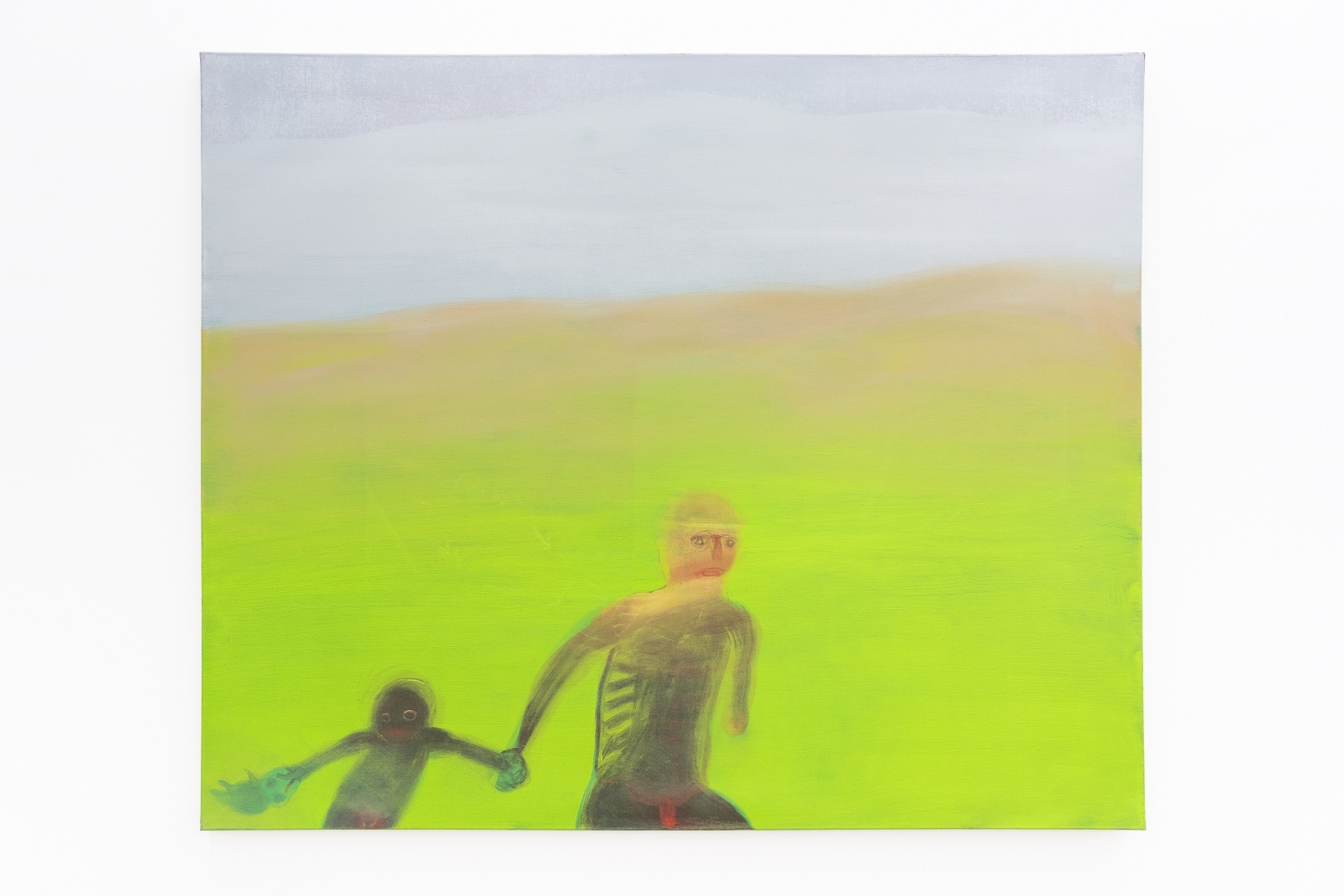
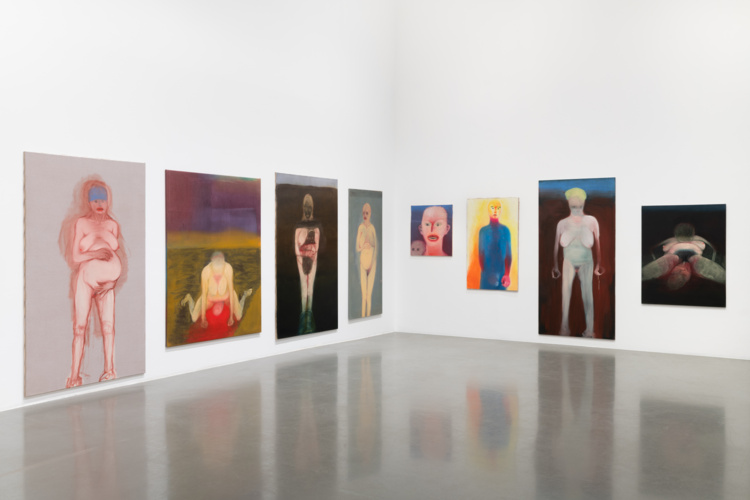
After entering the museum, I am met by a row of paintings lining the long corridor wall that leads to the exhibition space. Emerging from the vivid pastel background of each of these canvases stands an elderly woman, depicted frontally, naked and with her gaze fixed ahead. To enter the show, one must face these figures, whose eyes seem to scrutinize the viewer at the very threshold. Their bodies bear different traces of the passage of time inscribed on the nude flesh. Yet the fragility suggested by their aged, unclothed forms is countered by fierce stances and unwavering looks—quiet, insistent, almost inescapable. In their eyes seems to rest a blend of defiance and the burden of having witnessed and endured so much. Confronting these nearly life-sized figures and their insistent glances — which I later learned were self-portraits— I was immediately struck by their unconventional arrangement. The works are not aligned in any conventional way: not at the top, nor the bottom, nor even at the standard 150–155 cm line. At first, I read this simply as a bold statement against the rigid dogmas of the sacred trinity of hanging, but as I looked again at the figures, it became clear that they followed a different principle: the works are aligned by the figures’ eyes to coincide with the viewer’s, turning the act of looking into the very structure of the display.
Opening the exhibition with paintings of the artists’ own ageing body, aligned so that the figures’ eyes meet those of the viewer, is a choice that demands attention. Here, Cahn frames the body as the place where pain and empathy take shape, with looking as the essential act of confronting them, and painting as one of the ways to reveal what is unsettling, hidden, or repressed. In this sense, the artist represents a subject —nudes of elderly women— that is almost absent from art history—much like paintings of childbirth that we will encounter later on— exposing the prejudices inscribed not only in portraiture and art history but also in society at large. In the recent Against Ageism: A Queer Manifesto, Simon(e) van Saarloos[1] reminds us that ageism cannot be separated from broader structures of violence and oppression. Cahn’s work echoes this idea, implying that the marginalization tied to ageing stems from the same roots as the other forms of violence and domination she confronts across the exhibition.
Through the idea of aligning the works around the eyes of the figures so that they look into those of the public, the artist seems to imply that the body in the painting becomes visible not as a passive object/subject to be looked at from a fixed height, but as an active presence that returns the gaze. This shift proposes a radical sense of proximity, reciprocity, and honesty—akin to the truth we invoke when we say: look me in the eyes. It is through this levelling of vision, through the very organs that register life in its extremes, in its beauty and brutality, joy and sorrow, that the exhibition begins.
What Looks At Us presents a wide-ranging selection of the artist’s work across diverse media—from installation, video, and drawings to watercolors and oil paintings, the latter occupying a central place. Together, these pieces testify how Miriam Cahn has persistently exposed different ways in which vulnerability and fragility are exploited, whether on the intimate scale of the body or the collective scale of war and destruction —a concern rooted in both her personal history and early engagement with different forms of political activism.
Born in Switzerland to Jewish migrants who escaped Nazi Germany, she was from an early age drawn to activism and feminism, two elements that became guiding forces in a practice characterized by political urgency and formal experimentation. Already at the beginning of her career it is possible to observe a deep engagement with the body and its relation to the world, both physically and politically, as well as a performative approach that persists in different aspects of her work today. For example, in her first pieces of the late 1970s, influenced by performance art of that period, she began to create large-scale charcoal drawings in public spaces—graffiti-like interventions carried out quickly. In other pieces from this decade, she danced and moved across vast sheets of paper, using her whole body to create monumental floor drawings — some works in the show recall that approach. This performative impulse is somehow translated into her painting process today. Cahn rarely returns to a work more than once or twice and never spends more than two hours on a canvas—the maximum span of time she can sustain a state of intense concentration. She has made a parallel of this approach to Jochen Gerz’s performance Rufen bis zur Erschöpfung, in which he repeatedly shouted “hello” from a hilltop until completely losing his voice. For Cahn, painting operates in the same register: a performance marked by immediacy, intensity and exhaustion, its expressive force inseparable from the brevity of its making. This urgency simultaneously highlights her technical virtuosity, as even her largest works are completed in strikingly short bursts. Even the way she installs exhibitions carries a performative charge, though enacted behind closed doors. Since the 1980s, she has insisted on installing her shows alone, without curatorial involvement. This stance originated after her experience at Documenta 7, when her installation WACH RAUM was scaled down without her consent. In protest, she withdrew—and from then on resolved to set up shows in full autonomy, allowing curators to view them only once the installation is complete. According to the curators, What Looks At Us, too, follows this principle.
The series of works that the artist herself selected for this show spans different periods of her career, offering not only an extensive and cohesive overview of some of the themes that have long preoccupied her, but also a glimpse into the distinct way she conceives and installs her exhibitions. Here she presents a strictly non-linear and non-chronological path through some of her central concerns: from her enduring engagement with feminism, to the anti-nuclear movement, the European refugee crisis, the war in Ukraine, and more recently the Israel–Palestine conflict. For each of these contexts, she creates images that represent different situations in which power is imbalanced and human vulnerability is exploited. Yet, her responses feel uneven at times, revealing shifting layers of empathy and political sensibility, and leaving one to wonder why some struggles are given representation, context and solidarity, while others remain partially silent.
In one room, the installation UNDARSTELLBAR —German for unimaginable— comprises a series of paintings that confront recent instances of violence and suffering. Some works depict migrants drowned in the Mediterranean, others portray the horrors of war when all norms of conduct collapse and the strong prey upon the weak. All the canvases juxtapose stark brutality with ambiguous, pastel-hued compositions: faces rendered in bright tones, often with grotesque smiles, act almost as masks concealing the horror in the victims’ expressions and the inhumane gaze of perpetrators. This unsettling collision of a seemingly playful, childlike aesthetic with extreme violence mediates confrontation with the unimaginable and perhaps unrepresentable otherwise. A notable example is Fuck Abstraction!, an oil painting in which Cahn depicts a brutal scene of sexual violence in response to reports of abuse by Russian soldiers in Bucha, Ukraine. The work is stark and raw: the rapist’s body is powerful and muscular, his face reduced to a simple, comic-like circle, creating a space of abstraction where the atrocity is implied rather than detailed. The victims, in contrast, are also faceless but smaller, emphasizing their subjugation. The work immediately provoked controversy, with some interpreting the difference in scale between the figures as a reference to child abuse, with the result that different far-right groups petitioned for its removal from her 2023 exhibition at the Palais de Tokyo in Paris. French courts dismissed these attempts, but in May of that year, the painting was vandalized as an act of “protest”. What we see at MAAT today is the same work that was attacked and later restored.
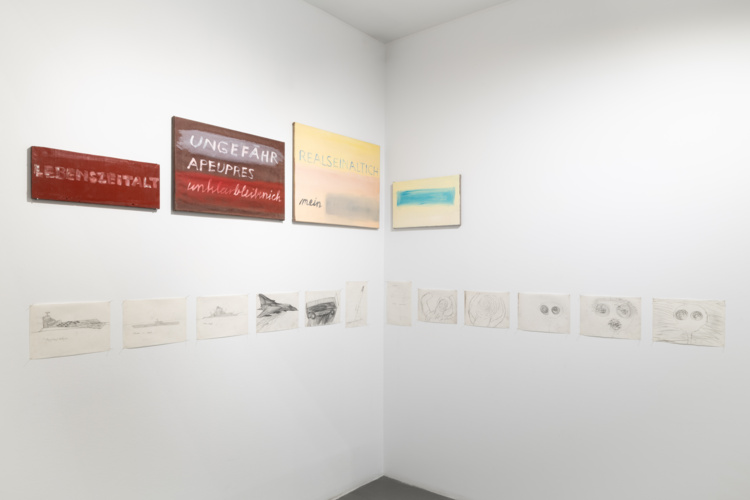
Before entering the next room, I passed through a corridor lined with older drawings and more recent paintings inscribed with German sentences, whose meaning I only later translated. The installation that followed returned to Cahn’s engagement with war and destruction, combining diverse media but relying on similar strategies to sustain ambiguity and provoke contradictory emotions. Alongside sculptural objects scattered on the floor, watercolors depict atomic bomb mushrooms, transformed into radiant, rainbow-hued bursts. Here, watercolor—a medium conventionally associated with delicacy and confined to naturalistic depictions—is pushed beyond its traditional/patriarchal confines, used almost performatively to convey devastation through sweeping bursts of color that mirror the explosions they depict.
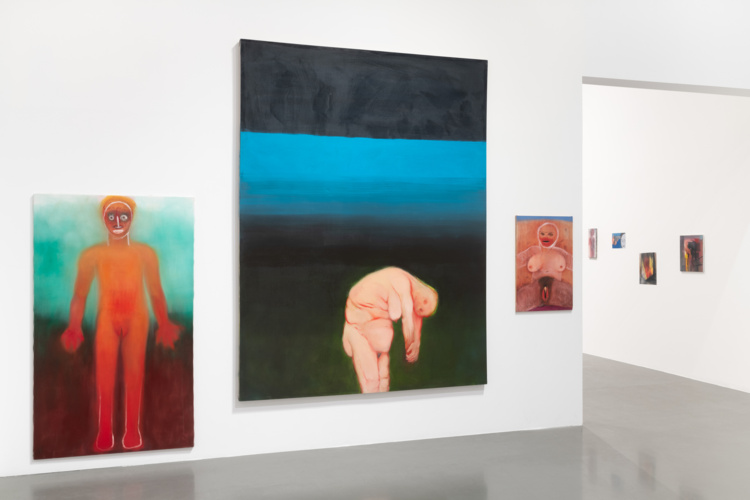
The next section, titled in German WEINENMÜSSEN (“need to cry”), presented a series of small portraits of grieving, tearful faces, all produced within a brief span of time between October 8 and 23, 2023. Unlike the earlier installation on the “unimaginable,” which included a wall text, this room offered no contextual framing, perhaps inviting viewers to confront the works in a raw and unmediated way. It was only later, during a guided tour of the show, that I understood they had been created in the immediate aftermath of the October 7th terrorist attacks on Israel by Hamas. This absence of context felt somehow dissonant: these works address one single moment from a conflict that has escalated into what many consider the darkest page of our contemporary history; why should they not be framed within the broader historical framework? At the same time, considering the disproportionate scale of destruction that followed the events depicted —a devastation that continues nearly two years later, presenting today only a representation of the October 7th attacks feels slightly one-sided. From that moment, I moved through the exhibition wondering if the other side, with its voices and suffering, might also be represented.
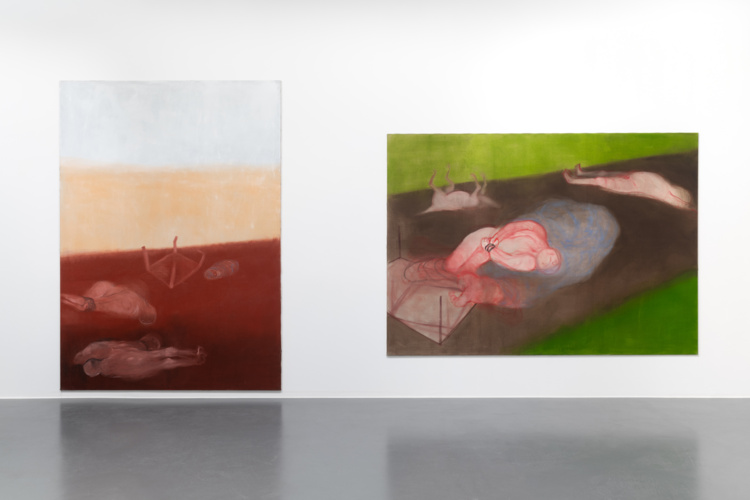
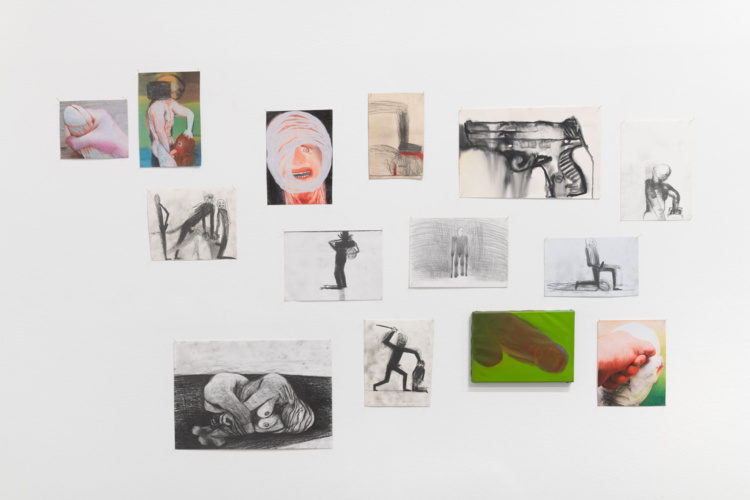
My search carried me into the next room, where the theme of war and violence reemerged across a variety of media—from large-scale drawings and oil paintings to small sketches on paper—assembled in one of Cahn’s signature “clusters”. Borrowed from contemporary music, the term refers to a chord built from adjacent notes, and here it serves as an analogy for her arrangement in which different media and formats come together in cloud-like formations, without hierarchy or linear order, whose thematic proximities create a whole that the viewer can read and navigate in multiple ways. This arrangement according to the artist implies a sense of equality among the pieces, regardless of their formal characteristics, as well as an intention to “liberate the viewer from the paternalism of isolated and confined images.” In this sense, the installation exposes multiple forms of violence—not only wars, but also sexual abuse and architectural and urban hostility—framing each piece within a wider awareness of brutality on different scales. Yet, despite the scope of this cluster, the perspective I was looking for remained absent.
Then I moved into the final section of the exhibition, which expands on some of the ideas encountered in the first corridor. Here, the look of the artist centres again on the female body through different paintings depicting childbirths, portraits, and nudes. These pieces underline Cahn’s longstanding engagement with the human figure in order to confront issues related to ageism, gendered assumptions, and systemic imbalances of representation. Yet even here, the perspective I had hoped to encounter was still missing.
As the exhibition came to an end, I left with mixed feelings: What Looks At Us is undeniably a powerful and moving show, yet I was also struck by the treatment of that particular theme. Confronted with depictions of a single moment from what I consider to be the most extreme and inhumane conflicts of my lifetime, the works addressing it felt not only decontextualized but also one-sided. The room offers no contextual framing, leaving the audience to respond solely on an emotional level—yet these are not abstract works detached from reality; they depict events that are still unfolding and therefore urgently demand context. I felt the asymmetry also in the paintings: only the reaction to Hamas’s attacks is represented, highlighting one side’s suffering, while the other side—the decades of dispossession, injustice, apartheid, and ongoing brutal violence that many experts describe as genocide—is completely absent.
In the weeks that followed, I searched for further information, asking myself whether Cahn might have consciously chosen not to represent “the other side” in her paintings, but perhaps addressed it elsewhere—in a statement, a text, or another artwork offering broader context. A video of a guided tour offered a clue[1]. According to the curators, her most recent canvases, inscribed with German sentences, the artist “refused, forced herself, was forced not to depict human figures—only sentences. In them she does not reflect on the historical situation itself, but on the time that has passed her by: on ageing as a person, on maturing as an artist, on the impossibility of showing.” These words read ambiguous: the entire exhibition revolves around seeing, looking, representing—so what does it mean that suddenly, in the face of this unfolding, figuration gives way to words regarding the artist's ageing and maturing process and on the challenges of showing?
Still unsatisfied with this “answer”, I kept looking, and my search led me to a recent article in Haaretz[2] on the booklet Mein rhythmisches Schreiben[3], produced for her show at the Stedelijk Museum Amsterdam (which was the previous iteration of this touring exhibition). This publication includes reflections on her Jewish origins and current position regarding the conflict. In a way, the booklet articulates what the exhibition itself leaves unspoken. In the sections I was able to access online, I came across passages where Cahn writes of her Jewish identity, her family’s escape from Nazi Germany to Switzerland, and her early encounters with Zionism through Leon Uris, whose heroic narratives once drew her in, and Jean Améry, who convinced her that anti-Zionism is inseparable from antisemitism. She recalls:
read Améry’s writing on the new antisemitism
Améry my hero
I understood why antizionism is antisemitic
even if it comes from the left
was confused
threw away my palestinian scarf
was never a follower again
Later in the text, she reflects on her 2021 exhibition my JEWS, presented parallel to Documenta 2021, curated by the Indonesian collective Ruangrupa, who faced accusations of antisemitism. Cahn dismisses their appointment as a gesture to appease “Western colonial bad conscience,” reducing their curatorial and artistic merit to identity politics. She then explains her disengagement from the art world, since in her opinion after October 7 institutions expressed solidarity with Palestine without acknowledging Hamas’s attacks.
That text was written on May 11, 2024, the same day 28 Palestinians were killed in Gaza within less than 24 hours, bringing the death toll since October 7 to approximately 35.000. Now, as I’m writing this text in September 2025, that already inconceivable number has almost doubled, surpassing 65,000, of which roughly 19.000 are children — and according to experts, as almost all hospitals were destroyed or severely damaged, the true number is likely higher. Reading that part of Miriam Cahn’s booklet containing those references and tones, in this particular historical moment, felt very unsettling. One author that she cites, Leon Uris, was an American novelist known for his historical fiction centred on Jewish identity and Zionism. His work, while popularizing a heroic vision of Israel’s founding, presents a narrative that ignores the first Nakba, presenting a one-sided account that has often been described as propaganda, imbued with Islamophobic elements and “cheap anti-Palestinian racism”[4]. The other one, Jean Améry, was a Holocaust survivor and intellectual, who argued in his essay The Respectable Antisemitism[5] that anti-Zionism can serve as a modern guise for antisemitism: "Anti-Zionism contains antisemitism like a cloud contains a storm". I believe that to invoke these figures uncritically in the third decade of the twenty-first century is deeply problematic. In light of what is happening in Gaza, Cahn’s adoption of Uris’ and Améry’s positionings without acknowledging their blind spots is troubling. To repeat the equation that anti-Zionism equals antisemitism in 2025 is a dangerous perspective. Anti-Zionism can also emerge from concerns related to politics, ethics, or human rights and is not inherently an expression of prejudice against Jews. In today’s context, this equivalence comes across as a form of political and empathetic blindness, reinforcing the widespread censorship in Europe that stems from the weaponization of the term antisemitism— one also adopted by the next Documenta. The art world Cahn describes as “pro-Palestine” is, in fact, at the institutional level, largely marked by silence—with museums censoring or avoiding the issue altogether. Meanwhile, on the grassroots level, against the backdrop of Gaza’s devastation, numerous protests and acts of solidarity in the arts have joined the broader global movement asking for an end to this massacre — a magnitude of humans from different countries, background and faiths whose positions cannot simply be dismissed as antisemitism, specially from an artist whose work has long engaged with human rights and human suffering. Yet Cahn’s own statements on positionality reveal a tension between principle and practice.
She recently remarked: “BLM is important, but the moment we claim that a white artist—a distinction I already find meaningless—cannot address issues directly affecting Black people, it becomes counterproductive.”[6] Her approach to ‘place of speech’ seems inconsistent: she can show empathy and represent struggles beyond her own experience, yet when it comes to issues closer to her cultural sphere, she reproduces a one-sided perspective and promotes narratives that perpetuate the very forms of violence she has otherwise confronted. Her solidarity appears selective, her outrage and willingness to represent atrocities suddenly stop at Israel’s borders. In privileging one trauma while overlooking another, the gaze of the figures at the exhibition’s entrance, which once felt honest, now seems less authentic.
Miriam Cahn
MAAT
Mattia Tosti (Rome, 1993) is an Italian-Brazilian curator and writer. His work focuses on research-based and site-responsive exhibitions, often embracing interdisciplinary collaborations and hybrid formats. His professional background includes experiences in museums, such as MAC São Paulo and MAAT Lisbon and in contemporary art galleries, notably serving as director of Monitor Lisbon (2020-2025). As an independent curator, he conceived exhibitions for institutional, commercial, and non-conventional spaces. With Orsola Vannocci Bonsi he started Órbitas, a series of shows held at Cosmos CAC. As part of Da Luz Collective, he curated the video art section of the Italian Cinema Festival in Lisbon for three editions (2022,2023, 2025). His writing has appeared in academic publications by Routledge and De Gruyter, and in internacional magazines.
Cover image: ©Pedro Pina
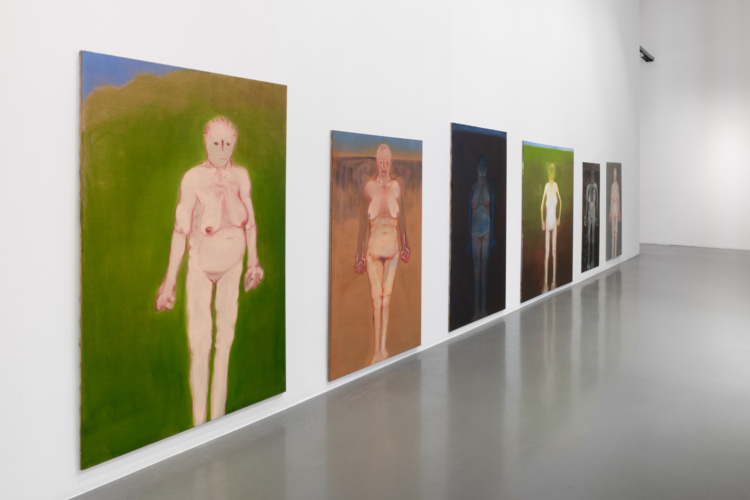
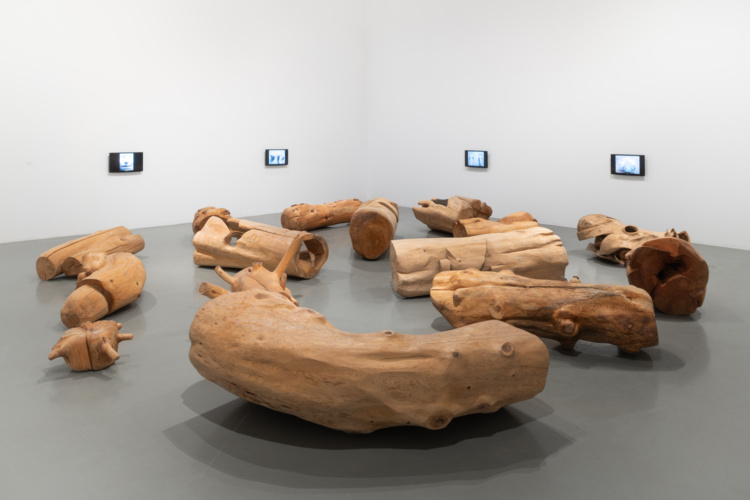
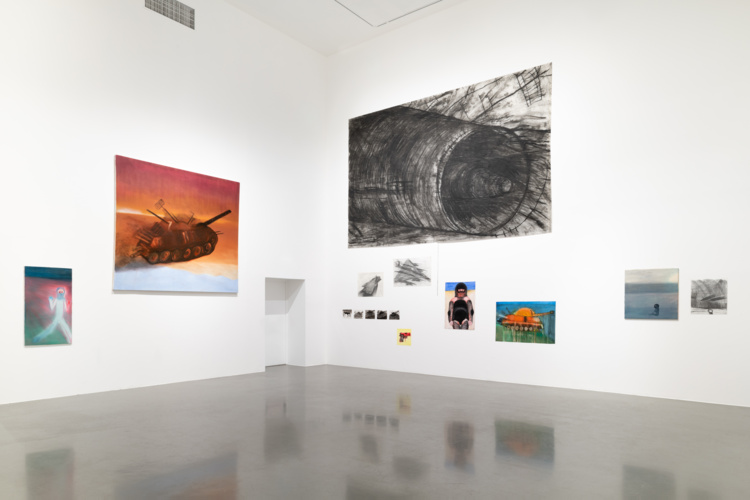
Miriam Cahn, What looks at us. Exhibition Views at MAAT, Lisbon, 2025. Photo: Pedro Tropa. Courtesy of the artist and MAAT/Fundação EDP.
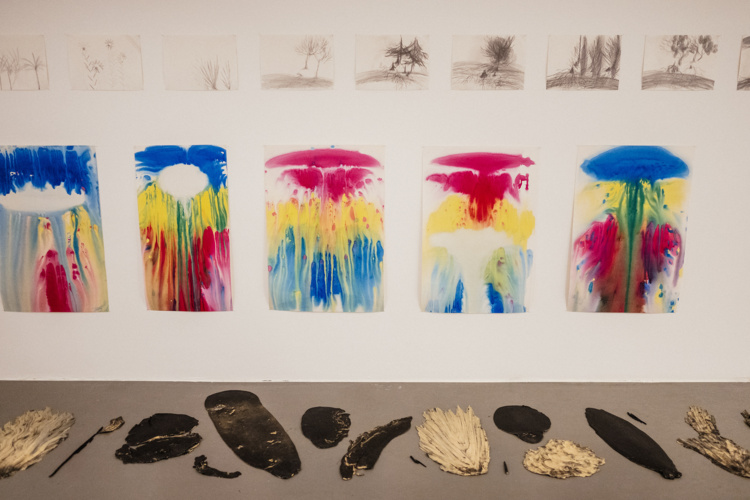
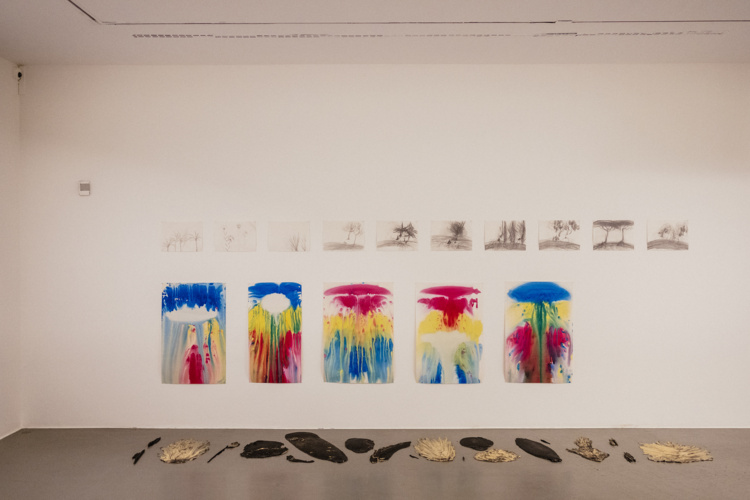
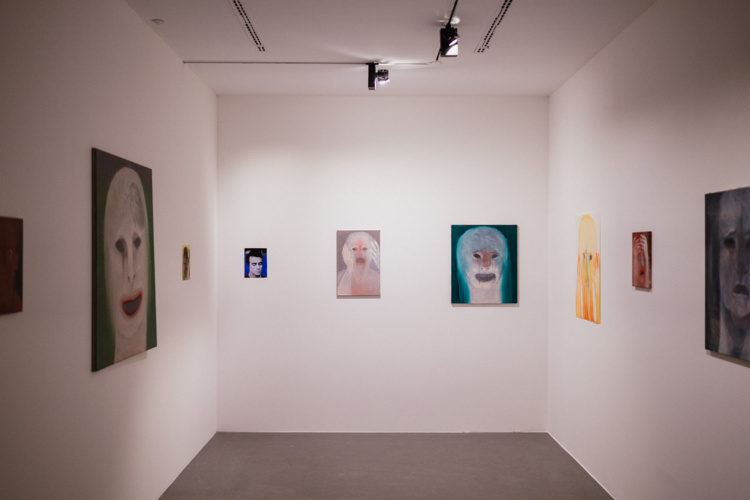
Miriam Cahn, What looks at us. Exhibition Views at MAAT, Lisbon, 2025. Photo: Pedro Pina. Courtesy of the artist and MAAT/Fundação EDP.
Notes:
[1] Simon(e) van Saarloos “Against Ageism: A Queer Manifesto”, SPBH Editions, 2025
[2] “Miriam Cahn – O que nos olha | What looks at us. Entrevista/ Interview” disponibilizado pelo MAAT Museu de Arte, Arquitetura e Tecnologia, 30 de Julho de 2025, 5’:24”-6’:00”, https://www.youtube.com/watch?v=49a_johisAY
[3] Esmee Postma, “At 75, Miriam Cahn Is Still Painting Out of Rage. This Time It's October 7”, 26 de Dezembro de 2024, https://www.haaretz.com/life/2024-12-26
[4] Miriam Cahn, “Mein rhythmisches Schreiben”, 2024
[5] Toine van Teeffelen, “Racism and metaphor: the Palestinian—Israeli conflict in popular literature”[racismo e metáfora: o conflito Israel-Palestina na literatura popular], Birzeit University of Israel, 2022
[6] Jean Amery, “Essays on Antisemitism, Anti-Zionism, and the Left” [ensaios sobre antissemitismo, antissionismo e a esquerda] (2022), Indiana University Press.