
Priscila Fernandes: Fanfare 2025
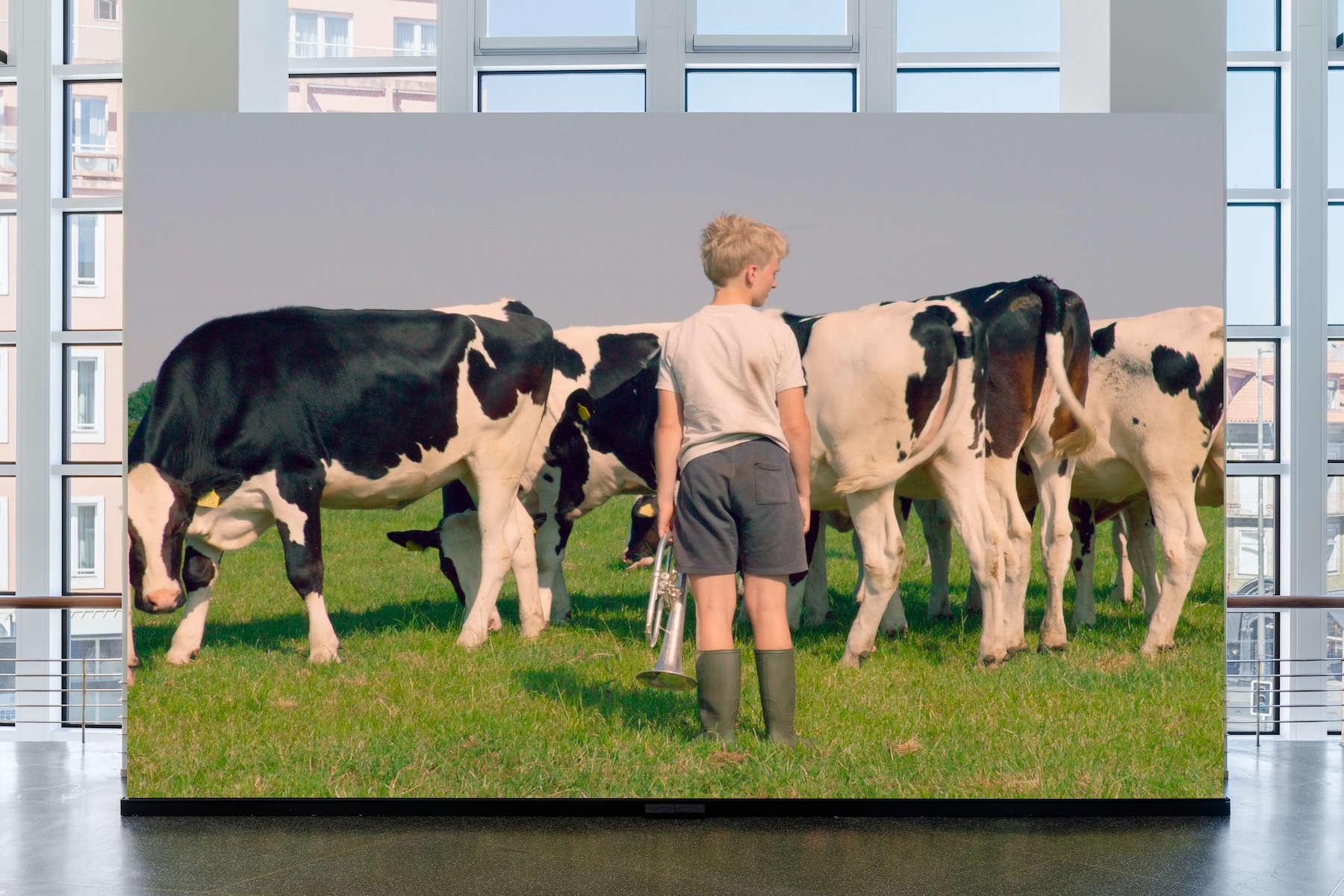
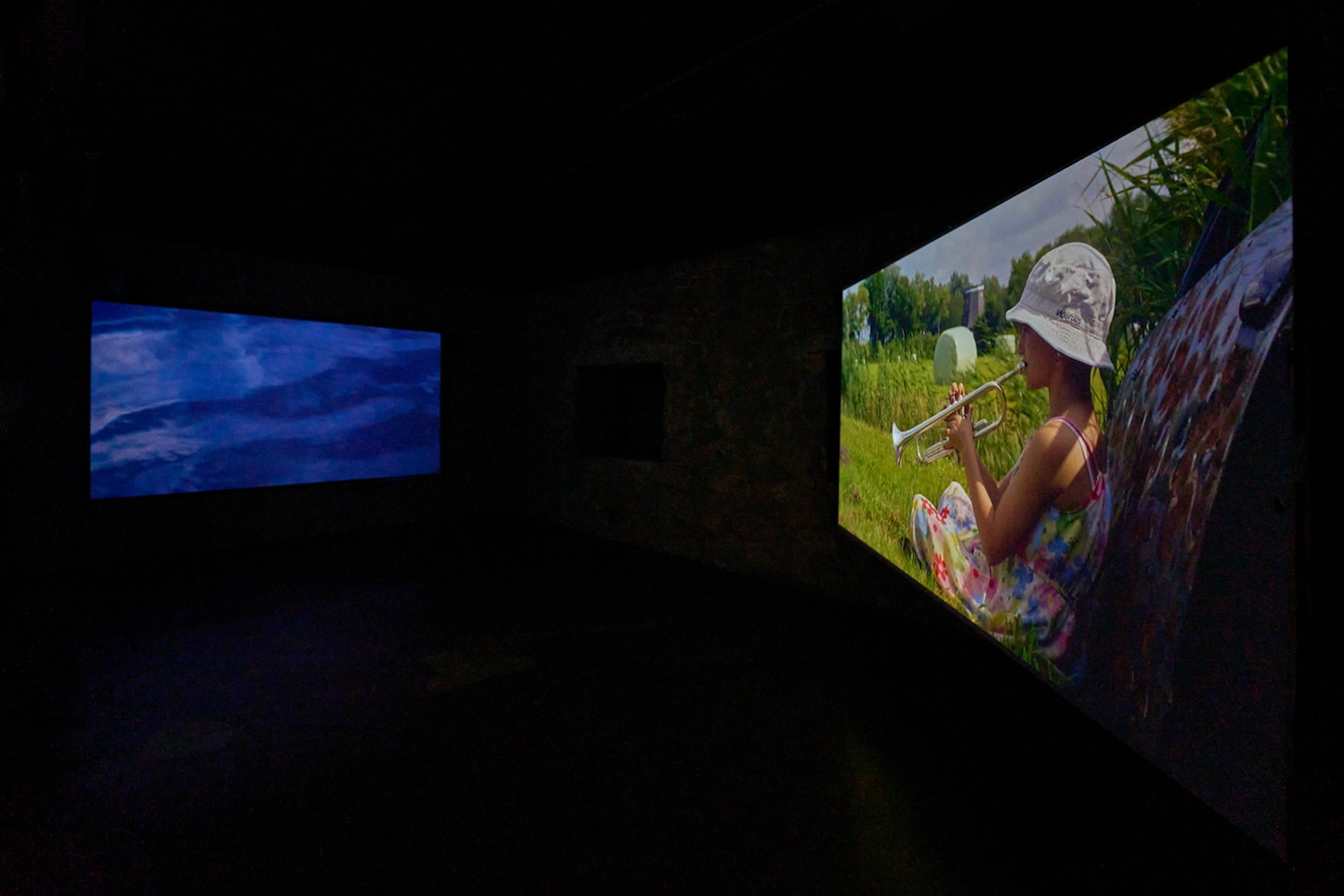
Priscila Fernandes’s Fanfare 2025 is absurd, comedic, loud, and bursting with contradictions. On view at Batalha Centro de Cinema in Porto,[1] the solo exhibition resists clear interpretations. Instead, it leaves me with disjuncted words and feelings that get lost in my attempts to grasp what hides behind the loud emotions of real and imagined community fanfares in the two works on display: There Are No Radical Futures (59’, 2025) and Fanfare 2025 (22’, 2025). Typically concerned with individual and collective freedom, Fernandes delves into music as political resistance in the European context, where division and oppression seem to be getting the best of us. Both the fiction in Fanfare 2025 and the documentary work in There Are No Radical Futures leave us to grapple with the increasingly doomed relationships of power and resistance, success and failure, unity and division.
Immaculately displayed, Fernandes’s pieces are powerful and magnetic in their playfulness. They echo the words of filmmaker Fatih Akin, “When an audience is laughing, that’s opening their souls somehow, and when you have an audience with an open soul, it’s much better to hit them with a knife.”[2] Behind their joyous first impressions lie deeper issues and a discomfort that Fernandes gifts her audience only upon deeper reflection. In the exhibition text, Isabella Lenzi writes that the pieces compose a “polyphony that resonates among ruins and the remnants of hope.”[3] And indeed, the works implore us to open our eyes in search of a silver lining of hope for a better future, even in places where kinship and community ties hang by a mere thread.
To begin to understand the meaning and context behind Fanfare 2025, we must first turn to the meaning of fanfare: a musical flourish performed by a military or civilian brass band with accompanying percussions for ceremonial, militant, and communal occasions. They are loud, pompous, celebratory, and mainly seen as a tradition of primarily European origin. When of the folkloric, communal kind that the show is concerned with, fanfare bands can be seen as descendants of medieval troubadour bands, and therefore linked to the carnival and popular traditions of common joy and humour as a tool to upturn power relations. In other words, their power lies in their loudness and in the ability of music to occupy space, increase energy, and bring people together—exactly what the video works speak of us needing so badly.
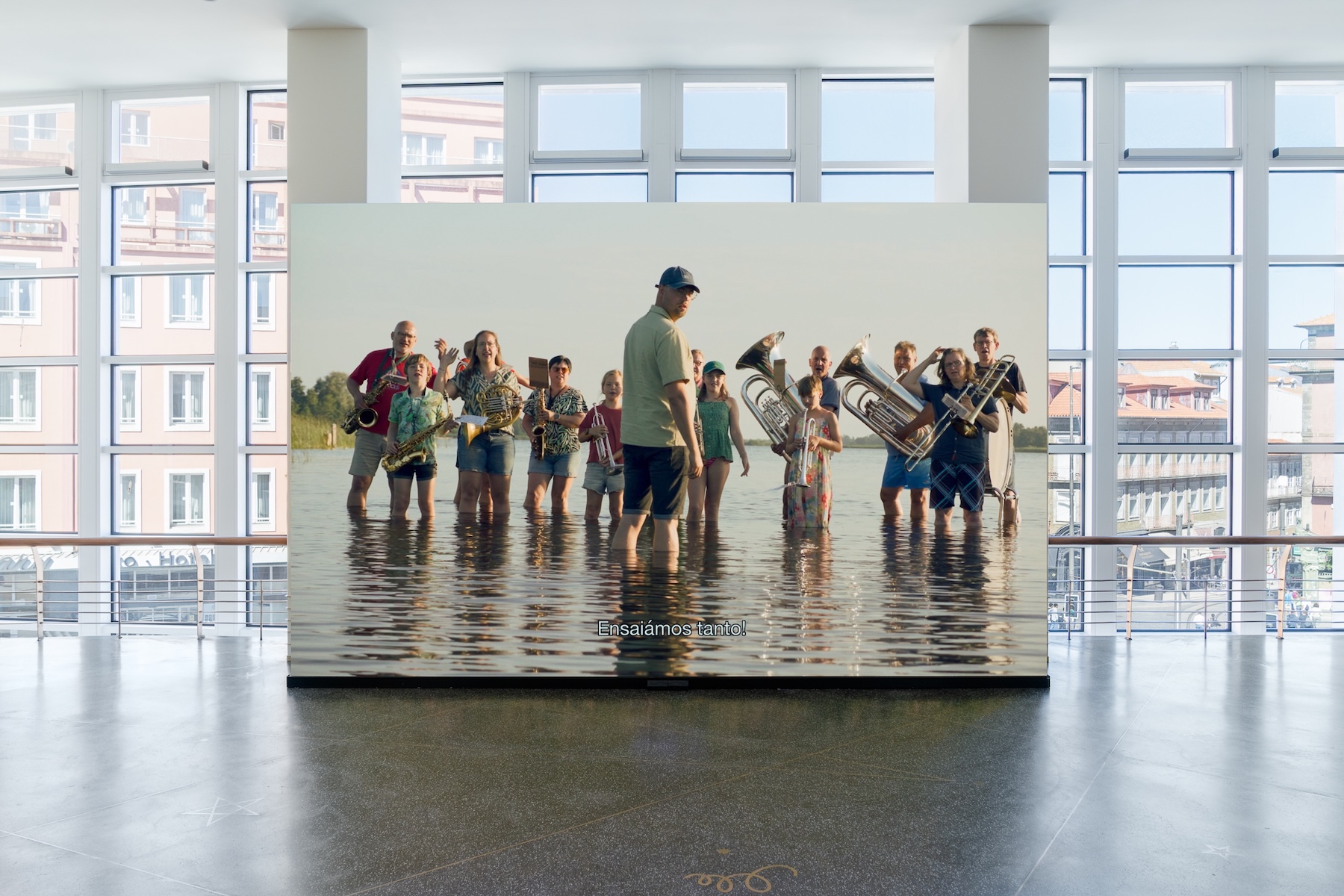
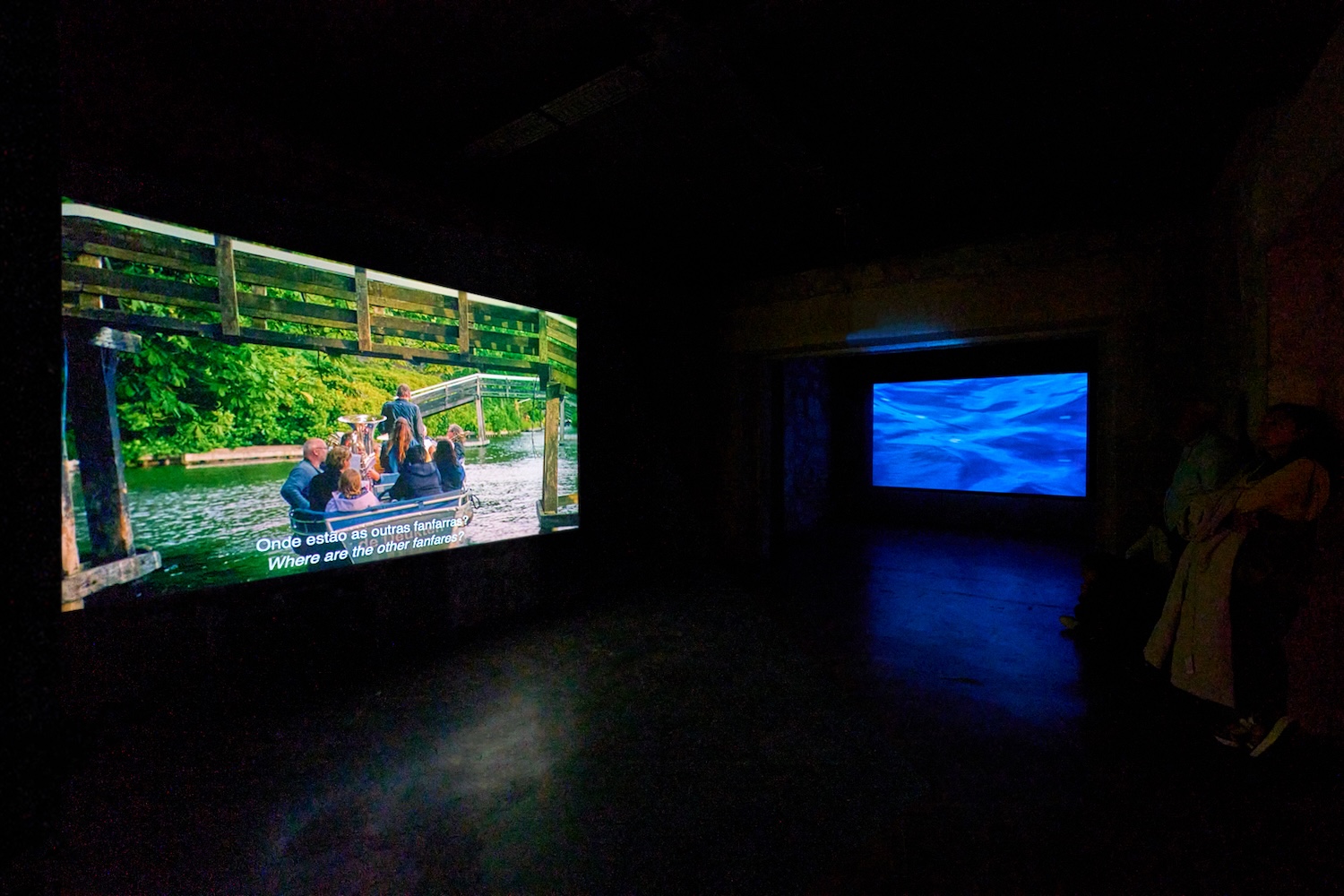
Video storytelling practice at its best, Fanfare 2025 is screened in the foyer of the second hall of Batalha on a large screen that places the real-size characters only a couple of metres away from the viewer. An absurd re-make of Bert Haanstra’s (equally absurd) comedy Fanfare (1958), the video piece replicates the classic’s plot of a village band’s attempt to win a competition, self-sabotaged by internal fighting. Described as a dystopian fiction, Fanfare 2025 shows a local philharmonic band in the fictional Dutch water town of Lagerwiede on their way to the competition. Internal fighting, insecurities, and disharmony mark their disoriented journey. Filmed at the same location in Giethoorn, Haanstra’s Fanfare features a village band split by a feud that reflects their familiarity, unity, and kinship with one another. The town band in Fernandes’s Fanfare 2025 instead recalls family fights that are symptoms of deeper unresolved issues. Think of sitting at a holiday celebration after a big family drama, and you get close to the feeling of the band trying to make their way to the competition on a small boat. Yet, the problems seem to be the same, as the introduction to Fanfare 2025 narrates:
In Lagerwiede, an hour lasts longer than anywhere else.
That’s time enough for divisions old and new to play out.
The more obvious the answer seems to you,
the more opposed your neighbour is.
…
Life has been like this here for 70 years.
Everything changed,
yet the problems remained.
Close your eyes to the changes and you might be charmed.
Look elsewhere and you’ll have to convince yourself it will be alright.
Look away a third time and you might be too late.[4]
With this backdrop, the plot of Fanfare 2025 takes us to the competition itself, where they find the blindfolded judge seated behind a table in the middle of the water. They wade off their boats and begin playing. The judge refuses to listen to their performance for more than a few seconds, interrupting them: “Stop, stop, stop! Second place.” As they try again and again, the judge interrupts them, awarding first third place and then an honorary mention, until the band finally gives up in a mess of falling over, wading aimlessly knee-deep in water and blowing their now half water-filled instruments.
The happy ending of Haanstra’s Fanfare, where the band’s differences are overcome by making a beautiful performance that sends the crowd wild, is replaced in Fanfare 2025 with a dystopia where those in power further existing divisions and instabilities, the bonds between people not strong enough to hold them together. The conflicts have different flavours: instead of a feud of neighbours whose lives are inextricably intertwined, as in Haanstra’s classic, Fernandes’s 2025 version is tainted by how individualism, greed, and internal competition get the upper hand. While Haanstra made the crowd superior to the judge, flocking to the stage after the performance, Fernandes’s film lacks a crowd altogether, with the judge instead a lone leader, superior and uncaring in a judgement that mentally destabilises the band. “Look away a third time, and you might be too late,” Fernandes warns the audience at the beginning of the film. In other words, we cannot, like the judge, see all this as none of our concern.
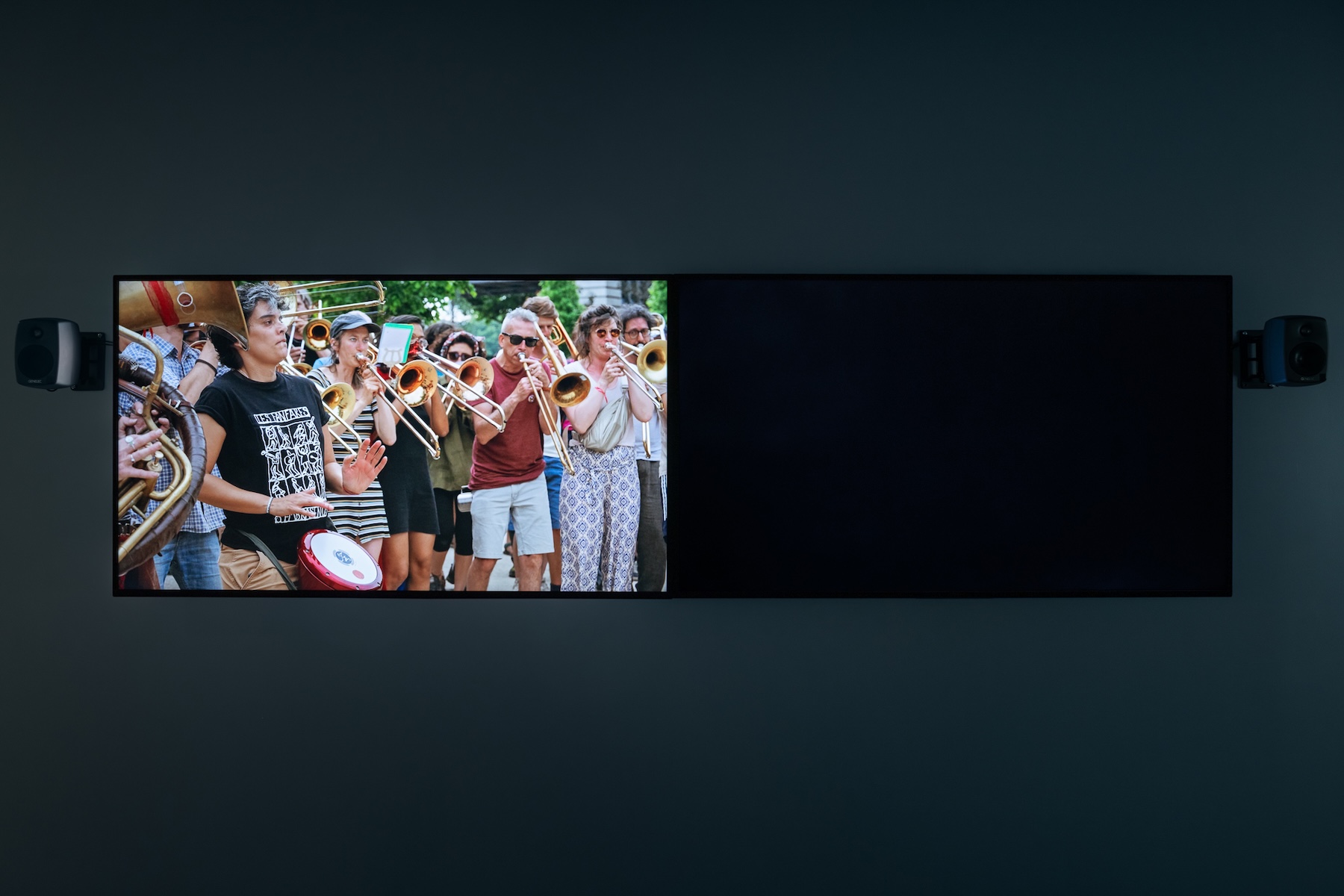
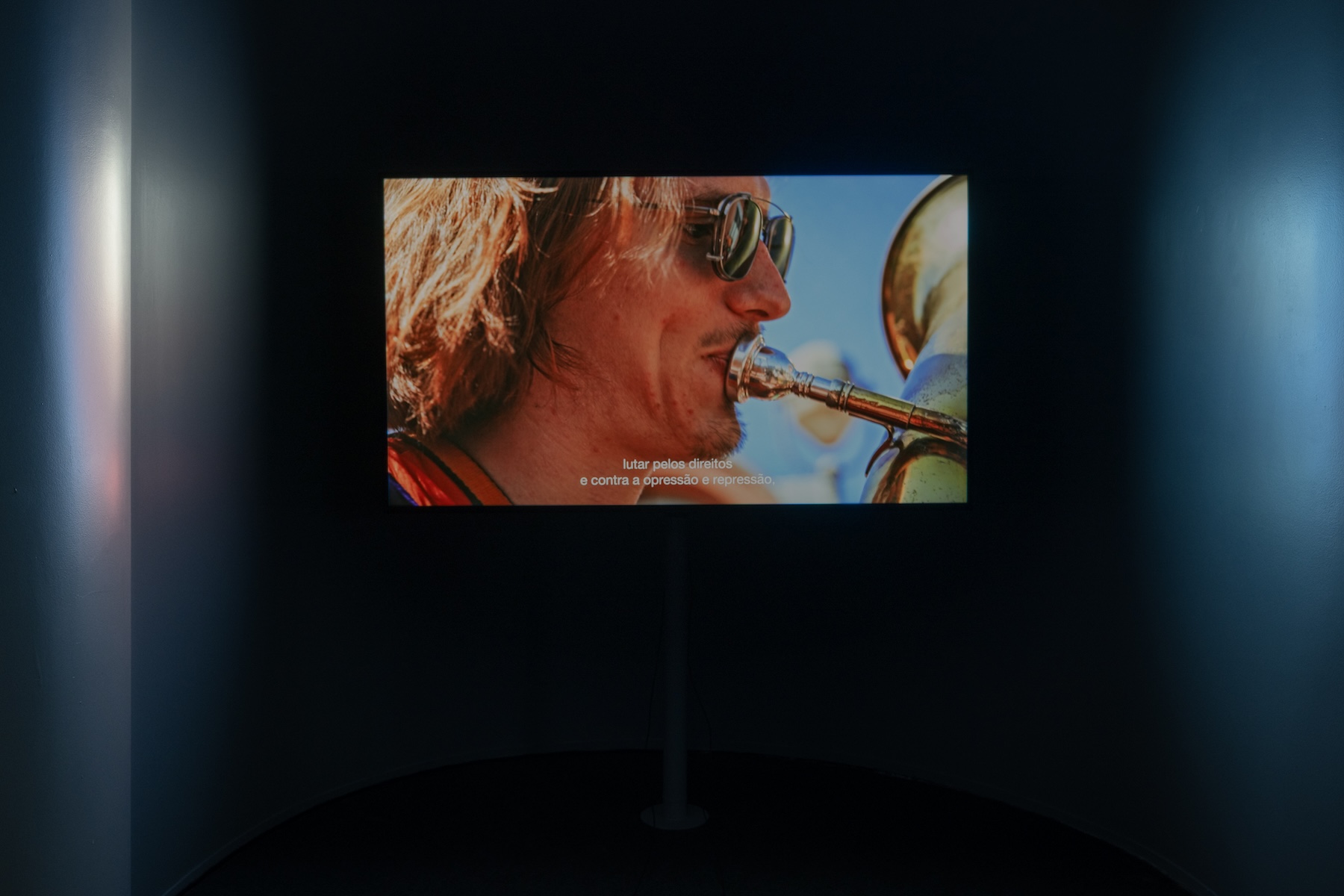
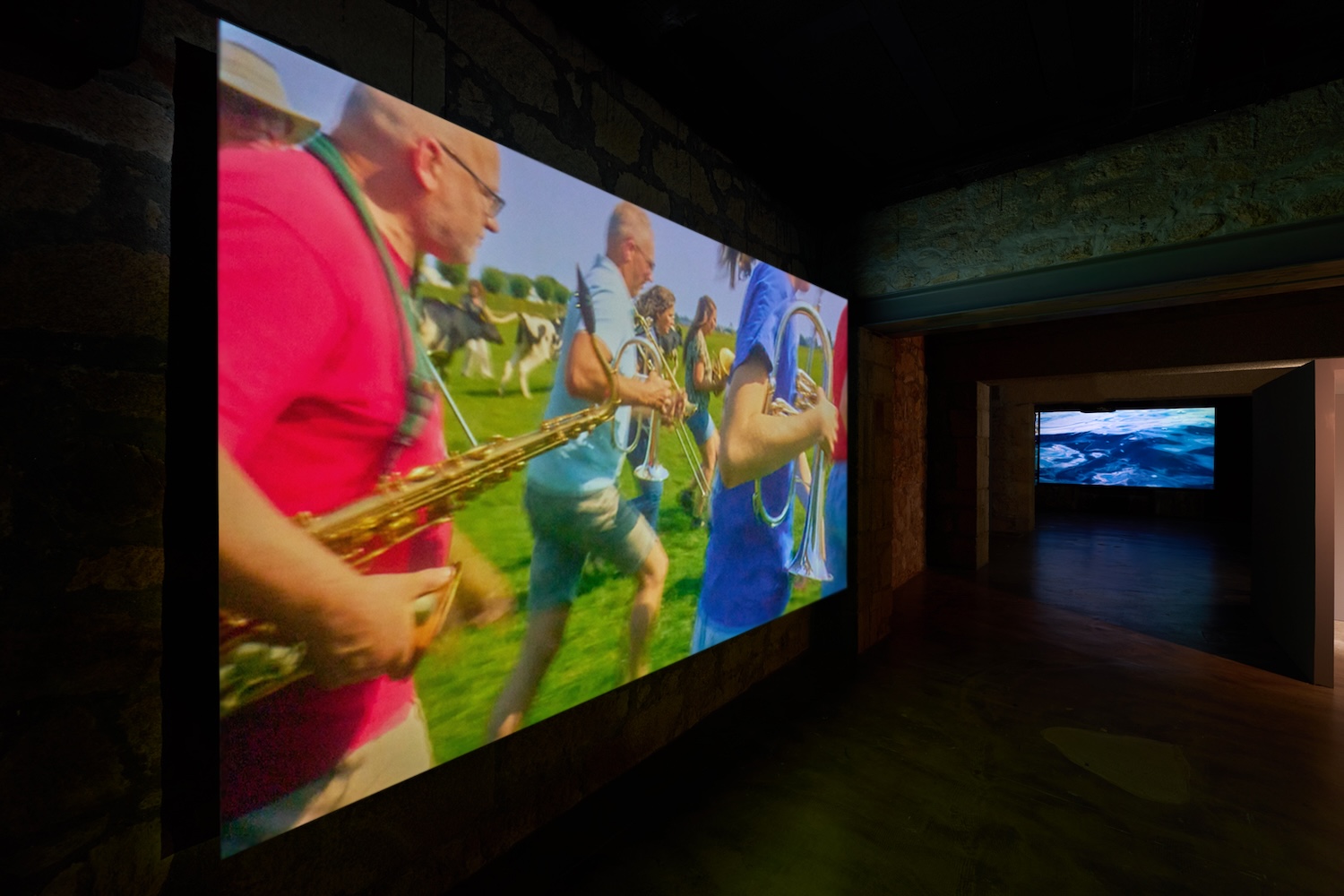
Countering Fanfare 2025’s dystopian fiction, There Are No Radical Futures feels at once hopeful and doomed, as it documents the European gathering of activist fanfares organised by La Fanfare Invisible in Paris in May 2025. Displayed in the corridor-shaped sala-filme of Batalha, we find here two screens placed side by side, intermittently following the nineteen bass brands’ performances during the days of the gathering, their music filling the hall and overflowing into the bar downstairs. Further down the room is a second display with headphones, documenting the fanfares’ spoken reflections on their experiences, tactics, and challenges.[5]
The filming is personal and caring, giving each individual and instrument space to respectively express their personalities and unveil their characters. Embedded within social struggles, fanfares all over Europe appear here as examples of innovative grassroots organising. Although band members tend to come from a privileged background, as they note themselves, we hear them reflect on how they try to make their actions more inclusive, common, and relatable. Each band’s organising structures differ, and so do their political opinions: one even comments on their discomfort regarding an action they performed together at the gathering on Palestine. In Spain, fanfares join blockades as a way to lessen police violence; in Germany, fanfares support these actions only from the sidelines, finding them too dangerous; the Neapolitan fanfares are concerned with mutual aid networks, as their community is very vulnerable; another fanfare speaks about the difference between joining an organised protest and going into rural neighbourhoods to play, asking which creates greater impact. Their stories are genuine and honest, reflecting their collective learning and continuous adaptation to their unique circumstances.
One fanfare member paraphrases Franco Basaglio: “Fascism grows in the brain without culture, music, and ideas.” Having been grappling with questions of community resistance today, with the current rise of the far-right in comparison to times of mass movements, and the role that art can play in this, the sentence and the video piece as a whole strike an uncomfortable chord. Somewhere behind the words, the laughter, and the care, there is an unsettling hunch that this is not enough. Just like Fanfare 2025 finds itself, 67 years later, far removed from the hopefulness of the post-war period, There Are No Radical Futures speaks of the end of a time when playing music at demonstrations and organising manifestations can reach as far as it needs to.
Is this Europe’s crisis of radicality, or have the ecological, social, and economic crises of capitalism reached the heart of the global imperial order? Behind the joyful, powerful resistance of the radical fanfares, we find contradictions and disagreements, struggles for space and diversity, as the structures for communal action are increasingly encroached upon. In Haanstra’s Fanfare, we find a town that, in feud as in joy, is tight-knit in kinship and commonality. In Fernandes’s Fanfare 2025, just as in There Are No Radical Futures, we find instead fleeting connections, instability, and uncertainty. Trying to untangle the potential of music as political resistance, Fernandes’s exhibition Fanfare 2025 emerges as a pressing call to rebuild the ruins of communal kinship and face our dystopia with eyes wide open. Perhaps we could even face it with a fanfare.
Note: This exhibition can be seen at the Batalha Cinema Centre in Porto until November 29th and was on display at the Solar Cinematic Gallery in Vila do Conde from September 20th to November 8th.
Maria Kruglyak is a researcher, critic and writer specializing in contemporary art and culture. She is editor-in-chief and founder of Culturala, a networked art and cultural theory magazine that experiments with a direct and accessible language for contemporary art. She holds an MA in Art History from SOAS, University of London, where she focused on contemporary art from East and South East Asia. She completed a curatorial and editorial internship at MAAT in 2022 and currently works as a freelance art writer.
Proofreading: Diogo Montenegro
Notes:
[1] Another version of the show is also on display at Solar Galeria de Arte Cinemática in Vila do Conde.
[2] Wendy Mitchel and Fatih Akin, “Going to Extremes: Fatih Akin on His Turkish-German Love Story ‘Head-On,’ Indiewire, 19 January 2005: indiewire.com/features/general/going-to-extremes-fatih-akin-on-his-turkish-german-love-story-head-on-78433/ (accessed 19 November 2025).
[3] Isabella Lenzi, “When the Water Rises, You Have to Play Louder,” as part of the solo exhibitions at Solar Galeria de Arte Cinemática and Batalha Centro Cinema, September 2025: priscilafernandes.net/projects/fanfare-2025/text (accessed 19 November 2025).
[4] Excerpt from script to Priscila Fernandes’s Fanfare 2025 (2025), inspired by Jan Blokker’s script for Bert Haanstra’s Fanfare (1958).
[5] There Are No Radical Futures features Banda Basaglia (Naples, Italy), Banda Comunale and Fiatelle Braskapelle (Dresden, Germany), XR Block Brass (Netherlands), Beatprotest (Munich, Germany), Acabanda (Bologna, Italy), Antifafare (Brussels, Belgium), Fanfare van de Eerste Liefdesnacht (Amsterdam, Netherlands), Banda Ramua (Munich, Germany), Street Noise Orchestra (Innsbruck, Austria), Fonc (Milan, Italy), Strampalabanda (Turin, Italy), Ottoni a Scoppio (Milan, Italy), Fanfarria Transfeminista (Madrid, Spain), La Fanfare Invisible (Paris, France), Clé de Lutte (France) Fanfare Militante / Fa-mi-le (Lausanne, Switzerland), Flûte des Classes (Paris, France) and La Locomotive Fanfare (Paris, France).
First sequence of images:
Priscila Fernandes: Fanfare 2025. Exhibition views at Batalha Centro de Cinema, Porto, 2025. Photos: Dinis Santos. Courtesy of the artist and Batalha Centro de Cinema.
Second sequence of images::
Priscila Fernandes: Fanfare 2025. Exhibition views at Solar — Galeria Cinemática, Vila do Conde, 2025. Photos: João Brites. Courtesy of the artist and Solar — Galeria Cinemática.